EDF announces 6% dual fuel increase on its standard variable tariff
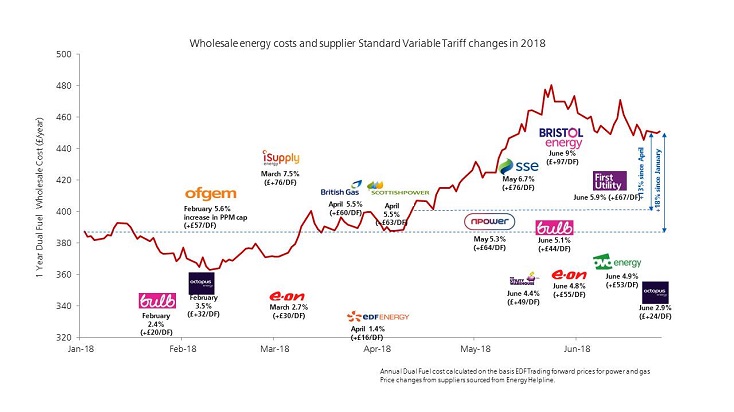
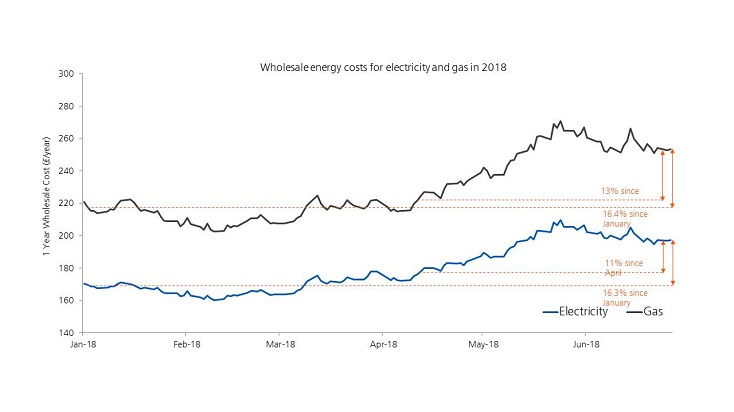
Wholesale energy prices have increased 18% since the start of the year, and 13% since April[1]
60% of customers will be unaffected, including vulnerable customers already protected by the prepayment and safeguard tariff caps
Dual fuel customers will on average pay £1.35[2] a week more from 31st August
EDF Energy is today announcing a change to its standard variable tariff prices, effective from 31st August 2018, following significant increases in the cost of wholesale energy since the start of the year.
About the changes
EDF Energy’s standard variable dual fuel tariff will increase by 6% to £1,228[1] a year (+£70). The standard variable electricity and gas tariffs will be increasing by 6.1% and 6% respectively.
The changes will affect EDF Energy standard variable customers, currently 40% of customers. Those on a fixed price tariff, prepayment tariff or the safeguard tariff for vulnerable customers will not see any changes from today’s announcement.
Why are prices going up?
Wholesale prices for dual fuel have increased by 18% so far this year, increasing sharply since April (+13%)[2]. This is due to a number of factors, including the ‘Beast from the East’ reducing gas storage stocks over the winter, compounded by global oil markets feeding into higher UK wholesale prices for both gas and electricity.
Ofgem acknowledged that costs faced by all energy suppliers had increased when it adjusted the level of the prepayment and safeguard caps in April.
EDF Energy’s 1.4% dual fuel increase, announced in April and which came into effect in June, included an increase on electricity that wasn’t fully reflective of all the cost pressures cited by Ofgem, as the company aimed to offset some of these through its own cost cutting. It has also held its gas prices for some time now, offering one of the cheapest standard variable gas price of the major suppliers for more than a year. Despite significant efforts to reduce costs, it is not possible to continue to absorb such significant increases, especially if they continue to rise.
In the past standard variable customers were protected from short-term fluctuations in wholesale markets due to EDF Energy’s policy of buying energy in advance – often several years ahead. Such long term forward buying of energy is no longer consistent with how tariff caps are being set.
EDF Energy Managing Director of Customers Béatrice Bigois said: “We know that another price rise will not be welcome, and we had hoped that our limited changes announced in April would be enough. However, energy costs have continued to rise significantly and despite our best efforts to absorb some of these by reducing the costs within our control – sadly we can no longer sustain this.
“Customers who wish to avoid this increase will be encouraged to choose one of our fixed price tariffs when we write to them later this month.”
All impacted customers will be written to this month, providing personalised information on how these changes will affect how much they pay. These letters will provide customers with information on cheaper tariffs, and for those paying by cash or cheque there will be additional detail on savings available if they switch to Direct Debit.
[1] Based on a dual fuel direct debit bill at typical consumption averaged across all regions. Typical use as defined by Ofgem is 3,100kWh standard electricity and 12,000kWh gas.
[2] Annual dual fuel cost calculated on the basis EDF Trading forward prices for power and gas
[3] Annual dual fuel cost calculated on the basis EDF Trading forward prices for power and gas
[4] Based on a dual fuel direct debit bill at typical consumption averaged across all regions. Typical use as defined by Ofgem is 3,100kWh standard electricity and 12,000kWh gas.
Notes to editors
For more information
EDF Energy Media Team
24-hour press line: +44 (0)1452 652233
media@edfenergy.com
For more information
Megan Johnson
External Communications Manager – Customers
megan.johnson@edfenergy.com
About EDF
EDF is driving the transition towards An Electric Britain – a secure, affordable, low-carbon future for everyone. As Britain’s biggest generator of zero carbon electricity, we are investing more than £100 million weekly in Britain’s electricity infrastructure. We supply millions of customers with electricity and help homes and businesses switch to electricity for heating, transport and industrial processes.
We operate five nuclear power stations and more than 35 onshore wind farms and three offshore wind farms. Since 2009, EDF has invested almost £9 billion in the nuclear fleet to improve reliability and extend station lifetimes. The five generating stations currently supply about 12% of the UK’s electricity demand.
EDF is building the UK's nuclear renaissance with the construction of a new nuclear power station at Hinkley Point C. We are a minority investor (12.5%) in and major supplier to a replica plant at Sizewell C in Suffolk. Hinkley Point C and Sizewell C will provide low carbon electricity to meet 14% of UK demand and power around 12 million homes. EDF Group companies Framatome and Arabelle Solutions have a presence in the UK and manufacture critical equipment such as reactor pressure vessels and turbines.
EDF is enabling its 5 million customers, both in business and at home, to choose electric solutions that save cash and carbon, whether it is buying an electric car, generating and storing electricity, selling energy back to the grid or installing solar panels or a heat pump. In 2025, EDF’s Customers business was ranked as one of the Sunday Times’s Best Place to Work.
It is also one of the UK’s leading developers of renewable energy through EDF power solutions UK and Ireland. We have more than 2GW of renewable generation in operation and over 10GW in construction, planning and development across a range of technologies including onshore and offshore wind, solar and battery storage.
We are one of the largest suppliers to British business and a leading supplier of innovative energy solutions that are helping businesses become more energy independent. In addition, the company’s energy services business, Dalkia, is one of the UK and Ireland’s largest technical service providers.
Related articles

Switching to an EV could save more than £1,350 a year on fuel, as diesel hits record high

Research from EDF reveals ‘flexy’ beats flirty when it comes to finding ‘the one’
