FreePhase - save when you use electricity smarter
Imagine paying less for your daily electricity at home. With FreePhase, shifting usage to cheaper times could help lower your electricity costs.(1)
Plus, when there is surplus renewable electricity on the grid, you could unlock periods of free electricity.(2)
What is FreePhase?
FreePhase is a smart time-of-use electricity tariff.
That means:
- Electricity prices change throughout the day, so you pay less when demand is lower
- You can save money by using electricity during cheaper times
- Customers who sign up to our Dynamic version can track prices to see when electricity is cheapest and free
- Shift your usage. Run appliances, charge EVs or use electricity when prices are lower
We have two plans available: FreePhase Dynamic and FreePhase Static—choose the one that fits best with your home and lifestyle.
What you need to get FreePhase
- A working smart meter – or be happy to have one installed
- Agree to share half-hourly data – so we can apply your tariff correctly
- Pay by monthly Direct Debit – simple, automatic and hassle-free

Meet Callum our FreePhase expert
Callum explains how FreePhase works, what the benefits are, and how the dynamic and static versions differ.
The benefits of our FreePhase tariff

Get cheaper electricity
Pay less outside peak hours. Sometimes there are free electricity periods when there's surplus renewable energy on the grid.

Save more by using electricity smarter
Shift your energy use away from peak (red) hours to see your bills go down. Set timers on your washing machine and dishwasher to run when electricity is cheaper.

Flexible electricity that works for you
With FreePhase, you choose when to use electricity. By shifting usage out of peak times, you also help reduce pressure on the grid and cut carbon emissions.
How does FreePhase tariff pricing work?
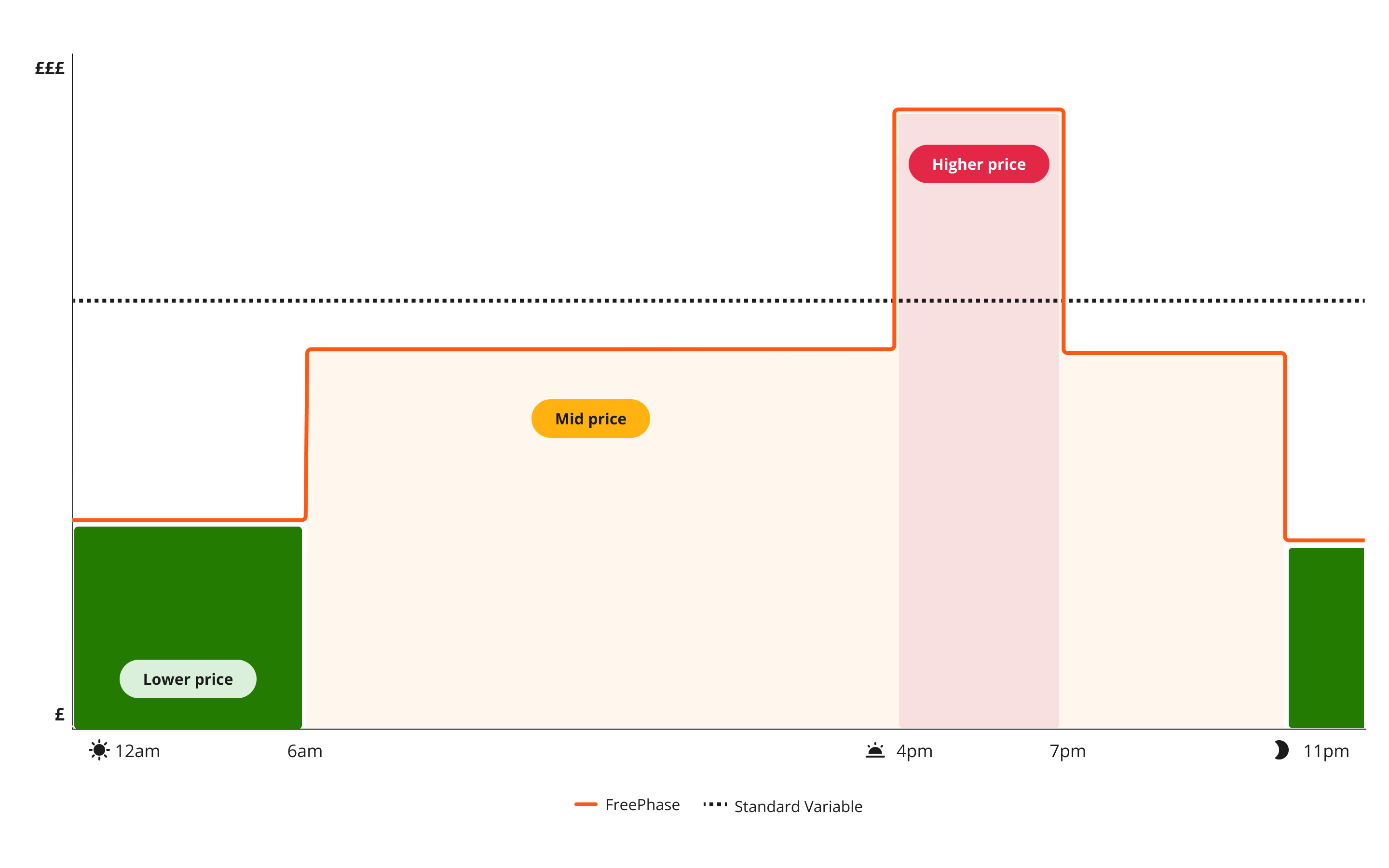
All FreePhase tariffs have a Red Amber and Green unit price that follow a fixed schedule
Red - 3 hours of peak prices
Amber - 14 hours of off-peak prices
Green - 7 hours of super off-peak prices
🔴 Red: 4 pm–7 pm (Daytime peak)
🟠 Amber: 6 am–4 pm (Daytime off-peak) and 7 pm–11 pm (Evening off-peak)
🟢 Green: 11 pm–6 am (Nighttime super off-peak)
If you choose the Dynamic version of our FreePhase tariff, your unit rates may change daily based on market conditions. If you prefer more certainty, the Static option keeps your unit rate the same for the full length of your plan, so your pricing won’t fluctuate during that period.
The chart below is a simplified illustration to help you understand how pricing works at a glance.
The two types of FreePhase tariff
FreePhase Dynamic
- You’re happy to check electricity prices regularly
- Your household is able to avoid using electricity when prices spike
- You are comfortable to track market prices
Works best for:
- Homes with smart technology already installed, like battery storage, air source heat pumps and smart thermostats

FreePhase Static
How to sign up
- Enter your post code to find your address
- When asked Can you shift some electricity use outside 4pm-7pm?, select Yes
- Compare FreePhase tariffs and choose which one you want and agree to switch
- Once you’ve switched, we’ll carry out a few checks to make sure we can access your smart meter data. This is so we can apply the right prices at different times of day. While we do this, you'll temporarily be placed on our Standard Variable tariff
- We'll email you once the checks are complete, usually within five days, to confirm you've been moved onto your FreePhase tariff
Is FreePhase right for me
Best for
- EV owners, happy to charge their electric vehicles overnight
- Heat pump owners
- Homes with solar batteries
- Homes that can be flexible when they using their electricity
- Customers with smart washing machines, dishwashers, etc., that have timers so you can schedule them to run outside peak hours
May not suit
- Households with limited flexibility around when they need to use their electricity
- Customers who use the most electricity between 4 and 7 pm
The power to plan ahead
Make it easy to use electricity when it’s cheapest, or even free. FreePhase gives you the tools to stay in control and maximise your savings.
Stay one step ahead
Sign up for FreePhase Dynamic to see tomorrow’s electricity prices so you can shift usage to cheaper or free periods and get the most savings.
Track and understand your energy
Using smart meter data, Energy Hub shows exactly how much you’re using and highlights ways to save more. Available in MyAccount and the EDF app.
Never miss a free period
We’ll send a text alert before a free electricity period starts so you can make the most of it.
FreePhase FAQs
Why is FreePhase a beta tariff?
FreePhase is a new kind of electricity tariff that helps you save money and cut carbon. It gives you more control over the price you pay and helps ease pressure on the national grid during peak times.
Because it’s a beta tariff, we’re testing and refining it to make sure it works smoothly. If we need to make improvements along the way, we’ll do so quickly.
We want you to feel confident about your choice
- FreePhase Dynamic doesn't have exit fees, so you can leave at any time
- FreePhase Static does have exit fees. However, if you’re an EDF customer and a Flextras member who signed up for the Static version, we won't charge you any exit fees if you move to our fixed tariff
Is my bill accurate?
Yes – your bill reflects the electricity you use and the rates that apply at the time you use it.
Because FreePhase is still a beta tariff, there are a few temporary limitations in how the bill is shown:
- Red, Amber, and Green rates aren’t on the bill yet. You can see a daily breakdown in the graph or check your consumption and costs in Energy Hub. For FreePhase Dynamic, we currently show a weighted-average unit rate
- Daily unit rate changes don’t appear on the bill, and the estimated annual cost currently only includes the standing charge
You’ll still see that you’re on one of our cheapest tariffs. If you’re shifting your usage, this should be accurate.
Find out your potential savings by getting a quote today
Existing customers get a quote
New to EDF? Get a quote
Why doesn’t my In-Home Display (IHD) show my FreePhase prices?
Right now, IHDs aren’t able to show smart tariff prices like FreePhase Dynamic. These prices update frequently, and the IHD wasn’t designed to handle that level of real-time data. We know this isn’t ideal, and working on improvements.
In the meantime, there are easier ways to track your prices and energy use:
- EDF Price Watch page – see today and tomorrow’s prices
- EDF Energy Hub – explore your usage and costs
- Third-party apps and tools – our FreePhase community has built great tools to help track prices and usage
- For tech enthusiasts – if you love data, you can dive into your usage with our open API
Will I pay any exit fees to leave my current tariff if I want to sign up to FreePhase?
If you're an existing EDF customer signed up for Flextras, our rewards and loyalty programme, you can switch to FreePhase without paying an exit fee.
If you're switching from another energy supplier, you may want to check your current tariff terms. Some suppliers charge an exit fee if you leave before your tariff ends. Your current supplier would charge any exit fee, not EDF.
If you decide to leave FreePhase in the future:
- FreePhase Dynamic has no exit fees. Please note that if you leave FreePhase Dynamic, you won't be able to rejoin that tariff for 9 months, even if you switch to another fixed or variable electricity tariff during that time
- FreePhase Static customers can leave without paying an exit fee as long as they're a Flextras member and move onto a fixed tariff
Do I pay any exit fees if I want to leave my FreePhase tariff early?
It depends on which FreePhase tariff you're on:
- FreePhase Dynamic: No exit fees apply if you choose to leave. If you leave FreePhase Dynamic, you won't be able to rejoin that tariff for 9 months, even if you switch to another fixed or variable electricity tariff during that time
- FreePhase Static: You can leave without paying an exit fee as long as you're a Flextras member and move onto a fixed tariff
How do I qualify for FreePhase tariffs?
To join FreePhase, you must:
- Be an existing EDF customer
- Or, join EDF. Once you’ve switched, we’ll carry out a few checks to make sure we can access your smart meter data. This lets us apply the right prices at different times of day. While we do this, you'll temporarily be placed on our Standard Variable tariff
- You'll also need a working smart electricity meter that can send us half-hourly readings
How do I switch to a FreePhase tariff?
If you're already an EDF customer, simply head to MyAccount to get a quote. You can then choose to join a FreePhase tariff if you're happy with your quote.
Are time of use, smart, three phase and multi rate tariffs the same?
Time-of-use tariffs are smart tariffs where the price of electricity varies depending on when you use it, rather than staying the same all day.
Smart tariffs use a smart meter to track your usage (usually in half-hourly intervals) and automatically apply the right price.
Multi-rate tariffs also offer different prices at different times, but they can work with smart or traditional meters (like Economy 7). Older meters use separate registers, while smart meters record usage digitally.
Three-phase meters are usually found in older or high-demand properties. These aren’t compatible with FreePhase tariffs.
In short:
- Time-of-use and multi-rate tariffs both have variable pricing
- Smart tariffs rely on smart meters
- Three-phase refers to a type of meter, not a tariff
How do you calculate the red, amber and green rates?
Prices change every day based on wholesale electricity costs for the next day. We use Nord Pool’s day-ahead market prices and apply a formula:
- Red:
Price = C × W + P - GD
(Coefficient × Wholesale Price + Peak Premium - Government Discount)
- Amber & Green:
Price = C × W - GD
(Coefficient × Wholesale Price - Government Discount)
What do C, W, and P mean?
- C (Coefficient): A multiplier that covers extra costs suppliers pay (like network charges). It varies by region
- W (Wholesale Price): The average market price for electricity during that time period
- P (Premium): An extra amount added only during peak hours (4 pm–7 pm) to cover higher costs at that time. Also varies by region
- GD (Government Discount): From 01/04/2026, we will be passing through the Energy Company Obligation (ECO) and the Renewables Obligation (RO) savings. This cost will be discounted from your unit rate
Price cap
No individual unit rate will ever exceed £0.75 per kWh (including VAT), no matter what happens in the market.
What are the current C and P values?
Last updated May 2026
| Region | Grid Supply Point | C | P |
|---|---|---|---|
| Eastern | A | 2.05 | 13.16 |
| East Midlands | B | 2.05 | 6.46 |
| London | C | 2.15 | 9.29 |
| Merseyside & North Wales | D | 2.17 | 7.52 |
| Midlands | E | 2.03 | 7.04 |
| Northern | F | 2.03 | 6.08 |
| North Western | G | 2.08 | 11.06 |
| Southern | H | 2.08 | 8.6 |
| South Eastern | J | 2.01 | 15.54 |
| South Wales | K | 2.08 | 8.64 |
| South Western | L | 2.01 | 11.26 |
| Yorkshire | M | 2.04 | 4.35 |
| South of Scotland | N | 2.05 | 7.21 |
| North of Scotland | P | 2.2 | 6.48 |
Will these values change during my tariff?
Yes. Changes to Coefficient and Premium values will occur automatically every April, but only in a manner fully linked to fluctuations in non-energy and peak-hour costs, which, regrettably, we do not control! Once they have been changed, we will ensure the current applicable C & P values are available here, so you will also have visibility of the latest values.
In short
Your price each day = wholesale electricity cost × a regional multiplier (C), plus a small extra charge (P) during peak hours. This ensures prices reflect real market costs while covering essential supplier expenses.
How do you calculate the FreePhase Dynamic standing charge?
The standing charge may change every January, April, July and October by tracking the EDF Standard Variable Tariff standing charge plus a FreePhase service fee. We will calculate the standing charge every three months using the following formula:
Standing Charge = A + B
A: The EDF Standard Variable tariff standing charge applicable for those months and your region
B: The FreePhase service fee
What are the current A and B values?
A: You can view the rates here
B: The current FreePhase service fee is 0p (nil)
Your current standing charge will be set out in your MyAccount.
Will these values change during my tariff?
Yes. Changes to the EDF Standard Variable tariff standing charge and FreePhase service fee will occur automatically every January, April, July and October. Once they have been changed, we will make sure the current applicable values are available here, so you will also have visibility of the latest values.
How do I see my free electricity?
Customers on our Static version
We add your 'Free Electricity' moments monthly as a credit to your account. You'll see this on your bill.
Customers on our Dynamic version
You'll see your 'Free Electricity' moments listed on your bill as 0.000p.
Why choose EDF

Simpler
Our customer service is rated excellent on Trustpilot

Cheaper
Find our lowest prices today!

Cleaner
We're Britain's biggest generator of zero carbon electricity(3)
Get more with EDF

Rewards and benefits with Flextras


