
What more needs to be done to tackle persistently high energy bills?
Last November, EDF published its outlook for energy bills through to 2030, alongside recommendations on how further price rises could be avoided.
Much has changed since then. Geopolitical events have driven significant volatility across energy markets during the first half of 2026, while the new Prime Minister Andy Burnham has said he will lead a "cost of living Government", placing “breathing space” and help with cost-of-living pressures at the core of its agenda.
With a rise in the energy price cap expected to be announced this week, this blog revisits our forecasts for wholesale and non-wholesale costs in 2030, drawing on the latest market and policy developments. It also asks a critical question: what should be done next to tackle persistently high bills? For too long, the response has relied on short-term, reactive interventions. To deliver on the Government's ambitions, more enduring approaches are now needed.


In this article:
- What's the outlook for energy bills up to 2030?
- What's changed since our November 2025 analysis?
- What needs to happen next?
- Conclusion
- FAQs
What's the outlook for energy bills up to 2030?
On current trends, our analysis, combined with data from Aurora, an independent energy consultancy, suggests that while recent policy decisions have reduced customer costs, relative to what they would have been, the outlook for 2030 is broadly unchanged from our November 2025 analysis. Bills still look stubbornly high at the end of the decade.
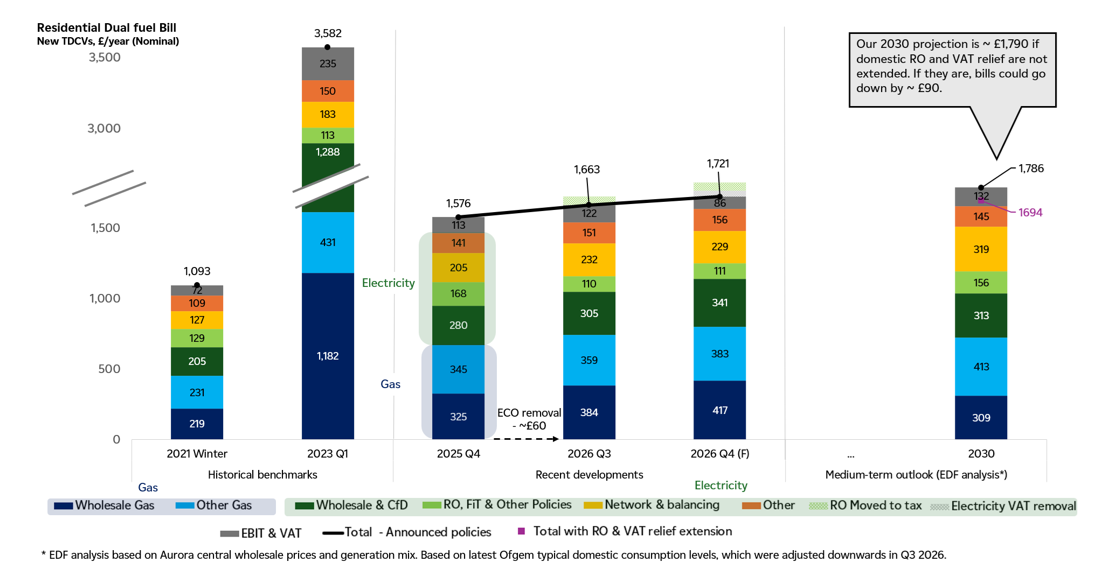
Our latest projection suggests average dual fuel bills in 2030 will be ~ 13% higher than Q4 2025 levels in nominal terms if recent Government interventions are not extended. This is broadly in line with our November 2025 analysis.1
Adjusting for inflation, the average dual fuel bill in 2030 is, therefore, expected to be slightly higher than in Q4 2025. Within this overall picture, electricity prices are, however, rising more than gas prices, as increasing non-commodity costs, including policy and network charges, offset easing wholesale costs.
While our analysis is focused on domestic energy bills, we anticipate that similar cost trends and pressures will apply for non-domestic customers
What's changed since our November 2025 analysis?
We have seen two big changes compared to our 2025 analysis:
Government support
Recent Government policy changes, including not renewing the ECO scheme, moving 75% of domestic Renewable Obligation (RO) costs into general taxation and cutting VAT for domestic electricity bills to 0% from October have had a notable impact on short term costs. If we assume the VAT and RO changes were to persist, they could reduce bills by around £90 per dual fuel customer in 2030.
However, the future of both the VAT and RO interventions are currently uncertain. Maintaining both the RO and VAT measures would cost the public purse around £3.5bn in 2030, despite declining RO costs as the scheme draws to a close.
The October VAT cut is currently only funded until next April. While the Starmer Government committed to place the three-year RO reduction on an “enduring legal basis” via the Energy Independence Bill,2 the new Government’s intentions remain unclear.
Wholesale costs
Recent events in the Middle East have pushed up short term wholesale costs, following the largest price increase in international gas and oil prices since the beginning of the war in Ukraine. This effect is clearly visible in the 2026 data above.
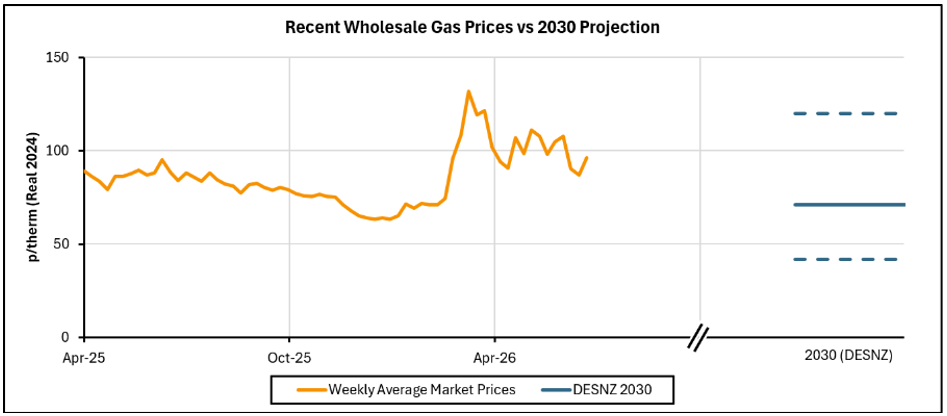
Looking to 2030, our modelling assumes moderation from recent highs, providing some downwards pressure on cost. The dual fuel outlook, however, remains highly sensitive to global gas markets (see graph above). Given this uncertainty, our projected 2030 wholesale assumptions remain aligned with our previous projection.
What needs to happen next?
Last November, we set out a range of steps Government could take to help stop bills rising further.
Our suggestions included reducing VAT and rebalancing some legacy policy costs. However, progress on others, like the Debt Relief Scheme and the Warm Homes Plan, has been slow.
We set out below three areas the new Burnham Government should now prioritise for action.
Transparency
First, we need greater transparency on future energy costs.
Understanding and transparency needs to move beyond the short term and highly limited view of costs provided by quarterly updates to the Default Tariff Cap.
Clear, independent modelling of how costs are expected to evolve, including network and balancing costs, would help both the market and customers navigate the medium-to-long term, better inform policy and commercial choices, and help build trust across the sector.
Transparency and certainty matter. Households and businesses need confidence about the costs they are likely to face in the years ahead if they are to make informed decisions about their energy costs, let alone invest in heat pumps, EVs and other electrification technologies.
This is not a new ask or a novel idea. The Government previously published an annual Prices and Bills Report showing its overall outlook for bills, but it has not done so since 2014. This gap is why we feel it is so important to publish our own analysis.
Given Ofgem’s role as the independent economic regulator, we believe it remains best placed to produce such an outlook on an enduring basis. Ofgem should commit to publishing a first independent outlook for energy bills before the end of this year.
Network and policy costs
Rising network and policy costs (non-commodity costs) are one of the big challenges to delivering reductions in future electricity bills.
On policy costs, in the short term we need clarity and certainty on the long-term future of both the RO and VAT policy interventions. The Government has indicated that decisions on VAT may be taken at October’s Budget. Longer term, we continue to support efforts to rebalance legacy policy costs away from the electricity bill.
On networks, given the pressures on customers, we have a responsibility to ensure investment is efficient and does not place unnecessary burden on today’s customers. We agree we need to invest in the network to connect essential new generation, address existing bottlenecks, and thereby minimise overall system costs. There is, however, currently very limited public information to assess whether the current programme of investment remains the right one. We explore this further here.
Government also need to consider what more can be done for non-domestic customers. As Energy UK and CBI recently highlighted,3 GB’s reliance on electricity bills to fund government policy make it an international outlier, holding back economic growth. While support schemes like the British Industry Supercharger (BIS) and British Industrial Competitiveness Scheme (BICS) are welcome, many businesses fall outside of their scope and remain exposed to rising non-commodity costs.
Nonetheless, the unfortunate truth is that network and policy costs are still likely to need to increase between now and 2030. While we can move costs around and ensure they are efficient, the need for investment remains.
This reinforces the need to move faster with efforts to electrify Britain on the demand side, especially in relation to electric vehicles and data centres, where NESO estimates the greatest growth potential over the next 5 -10 years (c100TWh combined).4 Electricity is only around 20% of the UK’s current total energy consumption, with oil and gas providing over 70%.5 Accelerating electrification alongside smarter and more flexible use of electricity, can help ensure generation and network assets are used more efficiently, and deliver greater value8for consumers from the infrastructure they are funding.
Debt and affordability
Finally, if energy bills are set to remain stubbornly high over the medium term, the status quo on debt and affordability is not sustainable – put simply, too many households cannot afford the energy that they need. According to DESNZ’s own figures, last year 30% of households in England alone were spending more than 10% of the income (after housing) on energy costs.6 Meanwhile, the latest Ofgem data shows that customers owe £4.8bn in energy debt, with Energy UK forecasting that this number could reach £7bn by the end of the year.7
As we have explored previously here, there is an urgent need to reset the sector’s debt landscape. This includes an expanded and simplified Debt Relief Scheme, progressing outcomes based regulatory reform, improving data sharing and making greater use of verification to better target debt support. The costs of debt already add £60 to the average bill. Baringa forecasts this could rise to £100 if total debt reaches £7bn.8
It is also time to get serious about safeguarding the most vulnerable consumers on an enduring basis. For too long have we responded winter-to-winter, one crisis after another, from one set of voluntary commitments and emergency support schemes to the next. We need targeted, long-term solutions to improve the affordability of energy for those most in need, including those in debt and those with high energy needs.
First, with ECO4 nearing completion, the Warm Homes Plan must move from ambition to action and start delivering real change for low-income households through lower bills. Government should launch a national application-based retrofit scheme, alongside any area/based programmes, to help households access the £3bn of capital support reserved in the Plan for supporting low-income households. We explore this further here.
Second, Government must finally introduce a new meaningful, well targeted social discount. The current £150 Warm Homes Discount (WHD) has changed little since its inception 15 years ago despite sharply rising energy prices. A new or reformed scheme should be funded out of general taxation, delivered via a mix of standing charge and unit rate reductions, and targeted at those households struggling under the weight of energy debt and fuel poverty.
Conclusion
While recent Government interventions have had material impact in the short term, the 2030 outlook is largely unchanged. This should not be surprising. As we said last year, there is no silver bullet for lower energy prices.
If the new Government is serious about tackling energy costs, greater transparency about where bills are heading and why investment is needed is the first step. Faster electrification remains the UK's most credible long-term route to more affordable bills. In the meantime, we must do more to support those most in need.
FAQs
Why are energy bills still so high?
There are several factors that affect the price that customers pay. While wholesale prices have reduced from the peaks seen during the recent energy crisis, other costs including network investment, policy costs and the growing cost of energy debt continue to put pressure on bills. While recent government interventions have helped reduce some of these costs, bills are still expected to remain above pre-energy crisis levels for some time to come.
Will energy bills go down?
Some costs included within energy bills are expected to drop over time. However, our analysis suggests that overall energy bills are likely to remain stubbornly high at the end of the decade, as increases in non-energy costs are expected to offset potential reductions.
What are non-energy costs on energy bills?
Non-energy costs are charges that are not directly linked to buying electricity or gas on wholesale markets. They include the costs of building and maintaining energy networks and supporting and funding environmental and social policies. As the UK continues to invest in modernising its energy infrastructure, these costs are expected to play an important role in future energy bills.
Why is energy debt increasing?
Due to several years of higher energy prices and wider cost-of-living challenges, many households around the country are continuing to face affordability pressures. Changes have also been made to the rules that have made it harder for suppliers to help prevent customers getting further into debt and ultimately recover it. As a result, more customers are struggling to keep up with payments and energy debt across the sector has continued to grow. Without further action to improve affordability and support vulnerable households, energy debt is expected to remain a significant challenge.
How could electrification help reduce energy costs in the long term?
Electrification means switching more of the UK’s energy use, such as heating, transport and some industrial processes, from fossil fuels to electricity. As more homes and businesses use electricity and do so in a smarter and more flexible way, generation and network assets can be used more and fixed costs can be spread across a broader base, helping to deliver greater value from the infrastructure customers are funding.
- On a comparable basis, our November 2025 projection was around £1,750 once revisions to Typical Domestic Consumption Values (TDCVs), the discontinuation of the ECO scheme, and the assumption that RO and VAT relief are not extended are taken into account
- https://www.gov.uk/government/publications/kings-speech-2026-background-briefing-notes
- https://www.cbi.org.uk/articles/cutting-business-energy-costs-to-boost-growth/
- NESO FES 2025 – Holistic Transition scenario 2035
- DUKES table 1.1.5 energy consumption by final user excluding aviation consumption
- https://assets.publishing.service.gov.uk/media/6a733816201b38b4dc3c2854/2026-fuel-poverty-statistics-report.pdf
- https://www.energy-uk.org.uk/wp-content/uploads/2026/02/Energy-UK_Energy-Debt-Everyone-Pays_February-2026.pdf
- https://www.baringa.com/contentassets/8760add02e784354910f9048708b063e/uk-household-energy-debt-and-how-to-shrink-it.pdf
Related articles

Why distribution network investment matters for affordability and energy security

Transmission costs: the need for greater transparency and strategic review
