Why distribution network investment matters for affordability and energy security
Recent events in the Middle East have had a big impact on international gas and oil prices, reigniting serious concerns around affordability, Great Britain’s energy security, and our vulnerability to geopolitical events through our exposure to fossil fuels. EDF believes that the best way to reduce our exposure to volatile fossil fuel prices, develop greater energy security, and lower consumer bills over time, is through increased domestic electrification.
Both the previous and current governments have intervened in reducing household bills, with the Starmer government axing the Energy Company Obligation Scheme (ECO) and moving Renewables Obligations subsidy costs to general taxation, reducing average annual household bills by £150 compared with what they otherwise would have been. Burnham’s government has expanded on this to cut VAT to 0% on electricity bills for six months from October. These short-term moves are welcome, but we believe the long-term answer is more domestic electrification. For example, electric vehicle (EV) drivers are saving more than £1,100 in fuel costs, compared with running a petrol car1. Electrified households will also be insulated from wider energy gas price spikes, with a 30% increase in gas and oil price only leading to a 1.7% increase in annual bills for electrified households, compared to a 13.5% increase for dual-fuel households2.
Having more consumers electrify their homes and using more Low Carbon Technologies (LCTs) like electric vehicles (EVs) and heat pumps will help to spread the cost of the required generation and network investment across a wider, more electrified consumer base. We recently set out how electrification can also be a driver of competitiveness, investment and growth in the economy more widely.
In this blog, we explore why investment in the electricity distribution networks is critical for nationwide domestic electrification, and why Government and Ofgem should do more to accelerate domestic electrification efforts, whilst balancing current consumer affordability challenges.

In this article:
- Making networks fit for the future
- What can be done to align ambition, adoption and investment?
- Conclusion
- FAQs
Making networks fit for the future
Investment in the electricity distribution network is critical to ensure they can facilitate the increase in LCT connections. These networks are the lower voltage networks that connect every home to the wider electricity system. Increasing numbers of domestic LCTs can strain the existing network as well as uncover issues with how these networks were designed in the past, both of which can delay installations. For example, Government3 estimate around 4 million homes (14% of all homes) are on a ‘looped’ supply, which can severely limit how quickly and easily people can connect new LCTs. Therefore, to fully enable domestic electrification, we must ensure the electricity distribution networks are appropriately developed. This is where Ofgem and the electricity Distribution Network Operators (DNOs) come in.
The DNOs own, operate and upgrade the main electricity distribution networks in GB4. Ofgem regulates the DNOs through regular ‘price controls’, with the next one in development (“RIIO-ED3, shortened to ED3”) covering 2028 to 2033 – a vital period for electrification.
Back in May, Ofgem5 gave DNOs a steer on the types of investment DNOs should make for their networks during ED3. Later this year Ofgem will review the DNOs’ business plans for the ED3 period and agree the trajectory of network investment.
To avoid sharp increases in consumer bills it is important that this network investment moves at the same pace as LCT deployment. Network investment costs are passed onto consumer bills, and more electrified homes will help spread the cost of this investment. If we invest too late, homes may face barriers to connecting and using their LCTs. But if we invest too early, consumer bills will rise before new demand can connect to spread the costs over a wider base. This is the key trade-off Ofgem will need to make. It is like hiring a private coach for a trip: the fewer people who travel, the more money each person has to contribute to cover the vehicle.
Ofgem have set out various positions for DNOs to consider in their business plans. We support many of Ofgem’s positions, for example:
- Moving to a ‘Build and Flex’ strategy, ensuring the network captures the benefits of consumer flexibility, whilst controlling the cost of necessary network upgrades.
- Proposals on stronger connection incentives, and the need for DNOs to deliver a proactive unlooping programme, both of which will help to speed up LCT uptake.
- Requiring DNOs to publish a ten-year Delivery Strategy, looking much further into the future.
However, a key position from Ofgem is that it expects the DNOs to use the National Energy System Operator (NESO)’s new transitional Regional Energy Strategic Plan (tRESP) publication6 to guide the scale and timing of investment.
The tRESP is an attempt to provide an independent, coordinated, and consistent view on the future needs of electricity distribution networks in GB. The tRESP is used as a bridge to the ‘full’ RESPs that NESO expects to produce by the end of 2028.
We are concerned that the tRESPs appear to be forecasting a higher LCT uptake than is happening in practice. On heat pumps, we have seen reduced annual targets in the Warm Homes Plan, alongside clear industry trends that show we are not on track meet NESO’s and the Government’s ambitions. Further headwinds for EV uptake include changes in vehicle excise duty (VED), and the Department for Transport’s review of the Zero Emission Vehicle Mandate7, which may see annual EV sales targets rise more gradually than previously anticipated.
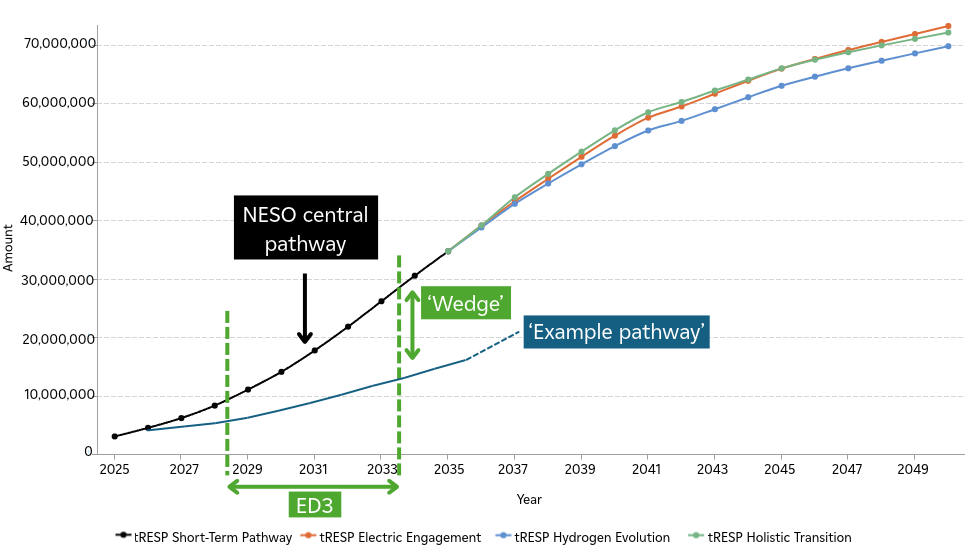
As set out above, a gap between forecast network investment need and reality could raise overall consumer bills through investment coming too early. To bridge this gap in LCT uptake will be a monumental task requiring careful management and policy support.
What can be done to align ambition, adoption and investment?
The underlying ambition in the tRESP is what we should be aiming for, but we are not on course to match it. We have considered ways to address this.
Increase the pace of LCT adoption
As mentioned previously, current LCT uptake rates are not in line with forecasts. If the ambition is to meet the tRESP forecasts, the policy environment needs to drastically change to speed up adoption.
Recommended action: Government should build on initiatives such as grants for EVs, the Warm Homes Plan and the Boiler Upgrade Scheme to strengthen incentives for LCT adoption and make it easier and cheaper for consumers to electrify. This is particularly useful for heat pump installations, where the installation costs are still unaffordable for many households, even with Government support.
Re-align investment plans with real uptake
When Ofgem assesses the DNOs' business plans later this year it will need to consider the impact on the customer bill, and whether aligning to the tRESP’s forecasts is the best option at this time.
Recommended action: We encourage Ofgem to give more weight to the DNOs' and other market stakeholders’ own market intelligence-led assumptions, such that the network investment moves in line with, not excessively in advance of, consumer behaviour.
In addition to the above, there should be better forward cost visibility for consumers and suppliers. Ofgem have not given industry a credible trajectory on the estimated distribution network costs and the subsequent impact on the customer bill over the next few years. The failure to do this for the current transmission price control has led to consumer detriment. This must be avoided for ED3. Ofgem should publish cost visibility figures for customer bill impacts from distribution network investment. As we have mentioned here, households and businesses need more confidence and transparency about future costs, especially at a time when affordability is the key issue.
Conclusion
The next few years will be a critical window of opportunity for GB’s energy industry to speed up domestic electrification. The good thing is that there is a strong drive to electrify because of the expected benefits for energy security and to mitigate long-term affordability concerns. For this vision to be fully realised, this drive must be met with an appropriate policy environment from Government and Ofgem.
With the right level of government support to speed up LCT connections, and the right regulatory environment created by Ofgem to incentivise build whilst strictly controlling costs, this can ensure distribution network investment is more closely aligned to consumer behaviour. Aligning these factors correctly will help GB get closer to an ‘Electric Britain’ that can deliver energy security and lower bills to customers in the long run.
FAQs
What is a DNO?
Distribution Network Operators (DNOs) own, operate and maintain the local electricity networks that connect homes and businesses to the wider electricity system. They’re responsible for upgrading those networks when additional capacity is needed.
What is RIIO-ED3?
RIIO-ED3 stands for Revenue = Incentives + Innovation + Outputs Electricity Distribution Price Control 3. It is Ofgem's five-year regulatory framework for electricity distribution networks in Great Britain, covering the period from April 2028 to March 2033.
Why is ED3 important?
ED3 provides the financial framework that determines how quickly electricity distribution networks can be upgraded to support growing demand from technologies such as electric vehicles and heat pumps, how the upgrades will be funded and what Ofgem wants the DNOs to focus on when upgrading the networks during the price control period. The decisions made during this period will play an important role in enabling electrification across Great Britain.
What is a looped supply?
A looped supply is a type of electricity connection where two or more neighbouring properties share a single cable connection to the local electricity network. While safe and commonly used, looped supplies can sometimes make it more difficult to connect low-carbon technologies such as electric vehicle chargers and heat pumps, meaning network upgrades may be needed.
What are low-carbon technologies (LCTs)?
Low-carbon technologies are technologies that can help reduce carbon emissions by using electricity instead of fossil fuels. Examples include heat pumps, electric vehicles and smart energy technologies.
- https://www.carbonbrief.org/analysis-uks-ev-drivers-are-now-saving-1100-each-a-year-and-3bn-in-total
- Page 5 https://electrifybritain.org/plug-in-pay-less
- https://www.gov.uk/government/publications/unlooping-electricity-network-connections
- https://www.energynetworks.org/customers/find-my-network-operator
- Ofgem’s RIIO-ED3 Sector Specific Methodology Consultation and Decision: https://www.ofgem.gov.uk/consultation/sector-specific-methodology-consultation-electricity-distribution-price-control-ed3
- NESO’s tRESP: https://www.neso.energy/what-we-do/strategic-planning/regional-energy-strategic-planning-resp/transitional-regional-energy-strategic-plan-tresp
- Department for Transport’s Zero Emission Vehicle Mandate Consultation: https://www.gov.uk/government/consultations/zero-emission-vehicle-mandate-review
Related articles

What more needs to be done to tackle persistently high energy bills?

Transmission costs: the need for greater transparency and strategic review
