Transmission costs: the need for greater transparency and strategic review
The new Government has expressed their commitment to focus on the cost of living. This comes at a time when we know many customers are already struggling to pay their bills, with prices potentially going up further ahead of the winter given continued geopolitical events impacting the wholesale price of energy.
At EDF, we agree that it’s essential that we do all we can to keep bills as low as possible, as well as reducing the price gap between electricity and gas to encourage electrification. The Government's decision to remove VAT from electricity bills is a welcome step in that direction that will offer some immediate help to households this winter.
But there is clearly a need to take further steps to reduce the cost of electricity more widely, and avoid locking in future price rises for households and businesses across the country. GB has amongst the highest electricity costs in the developed world, impacting households and businesses and acting as a drag on the economy.
In this blog we set out the issues, why we are calling for a radical increase in transparency, and the case for a strategic review of upcoming large transmission projects.


In this article:
- What's happening right now with the electricity transmission network in the UK?
- What's changed with investment in the transmission network?
- The case for increasing transparency on transmission costs
- Looking to the future
- FAQs
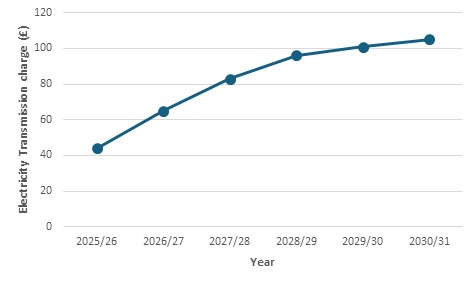
Rising network costs have been a contributor in recent years to rising bills, a theme that is set to continue with the record-setting programme of new transmission network investment due in the years ahead. The impact of this is stark – Ofgem forecast the transmission network portion of an average consumer bill to rise from £44 in 2025 to £105 by 2030, a rise of ~140% (see chart below). We've published our own updated view on future consumer bills here.
We agree with the need to invest in the network to connect new generation, address existing bottlenecks, and thereby minimise overall system costs. Part of this is also making up for investment that should have been done in previous decades to modernise the grid. The key is to ensure we are getting the balance right between minimising constraint costs and avoid building a transmission network that comes at a higher cost to the consumer than the savings it will generate by making the whole system more efficient.
While striving to deliver value for money in all investments across the sector is always important, this is particularly difficult to do at a point where the costs of that investment are changing. As the pace of network build increases, we are now seeing costs for individual projects rise significantly. There is currently very limited information available publicly to assess whether the programme of investment that is being pursued remains the right one in this context.
What's happening right now with the electricity transmission network in the UK?
The Transmission Owners (TOs) have a record investment programme underway to reinforce Great Britain’s electricity transmission network. This is intended to mitigate the impact of current and forecast network constraints, as well as connect new sources of generation and demand to the system.
Last year Ofgem estimated the TOs could collectively spend ~£70bn between 2026 and 20311. The vast majority of that spend will be on many large transmission projects to deliver NESO’s ‘Pathway to 2030’ plan, originally published by NESO in 2022. This is the equivalent of nearly £1000 for every person in Great Britain.
The ‘Pathway to 2030’ plan was then confirmed by NESO as a critical part of Clean Power 2030:
It is essential that the 94 transmission projects identified in the Holistic Network Design (HND) ‘Pathway to 2030’ report be delivered in full2. (November 2024)
In 2026 alone, Ofgem has already approved funding for at least 213 different projects, with several more under consultation at the time of this blog. We are unable to assess the total funding allowed in these decisions as the actual costs have not been published.
Recent publications by NESO, such as the ‘Beyond 2030’ and ‘Beyond 2030 refresh’, suggest further network expansion will be required to account for additional renewables growth, particularly for remote offshore wind in the North Sea. NESO has provided an estimate of £89bn for these further works.
All of this represents an unprecedented level of investment and activity for the TOs, recovered ultimately through consumer bills. Despite this, there is very little information available publicly on project costs and progress.
What's changed with investment in the transmission network?
The context for the planned investment on the transmission network has changed materially since the original plans were set out. In light of this, we have two key areas of concern:
- Construction costs are rising rapidly – There has been substantial supply chain cost inflation over the past few years, and this is likely to continue as countries across the globe tackle the same electricity network and generation challenges. We estimate costs have risen 2-3x since initial TO forecasts based on analysis of Ofgem’s own documents4. This is corroborated by our own experience of TO-driven connection cost increases for our generation projects.
- Some drivers for investment are changing or progressing slower than expected – Transmission investment is mainly driven by the need to avoid/relieve network constraints and connect new generation projects. We know from engagement with the wider industry that generation project connections are subject to increasingly severe delays. Our own projects are suffering an average connection delay of 2 years, with the worst now over 5 years. We also see that remote offshore wind projects are not progressing as expected – NESO’s ‘Pathway to 2030’ plan made provision for 11GW of ScotWind projects to be connected by 2030, but only two projects (4GW) are consented5 and none have yet secured a CfD.
In combination, rising costs and slower than expected generation deployment may be changing the case for some of the investment already funded or due to be funded in the coming years by Ofgem.
If we want to change direction, now is the last moment where this is possible without creating significant sunk costs, or delaying projects that are much-needed within the system. For example, only 3 of the 26 large transmission projects under Ofgem’s Accelerated Strategic Transmission Investment (ASTI) scheme6 have received full funding to-date. But decisions will be coming thick-and-fast, and more funding is due to be awarded over the coming months.
The case for increasing transparency on transmission costs
EDF strongly supports transmission investment where there is a well-evidenced benefit to consumers. There are clearly big opportunities to reduce the current and forecast high levels of constraint costs and to connect valuable new sources of well-placed low carbon generation, including to support our own nuclear and renewable projects. But getting the right balance is critical to ensure we minimise both the overall constraint cost and the build costs to consumers – and evidence suggests that the right balance may have shifted.
It is impossible for any individual or company to make a proper assessment based on the limited amount of information available. There is no analysis or public data available to authoritatively understand:
- How the costs of individual transmission projects have changed over time;
- How the underlying need for transmission investment has changed; and
- Consequently, whether the ‘Pathway to 2030’ network remains the best approach.
We believe this is an issue that needs to be addressed as soon as possible, and should be relatively simple to achieve.
Recommendations for the future of the UK transmission network
We recommend that Ofgem and NESO:
- Publish a transparent and detailed strategic review of upcoming ‘Pathway to 2030’ investments as soon as possible, including the latest information on cost and generation drivers, with clear statements on the revised value for money case to justify the funding for each project.
- Radically increase transparency on cost and ongoing construction progress through a live, publicly accessible tracker, in place before the end of 2026, updated frequently.
Having a clear, holistic view on the certainty of need and progress can ensure the whole electricity industry has confidence this spend is necessary and beneficial for consumers.
We also believe Ofgem need to change how they consult on these assessments and allowances. Recent publications have routinely provided insufficient information to make an informed view. We are keen to work with all parties to develop a way to engage consumer groups, suppliers and other industry parties much better and earlier in the process.
As set out in our blog on Reformed National Pricing, in the medium to longer term the Strategic Spatial Energy Plan (SSEP) represents a unique opportunity to determine the right mix of and locations for new generation and the network required to connect it.
NESO’s recent ‘Beyond 2030’ publications identified a further £89bn of transmission projects that could complete from 2031 onwards to support further new generation connections and network transfer capabilities. In the absence of an agreed SSEP, the drivers for this are clearly uncertain.
Locking in a programme of further investment now, with the SSEP still due would be hard to justify to consumers who will pay the costs through their bills.
We want to work with Ofgem and NESO to ensure consumer money is being spent well. Radically increasing transparency at this stage can pay dividends in providing reassurance that the right projects are being efficiently funded at the right time.
Transmission cost FAQs
What are Transmission Owners (TOs)?
Transmission Owners are the companies that build, maintain and upgrade the national electricity "motorways" that move power around Great Britain, with the costs of that work eventually recovered through customer energy bills.
What are transmission costs?
Transmission costs are the costs of building, operating and maintaining the high-voltage electricity network that transports electricity around Great Britain, helping move electricity from where it’s generated to where it’s needed.
How do transmission costs affect energy bills?
Transmission costs are included within electricity bills. As investment in the network increases, the costs recovered through bills can also increase.
Why does the electricity transmission network need upgrading?
As new sources of electricity generation come online, upgrades are needed to connect these to the national grid, reduce bottlenecks on the network, improve energy security and support growing demand for electricity as homes, businesses and transport switch to electric technologies.
Who pays for transmission network upgrades?
The costs of transmission network upgrades are ultimately paid for by the consumer through charges that are included within energy bills.
- RIIO-3 Final Determinations for the Electricity Transmission, Gas Distribution and Gas Transmission sectors | Ofgem
- NESO CP30 publication, page 12
- Based on EDF analysis of Ofgem’s publications in 2026
- Eight SHET Early Construction Funding applications | Ofgem
- ScotWind leasing round sites and developers | Offshore Wind Scotland
- Decision on accelerating onshore electricity transmission investment | Ofgem
Related articles

Why distribution network investment matters for affordability and energy security

What more needs to be done to tackle persistently high energy bills?
