
Are energy prices going up or down for small businesses?
The price of energy has been on the radar of many small businesses since 2022, when gas and electricity rates nearly doubled. So what caused the big leap and will energy prices go down now?
Read this blog if you want to understand:
- What’s happened to energy prices in recent years
- Why the long-term trend is for small business energy prices to increase
- What factors cause energy prices to go up and down
- Why the energy market remains unpredictable
- How to keep your energy prices down
What’s happened to energy prices recently?
The hike in energy prices over the last couple of years may have been unusual, but small business energy prices have always gone up and down. In fact, thanks to inflation, the underlying trend is a steady increase, as it gets more expensive to produce and supply energy. Prices have also been driven up in recent years by increasing subsidies to support renewable generation, alongside costs to maintain networks and ensuring there is enough generation to meet demand.
You can see the effect of this long-term trend in the graph below, if you look at the average prices paid by businesses, across suppliers, that use less than 500 megawatt hours (MWh) of electricity a year (1)
20 years ago, smaller businesses paid on average 5.5p for a kilowatt hour (kWh) of electricity, and 1.4p for 1kWh of gas. By 2021, this had risen to 16.5p for electricity and 3.6p for gas.
It’s worth remembering that these figures are based on government data for average unit prices across the industry. The graph also excludes the standing charge payable, as well as any VAT charges and the Climate Change Levy – so total costs for small businesses would have been higher, whatever their size.

Why do energy prices change?
At a basic level, energy prices are strongly influenced by simple supply and demand. In the winter, with cooler weather and darker days, there’s a much greater demand for electricity and gas, as businesses and homes use more heating and lighting. The supply of energy is limited, so the price goes up.
When it comes to electricity, supply and demand actually affect the wholesale price over a 24-hour period. Electricity suppliers pay more to buy power around the evening peak hours, and less during quieter periods such as overnight. So-called ‘time-of-use’ tariffs reflect this with variable pricing during the day. Rates also go down when there’s lots of wind or solar power available; and they increase on still, cold, cloudy days when there are fewer renewables sources on the grid.
Did you know? Nearly 33% of the UK’s electricity is now generated from wind and solar(2). While that’s a big step in helping Britain on the path to net zero, both sources are very weather-dependent, so they can have a big influence on daily electricity prices.
So far we’ve looked at the unit cost of energy, which varies depending on how much you use. But energy customers also pay a standing charge which is a daily fixed fee. It’s important not to overlook this: it’s risen considerably in recent years, and can make up a significant portion of small business energy costs. Read more about this in our blog on small business standing charges.
Why did business energy prices go up recently?
The recent surge in energy prices for businesses has largely been caused by global events, namely Russia’s February 2022 invasion of Ukraine.
This caused shockwaves in the energy markets, leading to rapid price rises for consumers and businesses alike. So while in 2021 small businesses were paying an average 16.5p per kWh for electricity and 3.6p per kWh for gas. Two years later, the average price for small business electricity had doubled to 31.9p, and 7.5p for gas(3). For many small businesses, their energy prices were higher than these averages still.
It was a time of great flux in the energy industry, with smaller energy suppliers going bust as they could no longer sustain the cheaper energy prices they’d been offering their customers. This meant even two similar-sized businesses based next door to one another could have been paying quite different energy prices depending on their contract type (fixed or variable) and its duration. For example, if one business had fixed their energy prices prior to 2022 for a longer period, they wouldn’t have been affected immediately by the average unit price increases.
To understand why the war had such an effect on energy prices, we need to look at the wholesale price of natural gas.
In 2021, Europe was heavily reliant on Russian gas imports, with the country supplying almost 40% of the EU’s gas demands(4). As the Ukrainian invasion developed, Russia began pinching off the supply of gas to Europe. The Nord Stream 1 pipeline was throttled back, and Nord Stream 2 was sabotaged before it could enter operation. By August 2022, European wholesale gas prices were 22 times their pre-crisis level!
While the UK used very little Russian gas(5), the spike in international wholesale gas prices meant that UK power companies still had to pay far more for fuel, rapidly pushing up rates for consumers. Energy regulator Ofgem, working with the government and industry, used its price cap mechanism to limit the price households paid for their energy. Meanwhile, businesses were supported by the Energy Bill Relief Scheme(6) and later the Energy Bill Discount Scheme(7), which closed in March 2024. Essentially, these reduced the unit prices paid by businesses if wholesale energy costs went above a certain level.
Like other European countries, the UK has been working hard to find other sources of natural gas, such as liquified natural gas (LNG) delivered by ship from global suppliers – as well as develop alternative energy sources for the long term, such as nuclear. At the same time, wholesale energy prices have fallen from their previous highs, even if they’re still higher than they were a decade ago.
What’s different between business and household prices?
The price that businesses and households pay for power mostly reflects what it costs the energy suppliers to buy gas and electricity. It’s no surprise, then, that small businesses and households have paid roughly the same rates for their power over the last 10 years, as the graph below shows(8).
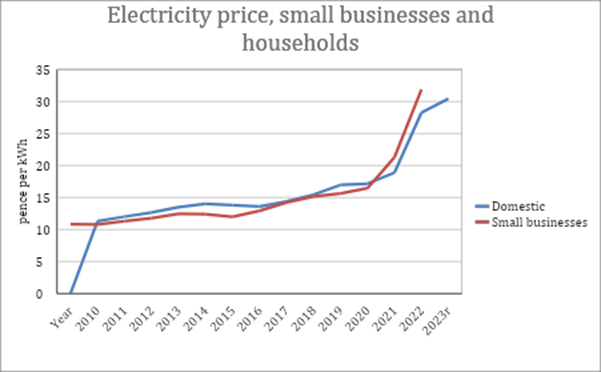
There are some differences, though. Business energy prices vary not just by supplier, but by the size of the organisation. Those classed as ‘very small’ or ‘small’ by the Government pay rates broadly in line with domestic users, who paid around 30.5p per kWh for electricity over the same period(9). A ‘very small’ business is defined by the government as a business using 20mWh or less of electricity a year (and less than 278mWh of gas); a ‘small’ business is defined as using 20-500mWh of electricity (and 278-2,777mWh of gas).
In contrast, a ‘very large’ business, was more likely to be paying 22.5p per kWh of electricity and 5p per kWh for gas. While they have greater purchasing and bargaining power, this lower cost also reflects the different network charges they pay. Businesses also don’t have to pay charges to cover the cost of providing domestic schemes like ECO and Warm Home Discount.
That said, businesses do have to pay the Climate Change Levy: an environmental charge applied automatically to organisations using more than 12MWh of electricity or 53MWh of gas every year (about four times more than the typical household)(10).From April 2024 this added 0.775p to every kilowatt hour of electricity or gas sold to businesses’ energy costs.
Are energy prices going up?
The short answer is that energy prices increased in the final quarter of 2024. Ofgem raised the energy price cap by 10%(11), with households paying a maximum 24.5p per kWh of electricity, and 6.24p for gas. While the price cap doesn’t apply to business customers, small business rates do typically remain close to those for householders.
Since late October, wholesale gas prices for the next year have increased by around 20%. This could feed through to a higher domestic price cap into 2025 and an increase in small business energy prices. But it’s by no means certain, as while energy prices are lower from their previous highs, the energy market is still largely unpredictable.
Want to keep up to date with EDF’s price cap predictions? While the price cap only refers to residential customers, it can influence the prices small businesses pay. If you want to stay ahead of the game and keep an eye on what’s happening in wholesale markets, take a look at our weekly updates on the price cap.
How to keep your energy prices down
So what can you do? First of all, make sure you’re on the best tariff for your business. If you’re on a variable tariff, you might also want to think about switching to a fixed to lock in your unit prices.
Then look at any other energy-saving measures you can take. For instance, switch to a smart meter to make sure you’re only paying for the energy you use. Most EDF Small Business customers also have access to Energy Hub: a powerful tool we’ve designed to give you detailed insights into your energy usage. This personalised dashboard can help you make smarter decisions and potentially save your business money. Find out more in our Energy Hub explainer blog.
Get more energy-saving advice in our Small Business blog or see if you can switch to a cheaper tariff by comparing EDF small business prices.
(2) https://assets.publishing.service.gov.uk/media/66a76bf2ce1fd0da7b592e5d/UK_Energy_in_Brief_2024.pdf, page 27
Related articles


