
Blog: Part Two: How the Capacity Market Works: Auctions, Agreements and Evolving Rules
In Part One of this blog series, we explored why the Capacity Market was introduced and what it aims to achieve in supporting Great Britain’s electricity security. Now, in Part Two, we turn our focus to how the scheme actually operates. From long-term demand forecasting and auction design to who can participate and how successful providers are rewarded, this section unpacks the mechanics of the Capacity Market. Whether you're a new entrant or just looking to understand the process, this part offers a detailed look at how capacity is secured, who delivers it, and the rules that govern the system.
The Capacity Market is based around annual auctions and is operated by the two administrative bodies,
- the Delivery Body, this role is delivered by NESO
- the Settlement Body, this role is delivered by the Electricity Settlements Company (ESC) a government owned entity which was set up specifically for the task. In turn they delegate much of the operational requirements to EMR Settlement Limited (EMRS) which is a subsidiary of Elexon.
The Capacity Market works in “Delivery Years”, each run from 1st October to 30th September the following calendar year.
1. Forecasting Future Demand
Each year, the government (via DESNZ and NESO) forecasts future electricity demand several years ahead and hence the requirement for capacity. Using this a “demand curve” is constructed for each auction. The form of the demand curve is shown below.

2. Capacity Auctions
The CM uses competitive auctions to procure the necessary capacity:
- T-4 Auction: Held 4 years before the Delivery Year.
- T-1 Auction: Held 1 year before the Delivery Year to fine-tune requirements.
Participants prequalify in the summer before the auctions. This process is meant to provide reassurance that their Capacity Market Units (CMUs) are genuinely capable of providing the promised capacity. Participants, known as Applicants at this stage provide details and documentary evidence about their CMUs to the Delivery Body (a function provided by NESO). Applicants must pass an assessment by the Delivery Body of their prequalification application in order to proceed to the auctions.
At prequalification Applicants will state what the Connection Capacity of their units is in line with the requirements of the Capacity Market Rule. A De-Rating factor which varies by the technology or type of unit will then be applied to this Connection Capacity to determine the De-Rated Capacity of the unit. It is this De-Rated Capacity which is entered into the auctions. The De-Rating factors are determined by the Delivery Body in accordance with the Capacity Market Rules except for those for interconnectors. In the latter case DESNZ determine these albeit NESO provide supporting analysis.
3. Eligible Participants
Eligible providers include:
- Existing and new power stations (gas, nuclear, biomass, etc.)
- Electricity storage (batteries, pumped hydro)
- Interconnectors
- Demand-side response providers
- Renewable generation
However, no generator that is or will be in receipt of low carbon support can participate. The assumption is that such support should already be enough to fund the asset so any more support would be excessive. This means plant that benefits from the New Entrants Reserve 300 (NER300), Renewable Heat Incentive (RHI), Feed in Tariff (FiT), Renewable Obligation (RO), Contract for Difference (CfD) or UK Carbon Capture and Storage commercialisation schemes is excluded. Once the support from such a scheme ends a generator can then participate. We can already see assets whose period of support from the Renewable Obligation has expired entering the Capacity Market.
4. Clearing Price and Awards
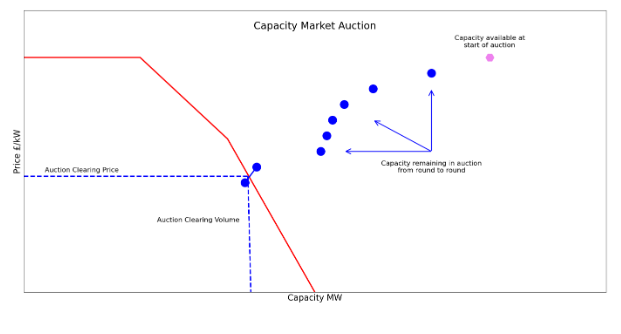
- The auctions are run as a “descending clock”. Auctions open at the auction price cap (which has been £75/kW in all auctions to date). The auctions progress through a series of rounds, each with a round cap and floor price, normally in £5/kW increments. In each round participants either remain in the auction or enter an “exit price” which indicates the lowest price for which they are prepared to provide capacity. At the end of each round the auctioneer compares the amount of capacity still in the auction i.e. those units which have not yet entered an exit price or where it is below the round floor price, with the capacity which the demand curve indicates should be bought at that floor price. If there is more capacity still in than the demand curve indicates then the auction proceeds to the next round, if there is less then the auction clears.
- Where the auction clears the auctioneer constructs a supply curve by stacking the exit prices and associated capacities of the CMUs that exited in the round with the demand curve and seeing where the curves cross. This crossing point identifies the clearing price and the amount of capacity procured.
- All successful bidders i.e. all those who entered an exit price below the clearing price and the clearing unit itself receive the clearing price (per kW per year) for agreeing to provide capacity.
5. Benefits
- The country has an assurance backed by financial penalties that generators and other providers of capacity will be available to meet demand over the next few years. We haven’t had power cuts due to a shortfall in capacity for many years.
- There is a clear route to participation in the market. Any would=be participant can go to the two administrative bodies’ websites and read for themselves what is required. Participants do not need to find contractual partners or negotiate terms.
- The scheme is transparent. Anyone can access the administrative bodies’ website to find out what prices the auctions cleared at, how much consumers will pay and who has obtained agreements.
6. Settlement
Capacity Providers are paid monthly by EMRS. The money for this is collected via a compulsory levy on Suppliers who are also charged monthly. At the beginning of a Delivery Year this monthly charge is set based on a forecast of each Suppliers demand during periods of “High Demand” which are 4 p.m. to 7 p.m. on any working day in November, December, January or February in the relevant Delivery Year. Once this data is known each Supplier’s charge is corrected to actual.
6. Summary
The Capacity Market plays a central role in ensuring the stability and resilience of Great Britain’s electricity system. Through structured annual auctions, rigorous prequalification, and a transparent settlement process, it secures the capacity needed to meet peak demand, while adapting over time to incorporate new technologies and environmental standards. Although administratively complex, the framework offers clarity, predictability, and accountability for participants. In the final part of this blog series, we’ll turn our attention to how the Capacity Market works in practice, walking through the participant journey, exploring timelines, performance obligations, and the real-world implications of being part of the scheme.
Related articles

Do you believe in life after ROCs?

Powering the UK's digital future: getting data centre connections reform right
