
How NESO Keeps Electricity Supply Stable Using Balancing Services, Part 2
How NESO Keeps Electricity Supply Stable Using Balancing Services – Part 2
Part 1 of this article provided a deep dive into the role that the National Energy System Operator (NESO) performs managing the transmission system, matching generation with demand second-by-second, and keeping system frequency stable and close to 50Hz. Click here to read part 1.
Also described was the suite of Balancing Services that NESO has available to perform this crucial activity. These services can be called upon to handle a sudden large loss of generation or demand which, if not immediately addressed, could ultimately lead to a nationwide blackout.
The purpose of the second part of this article is to provide a real-life worked example of exactly how NESO will utilise these different Balancing Services to manage a rare yet credible very large loss of generation. Additionally, particular attention will be paid to the order, quantity and duration of each service’s deployment.
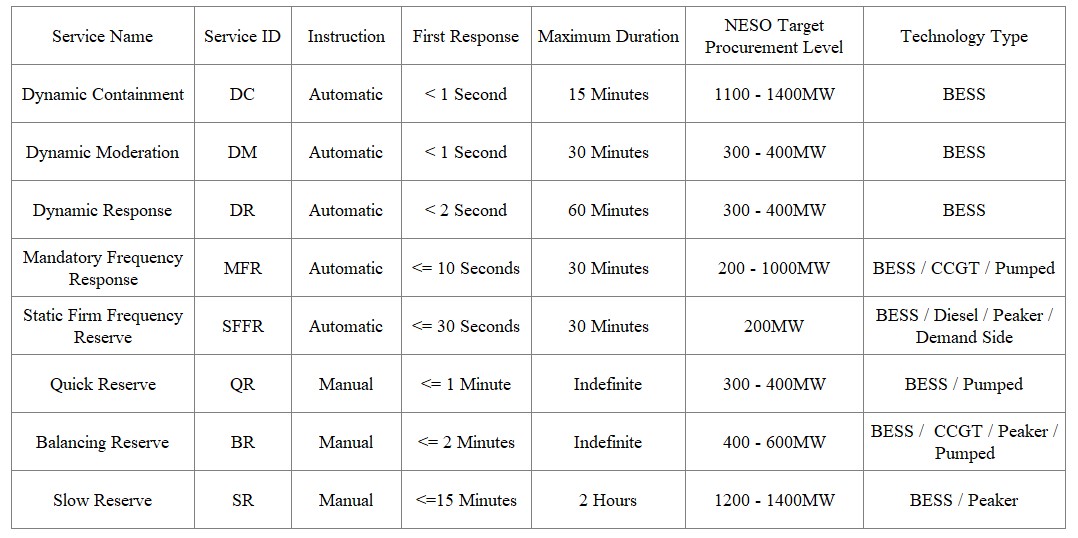
For a refresher of all these services and their main characteristics, please see the summary table on the final page of this article.
What does the use of Balancing Services look like in practice?
The scenario below demonstrates how NESO utilises the range of services it will have available in the future to manage a Largest Loss Reserve (LLR) event occurring across tea-time during a January weekday. In this scenario, the LLR was caused by the unexpected loss of 1.4GW of imports after a trip at the Viking Link interconnector.
The series of four diagrams displays the impact on the system frequency at different time intervals and how the lost MWs are replaced over a 2-hour horizon after the unplanned trip at 14:05:37. System frequency is gradually returned to 50Hz using the services NESO has at its disposal in 2025.
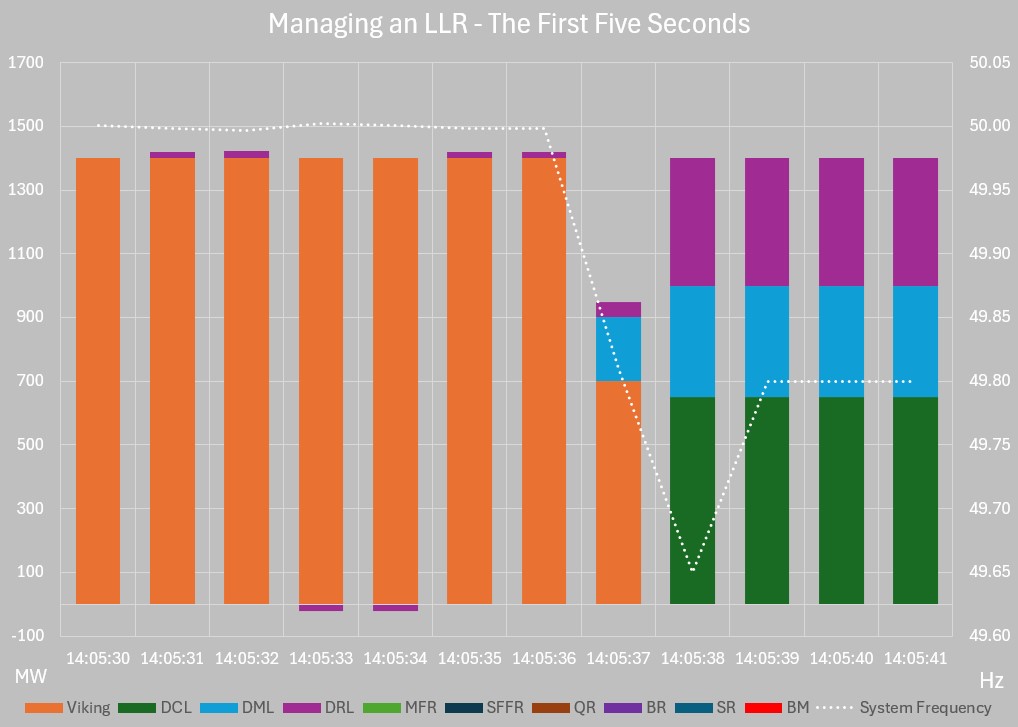
The diagram above displays system frequency relatively flat at 50hz as at 14:05:30, with the Viking Link interconnector flowing 1,400MW from Denmark to GB.
- At 14:05:37 the Viking Link interconnector unexpectedly trips, dropping instantly to 700MW and then down to 0MW one second later. The inertia being provided by a combination of Nuclear, CCGTs, Pumped Storage and Synchronous Compensators help slow down the speed at which the system frequency drops.
- All the procured DM low response service from BESS assets has kicked in within that first second of the trip, with some BESS DR low service also starting to react. The inertia plus the DM & DR help hold system frequency to 49.81Hz during the initial 700MW of loss.
- By 14:05:38 the system frequency has continued to plummet as the remaining 700MW of Viking Link is lost. As the frequency drops below 49.8Hz a large amount of BESS DC low service reacts, and along with the full 300MW each from DM and DR prevents frequency falling any lower than 49.65Hz, which is known as the frequency nadir.
- By 14:05:39, with all the initial output lost from Viking Link now replaced by DC / DM / DR the system frequency begins to climb back towards 50Hz.
- However, with DC only configured to respond when frequency is below 49.8Hz the frequency holds at this level, though additional MWs from other services will soon also begin to react, as displayed in the second diagram below.
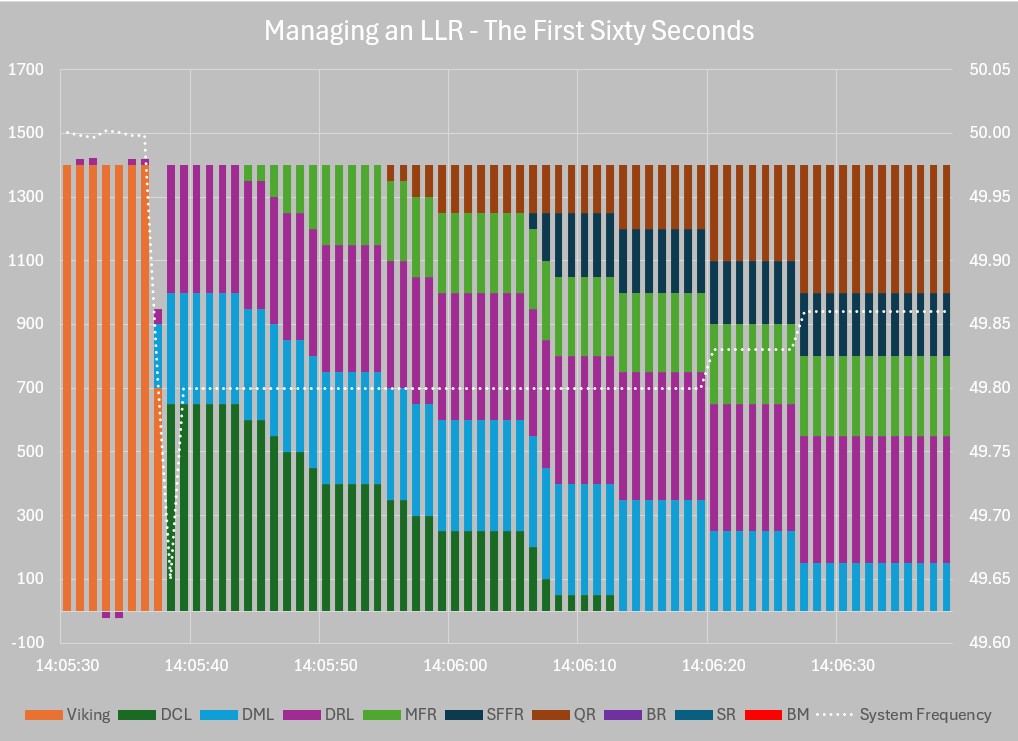
- At 14:05:44, a little under 10 seconds after the trip, the first amounts of MFR begin to deliver additional MWs on to the system. The contracted amount of 250MW of MFR reaches maximum output by 14:05:50, allowing the amount of DC to reduce though with system frequency still holding at 49.8Hz.
- By 14:05:55, BESS assets procured under - and that were almost immediately instructed via - BM action seconds after the trip, first begin to deliver extra MWs. The extra MWs from QR helps further reduce the amount of output DC needs to provide, but with frequency still holding at 49.8Hz.
- At 14:06:07, 30 seconds after the trip, SFFR also begins to deliver, having automatically switched on at the point frequency dropped below 49.7Hz, swiftly delivering its contracted output of 200MW by 14:06:08.
- By 14:06:12 DC is no longer required to hold system frequency in place, and as BESS assets procured under QR and instructed via the BM climb to 300MW the system frequency finally begins to climb up again, reaching 49.83Hz from 14:06:20 and allowing some of the DM response to ease back by 100MW.
- By 14:06:27 QR BESS assets have now topped out at 400MW, nudging up frequency to 49.86Hz, with DM output dropping further to just 150MW.
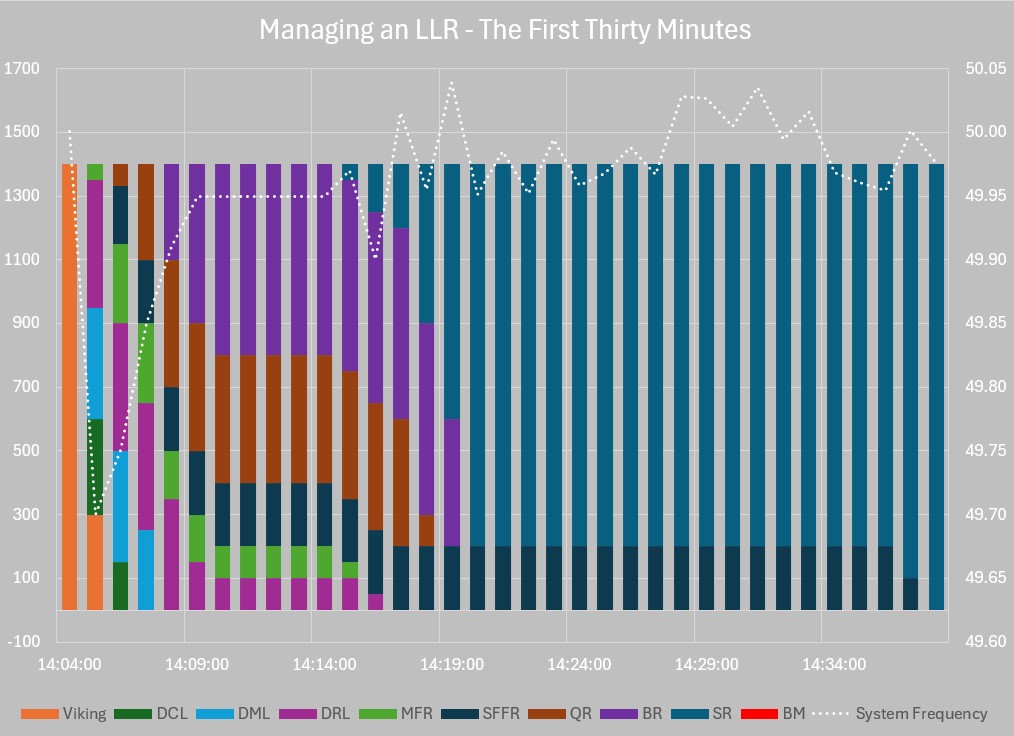
- With the NESO services having managed the 60 seconds of the LLR event, the NESO Control Room focus begins to switch to replacing the fast-acting response services with slower, more dispatchable MWs.
- From 14:08 onwards NESO now finally start to see some output from the up to 600MW of assets that have contracted to provide BR, which also must be able to begin responding by no later than two minutes after initially being instructed. The NESO Control Room was again pro-active in sending the initial BM instructions in the seconds immediately after the trip at 14:05:37.
- With BR providing 300MW, the frequency rises to 49.91Hz, resulting in DM response dropping to 0MW.
- By 14:10 BM-instructed BR output maxes out at 600MW, with frequency climbing to 49.95Hz, and each of DR and MFR seeing declines in their output as they are replaced by the MWs from BR.
- The situation holds steady now, with NESO now waiting for the 1,400MWs worth of SR-providing assets to begin responding to the BM instructions sent in the seconds after the trip. With SR assets expected to begin delivering output within 15 minutes of first instruction at the latest, MWs from this service first appear from 14:15, some 9 minutes after the trip.
- By 14:17, 200MW of SR MWs have now finally pushed system frequency back to 50Hz, and nudged out the final small output needed from DR and MFR.
- By 14:20, the 1,200MW of SR is now being delivered, allowing NESO to send instructions to cease generating to the QR and BR providers. The gap created by the 1,400MW Viking Link trip is now filled in its entirety by SR, topped up by the original 200MW from SFFR.
- At 14:38, having fulfilled its 30-minutes of contracted output, the SFFR providers curtail their output. NESO uses the final 200MW of SR to replace it and system frequency is now fluctuating in and around 50Hz, in line with normal operation.
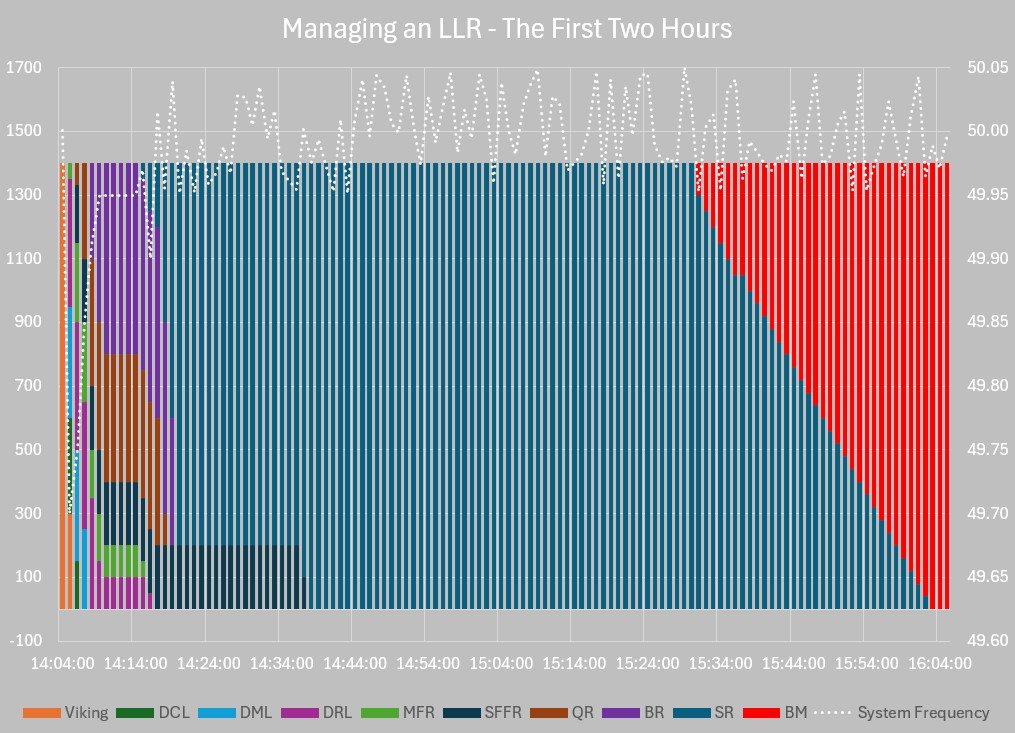
- The system remains stable, supported by MWs from SR for almost a further 40 minutes. However, NESO will always prefer to have the SR output returned to 0MW at the earliest opportunity, such that it may again be held in reserve to cover further large losses, however unlikely another one might be from statistical perspective.
- Consequently, in the seconds and minutes after the first trip, the NESO Control Room were busy sending out BM instructions to larger CCGT generators that were sitting idle but available in the BM, albeit needing between 55- and 80-minutes notice to switch on and begin ramping-up.
- At 15:31, the first of five CCGTs switches on via BM instruction and begins to ramp-up towards its minimum level of output. As all five CCGTs switch on and ramp-up, NESO can gradually ease back the output from the SR providers, also via BM instruction.
- Finally, by 16:03, almost two hours later, NESO are no longer relying upon any of their procured response or reserve services, and are purely rebalancing the system via large CCGTs that were willing and available to provide extra MWs within the BM.
- Meanwhile, throughout this process, the trading counterparties that had arranged to flow MWs across the Viking Link interconnector into GB will have been busy buying MWs from other market participants to rebalance their trading positions to avoid imbalance penalty prices. Over the proceeding hours the MWs lost from Viking Link will be replaced by generators agreeing to switch on or turn up and sell their MWs directly to those trading counterparties.
- These extra MWs sourced via market trading will eventually completely replace the MWs lost from the initial trip, with NESO then able to reduce the volume of MWs instructed by the BM down towards 0MW.
What are the key messages to take away?
- Managing the GB transmission system is an extremely complex and high-pressure role that NESO performs every second of the day, on average 24 hours per day, 365 days per year (366 in a leap year).
- It has become increasingly more complex in the past 15 years as the country has diversified away from a relatively small number of very large and centralised generators run on fossil fuels, to many hundreds and thousands of smaller, decentralised generators, many of which are powered by renewable sources.
- The next five to ten years will see further change, as the UK pushes towards an electricity system that is almost entirely powered by net zero sources. Installed renewable capacity is expected to double, supported by a five-fold increase in Grid Scale BESS capacity and a three-fold expansion of longer-duration storage solutions. In addition, the end-consumer is also expected to make a large contribution to balancing the system, as adoption of smart technology and automation will enable demand to be shifted, helping to manage national transmission or local distribution line constraints or adjust to drops in renewable output.
- To maximise the benefit of the low-cost generation available from renewables and reduce reliance on fossil-fuel-powered CCGTs as the ultimate back-up source of electricity, NESO will have to upgrade its Control Room systems to make full use of all the flexibility and capabilities that BESS technologies can provide.
- With an improved suite of models and optimisation planning algorithms, the Control Room will be able to procure thousands- rather than hundreds- of MWs of services such as Dynamic Containment, Moderation, and Response, and Quick, Balancing and Slow Reserve. The expected near 25GW of short duration BESS will be perfectly positioned to provide these services.
The scenario of a 1,400MW LLR event, or even a 1,600MW LLR after the Hinkley Point C nuclear power station commissions in the 2030s, will be managed in an identical manner as it would in 2025. However, NESO will no longer rely upon CCGTs picking up the slack at the end of the first hour. Instead, BESS assets held in reserve-charged up earlier in the day via renewable output and with their capacity secured by BR contracts for the higher demand periods - will provide the back-up MWs via the BM, replacing the need for back-up fossil generation.
NESO Services Summary Table
Related articles

The power of co-location: Accelerating an integrated energy system

How NESO Keeps Electricity Supply Stable Using Balancing Services, Part 1
