How NESO Keeps Electricity Supply Stable Using Balancing Services, Part 1
Introduction
The National Energy System Operator (NESO) is responsible for maintaining the operability, stability, and resilience of the electricity grid of Great Britain (i.e. the UK excluding Northern Ireland). As the energy mix evolves, with increasing renewables and decentralised assets, NESO relies on a variety of technology types to prevent blackouts, from large-scale generators such as Combined Cycle Gas Turbines (CCGTs), Nuclear and Pumped Storage to Battery Energy Storage Systems (BESS), Gas Reciprocating Engines (Peakers) and Synchronous Compensators.
This article explores how NESO uses these technologies to ensure a stable supply of electricity 24/7 by deploying a suite of ancillary services at different points in time to ensure grid stability.
What does stability mean with respect to the GB electricity grid?
Great Britain has operated an island-wide 50Hz alternating current (AC) electricity system since the 1930s. Hz, or hertz, describes the cycle rate of electricity generation, where 50Hz means that electricity production is cycling at 50 cycles per second or 3,000 revolutions per minute.
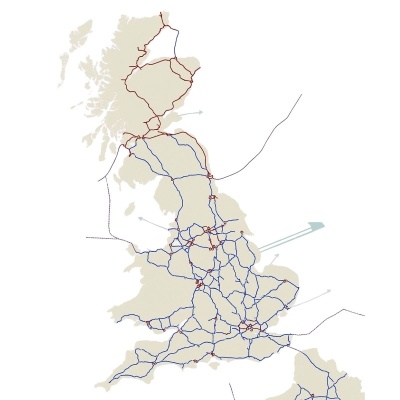
An AC system connects generators with consumers and is one of the most efficient approaches to transmitting electricity from its source of production to the end user along an extensive system of wires, pylons and substations.
However, for it to function safely and effectively, it requires generation to always closely match consumer demand, second by second, and even millisecond by millisecond.
If instantaneous generation drops too much below demand, then the AC system frequency will begin to fall below 50Hz, requiring NESO to instruct generators to increase their output, and if demand falls too much below generation, then the system frequency will begin to rise above 50Hz, requiring NESO to instruct generators to decrease their output. If system frequency falls to a level that is too low or rises to a level that is too high, then it becomes unsafe for generator systems to keep functioning, and they will automatically trip to prevent permanent damage, resulting in a cascade effect of further trips and an eventual nationwide blackout.
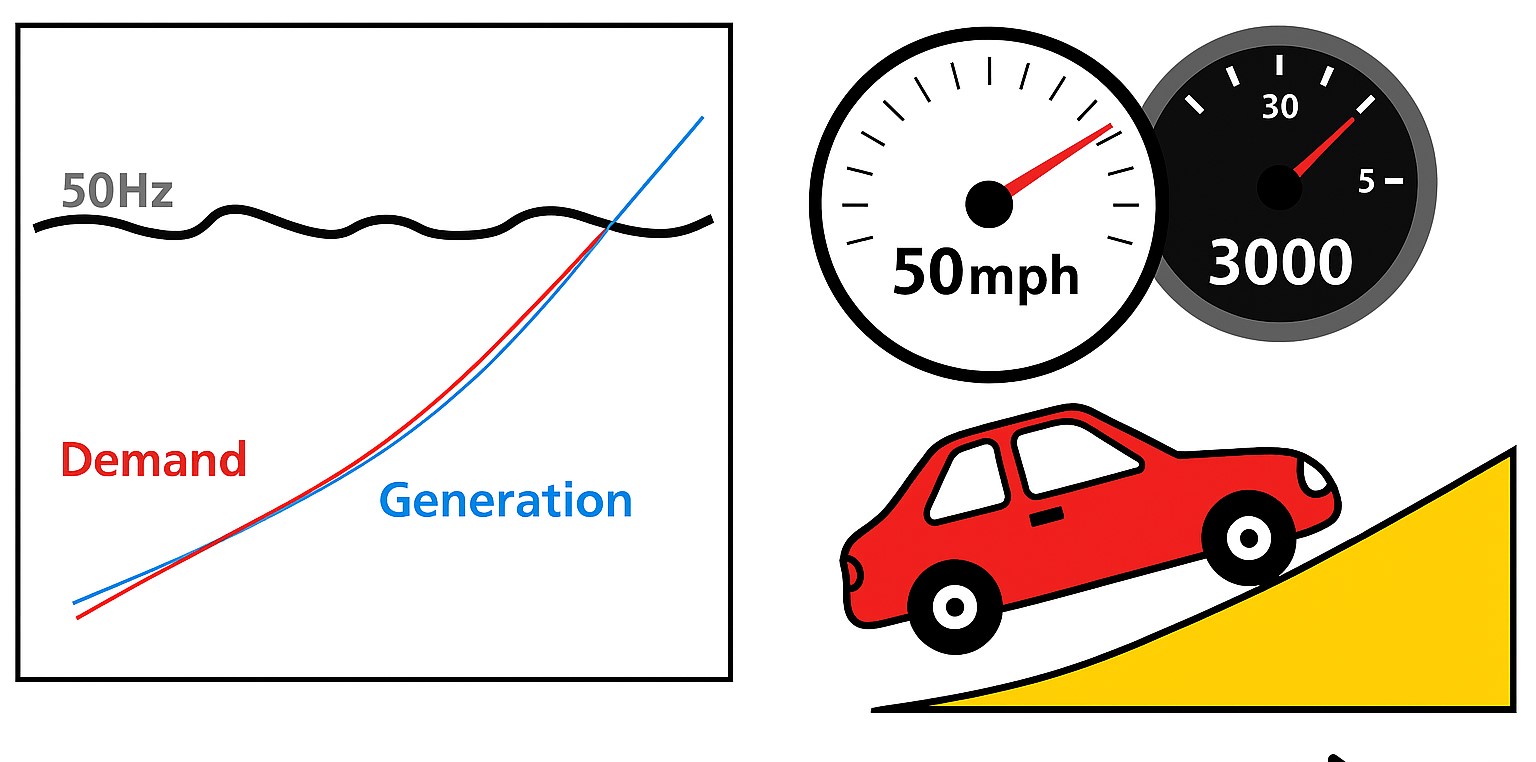
This is similar to the situation of a car driving on a flat road in 5th gear with an RPM of 3000 but with a hill climb fast approaching. As the road becomes steeper (i.e. as demand picks up) the driver of the car needs to press the accelerator down even harder (i.e. to increase generation), or else the RPM of the car drops and eventually it will stall and stop climbing the hill entirely.
Conversely, if the car begins driving down a hill, its RPM will begin to rise quickly unless the driver eases back on the accelerator pedal and applies the brake. Failing to do so will see the engine overheat and break down, and even before that point, the high speed could see the driver lose control of the car entirely and crash.
Therefore, the role of NESO is to act as the driver of an extremely large and complex vehicle, stepping in to accelerate and decelerate as the road changes in steepness, or in the case of the electricity transmission system, instructing generators to increase or decrease output second by second (and even millisecond by millisecond) to align it very closely with consumer demand. This ensures that system frequency remains close to 50Hz, and constant supply is guaranteed.
Given how risky this all sounds, why have electricity systems adopted AC so widely?
An AC system has the excellent advantage that it can transmit huge amounts of electricity across long distances in a very efficient manner, lowering costs to the end consumer considerably, but with the requirement that it must be operated at a stable system frequency.
Additionally, the historical make-up of electricity generation in GB tended to be almost entirely of large - and very heavy - spinning metal turbines driven by high pressure steam, and with the steam created in an industrial sized boiler that was heated by coal, gas or a nuclear reactor.
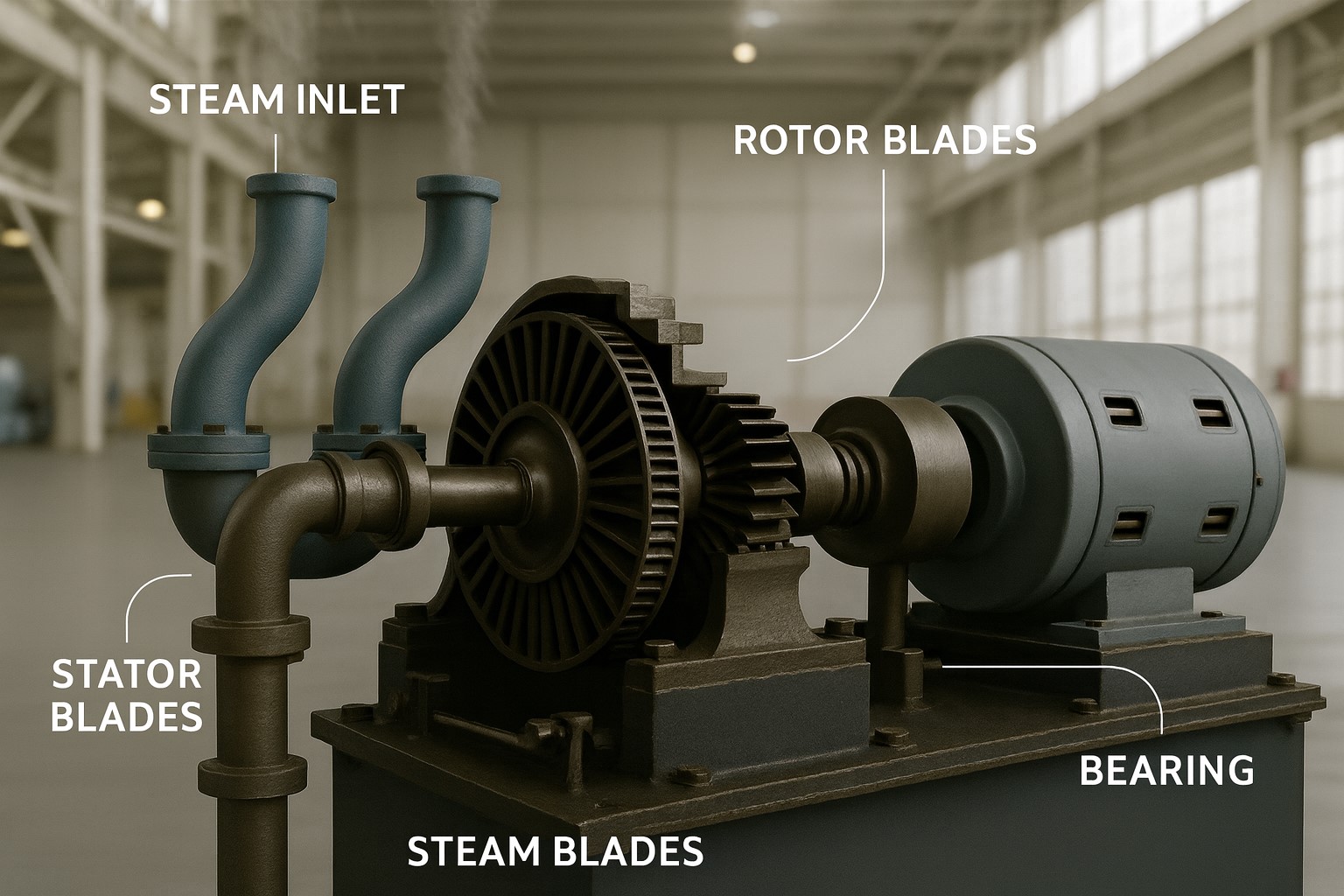
These large spinning turbines played a very important role in helping NESO to keep generation closely aligned with demand and thus system frequency flat at 50Hz at the sub-second level.
An unexpected outage (or trip) at one large generator would have its impact on system frequency dampened by all those other large spinning turbines at the other generators, which would continue to spin at the same speed for a few seconds before eventually slowing down as system frequency dropped.
This effect, known as system inertia, provided NESO extra time to quickly procure replacement generation from other generators via a series of extra services, known as Balancing Services, that would increase electricity output and return system frequency back to 50Hz.
Therefore, the role of NESO is also to ensure that it always has access to the right set of Balancing Services to keep the system frequency stable by matching generation with demand and so eliminating the risk of local or national power-cuts.
The set of Balancing Services to perform this task has undergone a wholesale overhaul over the past ten years, with further changes still required, as NESO adapts to a vastly different generation mix whilst the country pivots towards a cleaner electricity system.
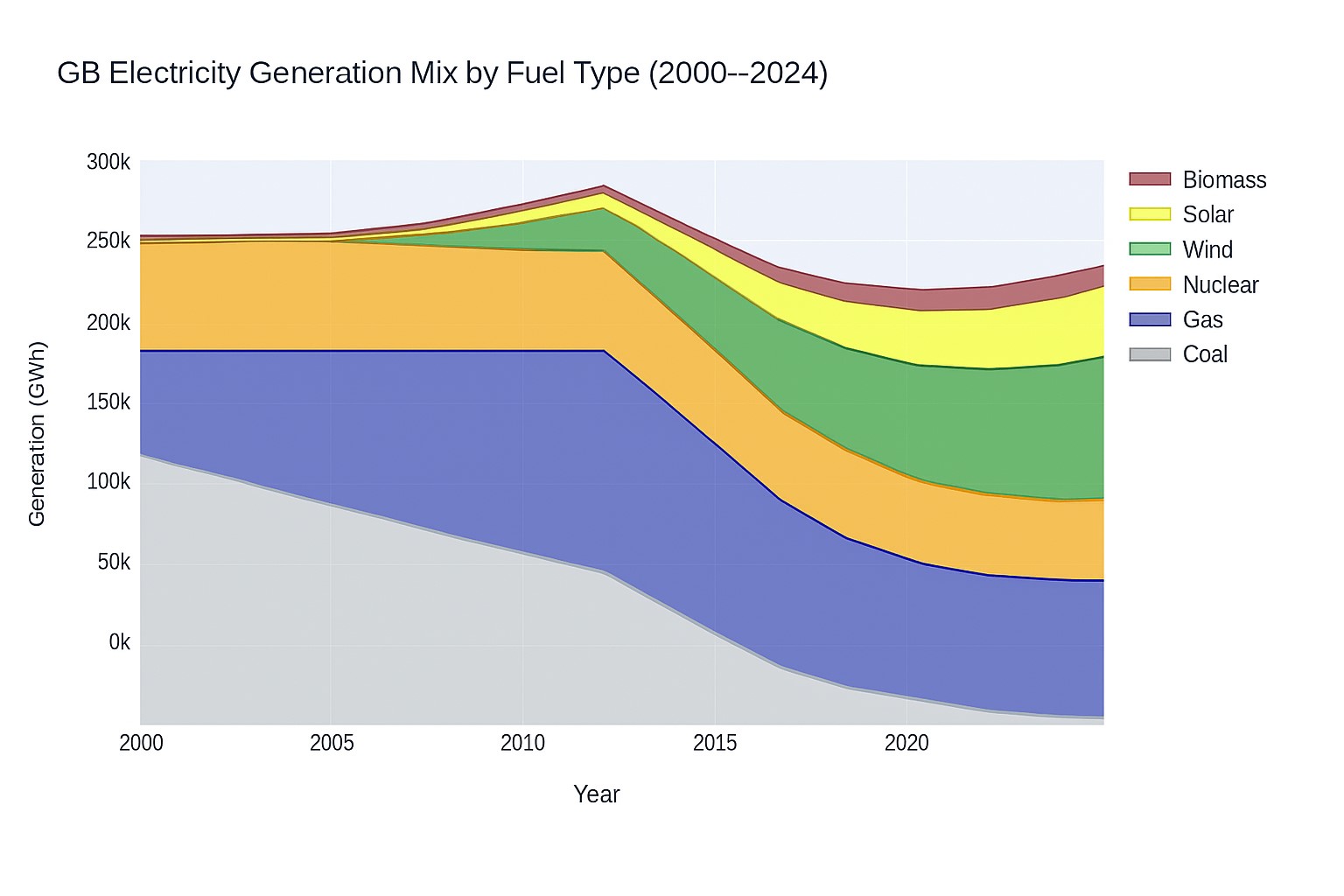
This transition has seen - and will continue to see - fewer large, fast spinning turbines powered by carbon-emitting fuel sources and a reduction in that crucial system inertia. These are increasingly being replaced by carbon-neutral energy sources, such as solar PV - which has no spinning turbines - and wind, which has far slower-spinning turbines. These technologies therefore do not contribute inertia to the system, leading to significant challenges in maintaining stable system frequency, as will be discussed in the next section.
What does NESO need to do to ensure a stable grid?
One of the key activities of NESO is to always keep system frequency as close as possible to 50Hz, with large and sudden changes in generation or demand the biggest threat that could see system frequency sky-rocketing or crashing, with the worst-case scenario being a nationwide black-out, if such an event is not contained immediately.
Hence it stands to reason that NESO will look to procure enough back-up services to handle a credible worst case large generation or demand spike. This credible worst case is known as the Largest Loss Reserve (LLR) and usually reflects the size of the single biggest point of failure across the entire system. As at September 2025, the LLR stands at 1,400MW, and is set by the Viking Link Interconnector.
The Viking Link Interconnector can flow up to 1,400MW between GB and Denmark in either direction, depending upon which of the two countries has the highest price of electricity at the time, hence an unexpected outage at this interconnector could see an instantaneous loss of either generation or demand of up to 1,400MW.
Consider a scenario where Denmark was supplying GB with 1,400MW of electricity via Viking Link. Were the interconnector to experience an instantaneous outage and supply to GB from Denmark fell to 0MW, the system frequency would immediately drop from 50Hz. At this point, the suite of NESO Balancing Services would come into play, with each service tasked with the job of preventing frequency from falling further (avoiding the cascade effect and nationwide blackout) and helping it recover back to the target of 50Hz as quickly as possible.
This set of services, procured in advance by NESO, is designed to address different phases of this largest credible loss, from dealing with the impact on system frequency in the first milli-seconds, all the way through until many hours later, by which time the natural market forces of supply and demand should have taken effect to help return things back to balance (more on this in our future blog “How does electricity trading work in the GB Power Market?”).
What Balancing Services does NESO use, and how are they used to return the system frequency back to a normal level?
Each Balancing Service that NESO procures performs a specific role in managing system frequency in general, but also in bringing about a stable system in the event of a significant event, such as an LLR sized generation loss.
The rules of the GB electricity trading system specify that market participants must fix their planned generation output for between 60 and 90 minutes ahead at a time, something which is known as the Gate Closure window. During this window, NESO takes full control of generator output via the Balancing Mechanism (BM). The BM is a sub-market that allows generators - and increasingly customer / demand-side participants - to offer flexibility to increase or decrease their output or input for a price. Outside of this window, market participants are free to amend their planned output or load as they see fit, ensuring that they attempt to trade in line with their plans.
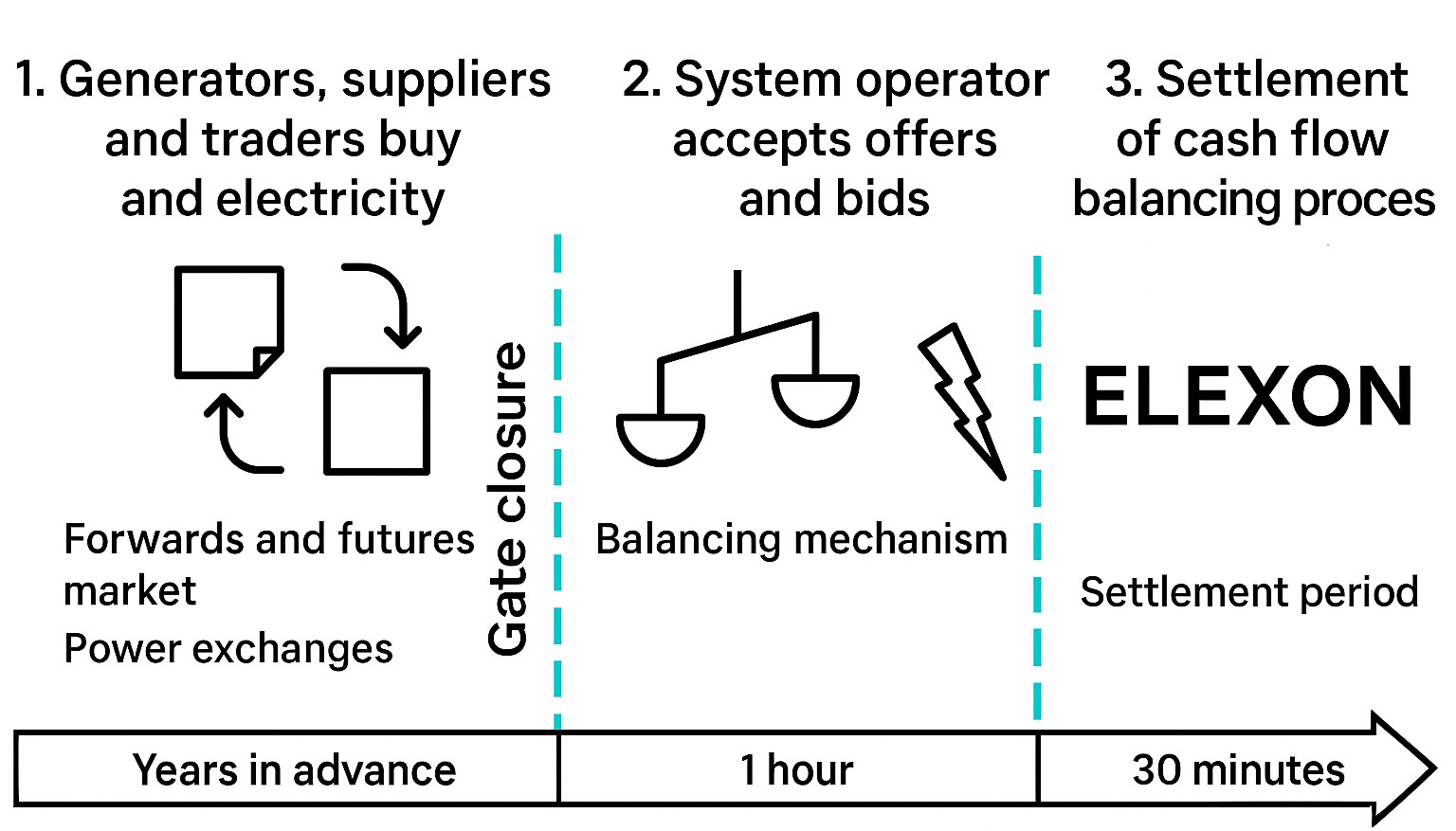
Hence, in the event of a 1,400 MW LLR-sized generation loss, those market participants impacted by the lost generation will look to re-balance themselves in all periods beyond the Gate Closure window. This leaves NESO to replace the lost generation, starting from the initial instantaneous trip, all the way up to 90 minutes into the future. NESO’s range of Balancing Services each plays its part in this activity, and these are set out below in the order in which NESO will usually utilise them.
Inertia
As was referenced previously, inertia historically has been a free service available to NESO as a by-product of large conventional generators using large and heavy steam-driven turbines to produce electricity. However, the rise in renewable and BESS technologies to supply electricity, supported by Government policy to increase the cost of carbon-emitting means of generation, has resulted in less inertia being freely available, especially during periods of high renewable output and where higher-cost CCGTs are displaced by wind or solar.
NESO estimates how much inertia will be available on the system given the forecast conditions, taking account of expected renewable output and the inertia that will be provided by any conventional generators still operating (such as nuclear units).
NESO estimates the system's available inertia and assesses whether it meets the threshold needed to counteract the significant frequency fluctuations that would ultimately follow an LLR-sized event and result in a cascade of trips. Having sufficient inertia slows down how quickly the system frequency rises or falls (known as the Rate of Change of Frequency (RoCoF)) in the event of a large generation or demand loss.
For example, if the system has sufficient inertia, a sudden loss of 1,400MW of generation might cause the frequency to drop from 50Hz to 49.5Hz over a period of five seconds. In contrast, with insufficient inertia, the same frequency drop could occur in just one second. The slower change in frequency, or lower RoCoF, will be less damaging to generators and other equipment connected to the electricity network, reducing the chance that these other generators might break down and stop operating and thus preventing the cascade of trips and eventual black-out.
During conditions of high renewable output, NESO has traditionally sought to increase the amount of inertia on the system to match its requirements by using the BM to turn down wind generators and turn on additional CCGTs. However, this increases the cost to the end consumer and does not align with the UK’s plans to operate a net zero electricity system.
Consequently, NESO created a new set of paid-for stability services, one of which includes the ability for NESO to procure inertia from new sources. One such source is BESS which, given its near instantaneous response, can act in an identical manner as the old large spinning turbines and inject output instantaneously on to the system when large frequency deviations are detected.
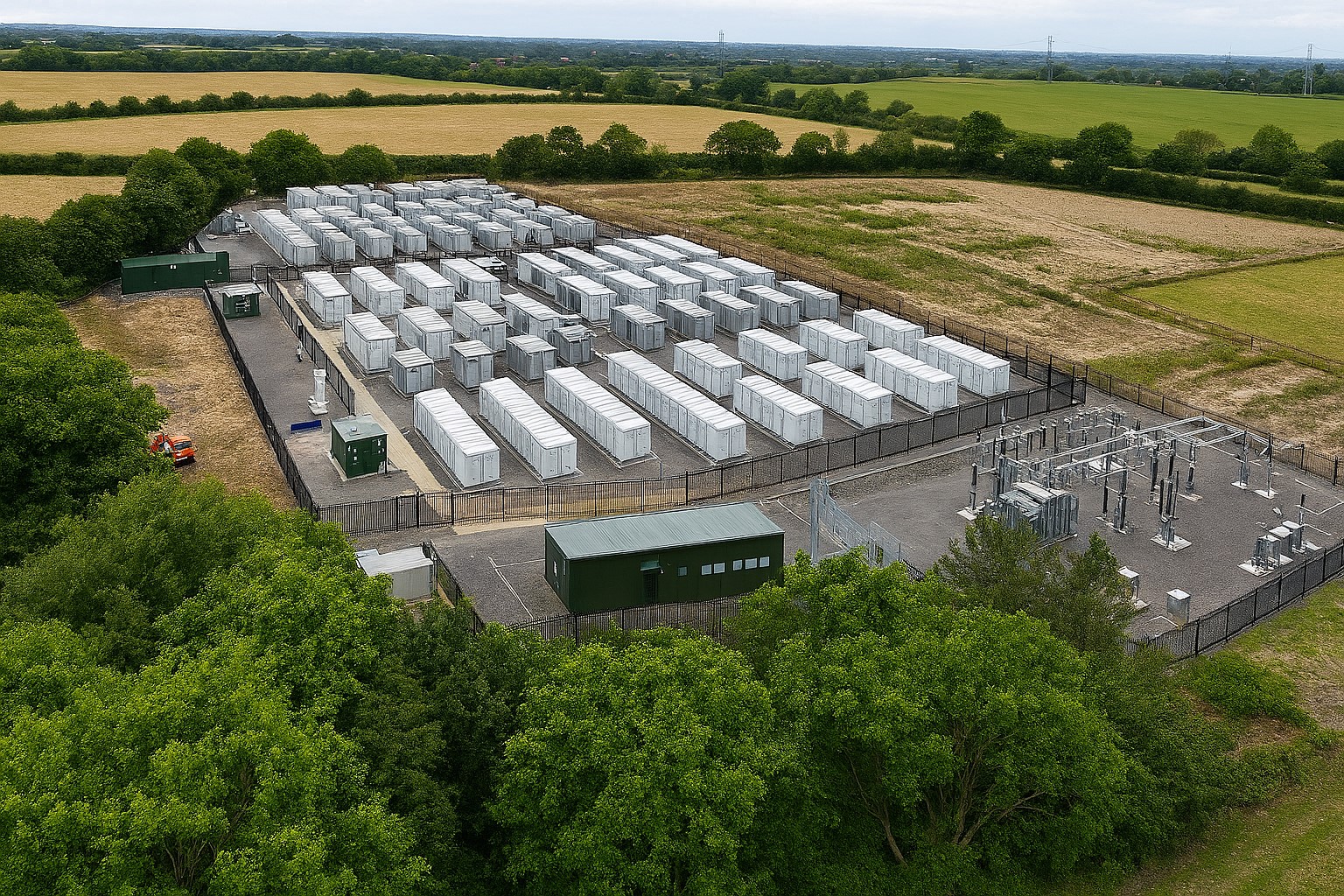
Another technology type that can provide inertia is the Synchronous Compensator. These can either be retired CCGTs that have had their turbines adjusted to only provide inertia, or brand-new installations designed to deliver inertia alongside other services.
NESO’s new stability services offer long-term contracts with guaranteed revenue, which has helped stimulate the investment required to develop emerging technologies. Further long-term contracts will undoubtedly be needed to ensure sufficient system inertia is available in a future world powered entirely by net-zero electricity sources.
Dynamic Frequency Response (DC / DM / DR)
After the initial large loss has occurred, and inertia has dampened the initial impact on system frequency, there is a near immediate need to begin replacing the lost generation or demand.
Historically, there was sufficient system inertia that allowed NESO to wait up to 10 seconds before its suite of Balancing Services would begin to fully respond to the large loss event.
However, with higher renewable output and less system inertia naturally available, NESO has released a suite of new services that react faster than was historically required.
The first of these services, known as Dynamic Containment (DC), went live in 2020 and is ideally suited to BESS. Indeed, it also served as one of the primary sources of firm revenue that helped kick-start the investment in build-out of BESS within the GB market.
The DC service is designed to kick-in once system frequency deviates by a significant amount (± 0.2Hz) from the target of 50Hz. Crucially, however, once frequency has crossed this threshold, the service requires that providers begin responding within no more than 500 milliseconds (half a second). In addition, the amount of response providers must deliver rises the further that frequency deviates from 50Hz, and providers must begin delivering the full amount of extra generation or demand within one second and must be capable of maintaining this for up to a maximum of 15 minutes.
Two additional fast responding services, Dynamic Moderation (DM) and Dynamic Regulation (DR) were then rolled out by NESO in 2022.
DM provides a similarly fast response to DC; however, it is more intensive in that greater amounts of generation or demand must be provided at lower levels of system frequency deviation (between ±0.1Hz and ±0.2Hz) and must be maintained for up to a maximum of 30 minutes.
Finally, DR kicks-in at even lower levels of system frequency deviation than DC or DM, operating within deviation ranges of between 0 and 0.2Hz but can take up to two seconds to respond. Dynamic Regulation is the most intensive service in the respect that even greater amounts of generation or demand must be provided at lower levels of frequency deviation and must be maintained for up to 60 minutes.
DC is designed to handle the very large and instant losses of generation or demand, with NESO typically looking to procure between 1,000MW – 1,400MW of the service via daily auctions. Meanwhile, DM and DR are more targeted at keeping system frequency stable within the normal limits of generation and demand fluctuations, with NESO looking to procure 400MW – 600MW of each, also via day-ahead auctions.
All three are typically only currently provided by BESS assets and each service allows the amount of response to drop-away as system frequency returns to normal levels.
Static Firm Frequency Response (SFFR)
SFFR was introduced by NESO from 2017 and acted as something of an interim new service, bridging the gap between older services such as Mandatory Frequency Response (MFR) – more about this later - and the still-to-be-created DC / DM / DR services.
The SFFR service kicks-in at the point at which frequency drops below 49.7Hz (hence most likely after a large generator loss / LLR type event). Providers are expected to reach their contracted MW output level (which must always be at least 1MW) after not more than 30 seconds and must hold that level of output for at least 30 minutes.
This service is usually tendered for by a mixture of diesel engines, BESS and demand-side response providers. The latter is usually where a market aggregator has contracted with many smaller sized customers that are able to either reduce their demand or use small on-site generators to offset the amount of demand they take off the grid.
NESO typically procures up to 200MW per day of this service via day-ahead auctions and, once triggered, the providers must continue to deliver for the full 30 minutes, regardless of whether the system frequency has recovered or not, hence the static nature of the service compared with the dynamic nature of DC / DM / DR.
Mandatory Frequency Response (MFR)
MFR has been available to NESO as a service since the Grid Code was first introduced in 1990. It continues to be used every day and is primarily provided by conventional generation technologies such as CCGTs, Biomass, Pumped Storage, Hydro and smaller less efficient fossil fuel generation assets (BESS can provide the service but instead targets the newer dynamic response services). Wind generation is also capable of providing MFR, however they will often be the least commercially attractive option available to NESO given the renewable subsidy payments that Wind must forego to deliver the service.
MFR itself is split into two parts: one that responds to a drop in system frequency (Low), and another that addresses an increase in frequency (High).
The Low MFR service sees generation output beginning to rise within 10 seconds of a drop in system frequency below 50Hz. This initial kick-up in generation, referred to as the Primary response, must be held for up to 20 seconds. After 30 seconds following the drop in frequency, the Secondary response kicks-in, where higher generation output must be sustained for up to 30 minutes.
The High MFR service responds by reducing generation output within 10 seconds of a rise in system frequency above 50Hz, and this reduction must be sustained indefinitely.
NESO does not actively procure this service through the same daily auction approach as with DC / DM / DR / SFFR. Instead generators will indicate each month the price at which they would be prepared to provide the service. NESO then uses the BM to schedule conventional generators to run part-loaded, where they operate between their minimum and maximum possible levels of output, and then instructs them to begin providing MFR. The amount of MFR made available through this approach will vary across the times of the day and depending upon system conditions, such as whether demand is at a peak or a trough. However, the response volumes can be many hundreds of MWs if required.
This service was perfectly fit for purpose from 1990 through until c.2015, with limited renewable penetration, large quantities of conventional generation operating and high amounts of system inertia ensuring that the 10 second gap before response kicked-in was manageable.
It remains an important service today and will likely continue in some form through till the end of the 2020s, with NESO announcing plans to reform the service within the next few years.
Fast / Quick Reserve (FR / QR)
All services described so far increase generation or demand automatically in response to changes in system frequency, which itself is caused by the misalignment between generation and demand. The remaining NESO services instead allow NESO access to MWs held in reserve by paying generators to sit with unused capacity to either increase or decrease output, and from there it is down to active decision making and instruction by the NESO Control Room and its operating systems to utilise this reserve in response to a given event.
The FR service was first introduced in the early 2000s and has largely remained unchanged through until today. It enables NESO to actively send dispatch instructions to larger sized assets, either via the BM or other methods for those generators operating outside of the BM. Providers must be able to ramp-up their output by no slower than 25MWs per minute and must be able to deliver at least 25MWs for a minimum of 15 minutes. They must also be able to start and stop delivering the service within two minutes of receiving an instruction from NESO.
The requirement of the service to be able to ramp quickly and at minimal notice limits the generation technology types that are qualified to deliver, hence historically it has been Pumped Storage and BESS generation assets that have tendered for and provided this service.
NESO released Quick Reserve (QR) in Q4 2025, an upgraded version of FR that is more integrated into NESO’s improved IT systems, with the intention to phase out FR entirely by 2026 to be replaced by QR.
QR itself is split into two variants. The first is Positive QR (PQR), which is similar in nature to FR. And the second is Negative QR (NQR), which enables NESO to reduce generation or increase demand, something that the existing FR service does not offer.
QR requires an even faster response time of less than one minute, allows NESO to increase and decrease generation and be open to smaller sized assets. BESS remains the best positioned asset class to provide the service, and as at October 2025, NESO procures between 300MW and 500MW daily via day-ahead auctions.
QR is typically used by NESO in response to very short-term deviations in generation or demand, as observed by changes to system frequency. Utilising BESS assets made available via QR ensures that the automatic services, such as DC, will be used less intensively, preserving their availability should an LLR event occur.
https://www.neso.energy/industry-information/balancing-services/reserve-services/quick-reserve
Short Term Operating Reserve (STOR) / Slow Reserve (SR)
STOR is another legacy service introduced back in the early 2000s alongside FR and is focussed on securing additional generation output at a slower activation rate, but with the capability to sustain output for a much longer duration. Hence if FR was about providing a shorter burst of immediate relief after an LLR event, STOR is better placed to pick up the slack once the delivery from FR dissipates after 15 minutes and help return system frequency back to within 0.2Hz of the normal level.
Providers of STOR must be able to offer at least 3MW of generation increase or demand decrease, and this may be achieved by aggregating across multiple sites or assets.
BM providers must begin delivering the MWs within 20 minutes of receiving BM instructions from NESO and must continue to provide the agreed level of output for at least two hours. As with FR, Non-BM providers are instructed by other methods but with the same timings.
Typical technology types that provide the service are Open Cycle Gas Turbines (OCGT – a generally older and much less efficient version of a CCGT), Gas Peakers, Hydro, Diesel and demand-side participants that can switch off or shift their demand load.
From 2026, NESO is also looking to develop and release a replacement service for STOR called Slow Reserve (SR), which will also be integrated into NESO’s improved IT systems.
Like QR, SR will be split into positive (PSR) and negative (NSR). PSR is like STOR in that it enables NESO to increase MW output, whilst NSR enables NESO to reduce MW output, a capability which does not exist via STOR.
SR will see a reduction in the minimum provider size to just 1MW, but with a shorter time to respond to the first instruction of no more than 15 minutes. The minimum delivery duration of two hours remains.
NESO has usually procured between 1,300MW and 1,700MW of STOR via day-ahead auctions, depending upon the prevailing market fundamentals. However, the arrival of SR and phasing out of STOR will see NESO looking to procure up to 1,800MW of PSR and 800MW of NSR each day, also via day-ahead auctions. It is expected that Gas Peakers & OCGTs will continue to focus their efforts on winning contracts to provide PSR. Although BESS assets exceed the technical requirements to deliver the service, they will be very well placed to provide NSR and this may prove to be another viable source of BESS revenue, although they may not be able to tender as cheaply as wind generators.
https://www.neso.energy/industry-information/balancing-services/reserve-services/slow-reserve
Balancing Reserve (BR)
The final reserve service at NESO’s disposal has less stringent requirements in relation to the speed, rate and duration of MW ramping compared with other reserve services. It is therefore open to almost all generation technology types, including CCGTs, Gas Peakers, BESS, Pumped Storage and Wind. However, as at October 2025 only BM assets may provide the service.
To deliver the Positive BR (PBR) service, the provider must ensure that there is sufficient headroom between its scheduled output and its maximum possible output. Meanwhile, the Negative BR (NBR) service requires sufficient footroom between each provider’s scheduled output and its minimum possible output. In the case of Pumped Storage and BESS technologies, the minimum output corresponds to the maximum amount of pumping / charging each can perform, which requires increasing their demand from the grid.
Providers are expected to be able to respond to an instruction sent by NESO via the BM within two minutes and be able to deliver the agreed MWs in line with what NESO has procured.
NESO procures the service via a day-ahead auction, with between 200MW and 600MW of PBR usually targeted. NBR requirements can be anything up to 1,400MW although, as at October 2025, NESO is not actively seeking to procure any NBR since negative reserve is frequently freely available naturally through the BM??
Whilst this service can help NESO to ensure that it has firmly available MWs held in reserve to respond to an LLR event, it may also use these MWs to re-balance any forecasted imbalances between generation and demand.
https://www.neso.energy/industry-information/balancing-services/reserve-services/balancing-reserve
Summary
Having run through all the most significant NESO balancing services that are in live operation, Part 2 provides a worked example of how NESO will utilise each of these services in response to an LLR event.
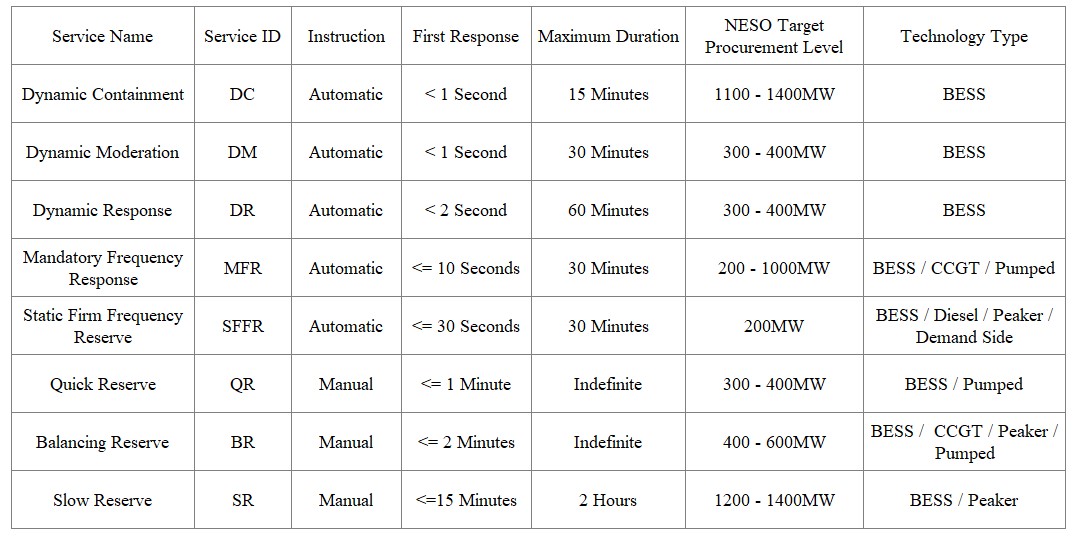
For a quick reference of all these services and their main characteristics please see the summary table on the final page of this article.
NESO Services Summary Table
Related articles

Do you believe in life after ROCs?

Powering the UK's digital future: getting data centre connections reform right
