Solar panels made simple: What your small business needs to know
How do solar panels work for small businesses?
Solar panels work by capturing sunlight and turning it into electricity for your small business. When sunlight hits the solar panels, they generate power as direct current (DC). This electricity then passes through an inverter, converting the DC into alternating current (AC) - the type of electricity that runs your appliances, lights and equipment. Once converted, the energy can be used immediately, stored in a battery for later, or sent back to the grid, earning your business savings on energy bills.
What are the advantages of solar energy for small businesses?
- Cost savings: Resolve Net Zero have calculated that solar energy can reduce business operating costs by cutting electricity bills by 30-60%. Small businesses that operate during the day benefit from the biggest savings as they can use the solar energy as its generated.
- Earn extra income: Through the UK’s Smart Export Guarantee scheme you can receive payments for exporting excess electricity back to the grid. Find out about the SEG tariffs we offer small businesses here.
- Generous tax benefits: Through the UK’s Annual Investment Allowance, businesses can deduct up to £1 million spent on renewable energy equipment, including solar panels for small businesses, from their taxable profits.
- Protection against rising energy prices: Installing solar panels at your business provides you with stable and predictable energy costs, helping you avoid future cost increases- excluding your existing contracts.
- Reduced carbon footprint: Solar power is a clean energy solution for businesses that cuts emissions and reduces reliance on non‑renewable resources.
- Return on investment: Solar panels for small businesses significantly reduce your electricity bills, meaning the system pays for itself over time - providing long‑term savings and financial benefits once the initial cost is recovered.
- Low maintenance: Solar panels are designed for long‑term durability, needing only minimal maintenance. Rainwater helps keep them clean and many systems are backed by warranties of 25 years or more.
Is your small business suitable for solar panels?
Switching to solar is a smart and sustainable choice for your small business but it’s important to understand whether your business property is a good fit before getting started. The points below outline the main things to consider when determining whether solar is the right fit for your business.
- Roof space: An average system requires 15-20 m² of roof space. The more solar panels that are installed on your roof, the more energy that is generated. South-facing roofs with no shade are ideal for maximum generation, East and West-facing roofs work too but generate less electricity. Suitable roof types include corrugated metal, standing seam, tile and asphalt shingle.
- Consistent daytime energy use: Solar performs best when most of your energy consumption happens during the day, your business can use the electricity as it is generated, so it’s worth checking how much day light your business roof gets.
- Long Term Plans: Solar panels for small business are an investment which pays off over time. If you intend to remain at your current location for several years, you’ll be more likely to maximise the financial benefits.
What are the benefits of adding battery storage?
Adding battery storage to your small businesses solar setup is one of the smartest ways to maximise the power your panels generate. Solar panels don’t produce electricity at night- with battery storage you can store excess energy created during the day and use it later when your business needs it most. Alternatively, if you have multiple business sites, you can transfer the battery to another location and use the stored battery there. Therefore, your small business is cutting costs and avoiding paying night-time energy rates as you no longer rely on the national grid after sunset.
Battery storage also unlocks access to our Export 12M Small Business tariff, helping you get even more value from the energy you produce. Additionally, the Sunsynk Connect app is available, so you can track in real time how much energy your panels are generating.
Beyond the energy savings, battery storage can also give your small business a competitive advantage. By generating and storing your own business electricity, you reduce your overall cost to serve, meaning you spend less on day‑to‑day operations. Lower operating costs allow you to free up budget that can be reinvested in your small business, this also means you can offer more competitive pricing to customers without compromising your margins.
With battery storage supporting both financial efficiency and operational stability, it becomes more than just an energy upgrade - it’s a strategic small business investment.
Where will the battery be installed for small businesses?
Choosing the right location for your small business battery storage is essential for safety and performance. It should be installed in a space which is well‑ventilated, easy to access and capable of supporting the battery’s weight. Most batteries are installed in garages, utility rooms, cupboards or outbuildings as they are a secure and naturally cool space that keeps the battery protected.
Can solar energy work with electric vehicle charging?
Pairing solar panels for small business with commercial EV chargers gives you a powerful way to charge fleet or employee vehicles using renewable energy generated directly on-site. The most effective systems combine solar panels with solar‑compatible EV chargers and battery storage, ensuring clean energy is available - even for overnight or off‑peak charging. Together, these technologies create a resilient, future‑proof approach to electrifying transport for small businesses.
What is the installation process?
To help you understand exactly how everything works, here’s a breakdown of each step in the installation process:
Step 1: Get a quote
After filling out our quick webform, we'll get you in contact with a solar expert to find out what solar design works best for your small business. You'll then be contacted with your tailored quote.
Step 2: Survey
Next, your installer will conduct a thorough survey to ensure your small business and roof are suitable and safe to install the solar panels.
Step 3: Scaffolding
The installers will put up the scaffolding a few days before your installation.
Step 4: Installation day
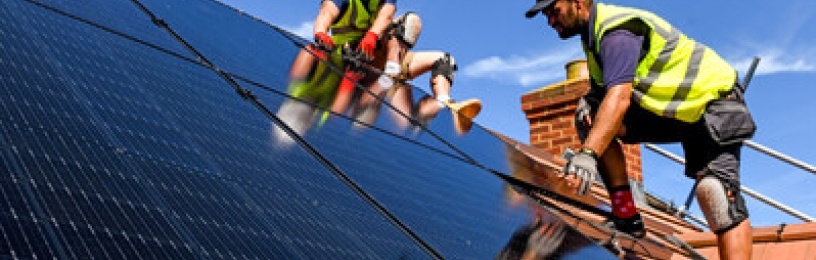
On installation day, our trusted installers will handle the entire process. This includes mounting the solar panels, installing the inverter and installing battery storage if you've opted for a battery too.
Ready to explore what solar could look like for your small business? Get your personalised quote here.
Related articles


