R&D UK and Nuclear Operations deliver innovative Nuclear Hydrogen project
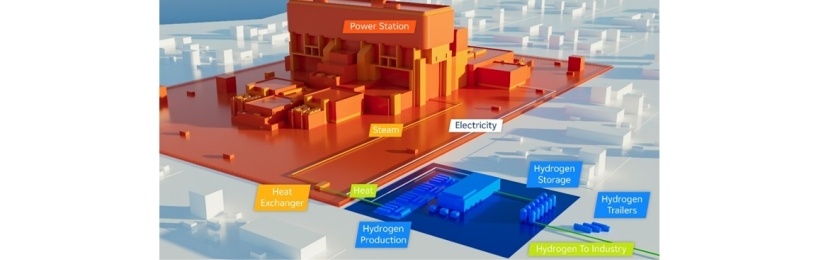
The Bay Hydrogen Hub is part of the Department for Energy Security and Net Zero’s £1 billion Net Zero Innovation Portfolio which provides funding for low-carbon technologies and systems and aims to decrease the costs of decarbonisation helping enable the UK to end its contribution to climate change. The project is supported with a grant of £3.5m and explores the production of hydrogen via high temperature electrolysis integrated with nuclear power, and the potential industrial use cases of low-carbon hydrogen.
The consortium members are: EDF Nuclear Operations UK (consortium lead), EDF UK R&D, Heidelberg Materials, United Kingdom National Nuclear Laboratory (UKNNL) and Vulcan Burners.
Nuclear Enabled Hydrogen (NEH) Handbook
The project has successfully delivered a detailed and practical guide for the integration of a Solid Oxide Electrolyser (SOE) with nuclear power, summarised in the Nuclear Enabled Hydrogen (NEH) Handbook which will be released later in this year. The handbook answers how to build a commercial scale SOE near a nuclear licenced site in the UK, addressing the technical, economic and regulatory challenges that such a project might face. Solid Oxide electrolysis, although less mature than other electrolysis technologies, has the potential to be 20-30% more efficient, particularly if using heat from nuclear stations as well as electricity.
Hydrogen trials
The next phase, which is planned for July, will see Heidelberg Materials trial a 100% hydrogen combustion burner designed, developed and tested by Vulcan Burners to decarbonise the production of asphalt. The trial will be the UK’s first (and the world’s second) demonstration of hydrogen as a fuel in asphalt production, where fuel will be switched gradually from liquefied petroleum gas (LPG) to hydrogen over the period of a month.
Find out more:
Olga Dubinin olga.dubinin@edfenergy.com, Lead research Engineer, Future Energy Systems
Related articles


Leveraging AGR know-how for AMR success
