Direct Air Capture and E-Fuels
In 2024, the UK R&D Zero Carbon Hubs team investigated Direct Air Capture (DAC) and e-fuel technologies to understand the potential benefits of co-locating with nuclear to provide low-carbon fuels into sectors such as aviation.
As part of an ongoing programme with Nuclear Operations, the Zero Carbon Hubs team is working with MFEE (Fluid Mechanics, Energy and Environment) in R&D France, EIFER in R&D Germany and the Nuclear Operations business to investigate the technical maturity, performance, economics and future market landscape for e-fuels and DAC in the UK.
Direct Air Capture
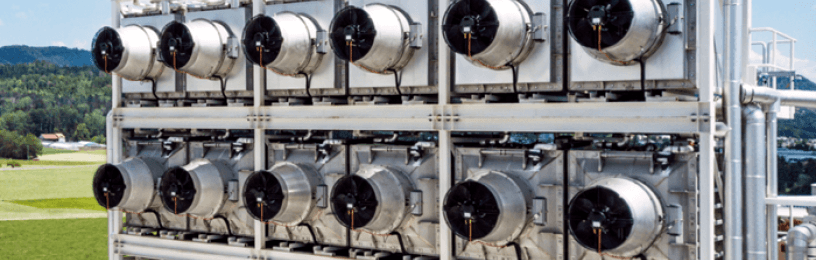
Direct Air Capture (DAC) is a technology that extracts carbon dioxide (CO₂) directly from the atmosphere. The process of DAC involves drawing ambient air through fans into a system where CO₂ is trapped by a recirculating fluid or solid sorbent. Solid sorbents involve materials that physically or chemically bind CO₂, while solvent-based systems typically use chemical absorption.
Producing e-fuels
The captured CO₂ can be combined with low-carbon hydrogen, made from electrolysis, through chemical processes to produce e-fuels, such as e-kerosene for use in aviation. Hydrogen can be generated using water electrolysis, while CO₂ can be captured either from industrial emissions or directly from the air. H₂ and CO₂ are combined through processes including Fisher-Tropsch synthesis to produce drop-in e-fuels. An approach in development is the use of solid oxide cells to electrolyse CO₂ and water
simultaneously, producing a syngas mix of CO and H₂ at optimised ratios for downstream fuel production.
The benefits
By recycling atmospheric CO₂, DAC enables carbon-neutral fuel production, reducing greenhouse gas emissions and supporting the UK’s decarbonisation goals. Nuclear energy can play a role in both e-fuel production and DAC by providing heat and electricity to hydrogen electrolysis, carbon capture and e-fuels synthesis. This enables the efficient production of e-fuels with minimal greenhouse gas emissions, offering a viable alternative to fossil fuels in hard-to-decarbonise sectors like aviation and shipping.
Related articles


Leveraging AGR know-how for AMR success
