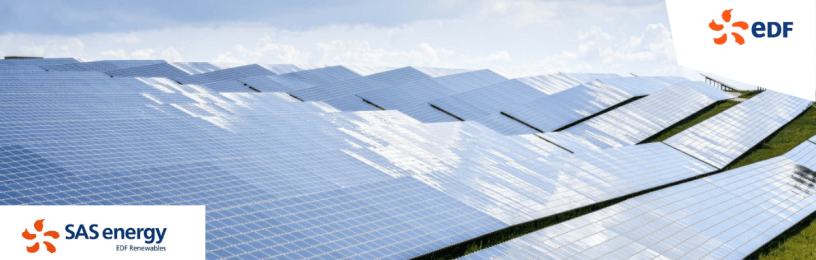
Harnessing Onsite Solar: From Myths to Market Readiness
TalkPower Guest Blog and Video - With insights from EDF Group Partner, SAS Energy EDF power solutions C&I Solar Division
In this guest feature, Pranav Verma, SAS Energy’s Business Development Manager, explores how organisations can benefit from onsite solar energy, dispelling common myths and outlining the practical steps needed to move from concept to construction.
As the UK accelerates its journey toward Net Zero, onsite solar power is emerging as one of the most practical, popular, and cost-effective energy solutions. But, there remains huge untapped potential for commercial and public sector buildings.
Utilising just 5 per cent of suitable commercial rooftop space for solar could save UK businesses and public organisations £12.6 billion annually, as highlighted in the Government’s Solar Roadmap and Clean Power 2030 strategy.
There are substantial opportunities for public sector organisations too, with Great British Energy committing to installing rooftop solar at around 200 schools and 200 hospitals across England.
Why should your organisation consider on-site solar?
Onsite solar is one of the simplest steps a business can take toward Net Zero. By harnessing unused assets such as rooftops, land (ground-mount solar), or even car parks (solar car ports), onsite solar provides clean, reliable power without interrupting daily operations – along with long-term financial and environmental benefits.
Key benefits for large businesses and public sector bodies include:
- Cost savings & protection from energy price volatility: Generating your own electricity offsets grid reliance, ultimately lowering your energy costs and helping to avoid fluctuations in wholesale market prices.
- Operational continuity: Onsite solar supports business operations and aligns energy generation with your working hours. Pairing solar with battery storage allows greater flexibility by storing excess energy for use when needed.
- Future-proof: Onsite solar supports other low carbon solutions that will be required in future, such as heat pumps and EVs.
- Sustainability: Onsite solar reduces Scope 2 emissions – the indirect greenhouse gases from purchased electricity – helping organisations meet Net Zero targets and strengthen their green credentials via Renewable Energy Guarantees of Origin (REGO) certificates.
Deployment options: CAPEX vs PPA
Choosing the right financing approach early is key:
- CAPEX (Self-Funded): Organisations with capital can purchase solar systems outright, gaining control and long-term savings. Payback periods have shrunk from seven-15 years to as little as three-five years in many cases.
- Power Purchase Agreement (PPA): For those seeking no upfront costs and budget certainty, PPAs are an attractive option. The provider funds, installs, and manages the system, while the organisation purchases electricity at a fixed, often discounted rate. Project risk is transferred to the provider, usually over 15-25 years. While PPAs have more contracting requirements, they offer a low-risk, cost-effective path to solar adoption.
Dispelling common myths about onsite solar
Misconceptions can prevent organisations from embracing solar. Here’s the reality:
Myth 1: Solar panels must face south. Reality: East-west roof orientations can deliver more consistent power throughout the day.
Myth 2: Solar can’t supply significant energy needs. Reality: On-site solar can provide 10-30 per cent of your energy demand, depending on your site and consumption.
Myth 3: Installation disrupts operations. Reality: Most installations take three weeks to three months, with minimal interruption – usually just a brief power shutdown.
Myth 4: Solar is expensive and hard to maintain. Reality: Costs have dropped sharply; payback is often under six years. Maintenance involves routine cleaning and remote monitoring.
What to expect: Project timeline and process
Most onsite solar projects move from concept to construction in about nine months. This includes desktop design, site surveys, detailed engineering, and obtaining approvals from the Distribution Network Operator (DNO) and planning authorities.
Recent government reforms have removed the 1MW rooftop solar cap, simplified approvals, and expanded permitted development rights – reducing delays and costs for larger commercial and public sector projects (GOV.UK, 2024).
Ready to evolve your net-zero strategy?
On-site solar is a proven way to reduce your long-term energy costs, whilst also delivering carbon and reputational benefits, for both large businesses and public sector organisations.
SAS Energy can support you with your solar projects, starting with a desktop feasibility assessment.
Get in touch with us at LetsTalkPower@edfenergy.com to speak to one of our experts.
Visit our Net Zero Solutions for Business page to learn more.
SAS Energy is EDF UK’s B2B solar company (part of EDF power solutions C&I Solar Division), and one of the leading EPC solar providers in the country today, experienced in the design, supply, and installation of renewable energy solutions.
Watch Pranav's original presentation from the MEUC Conference in October 2024:
Post a comment
Related articles

An Electric Britain: Powering business progress and the road ahead

