
Summer 2025: A record season for solar cannibalisation in GB
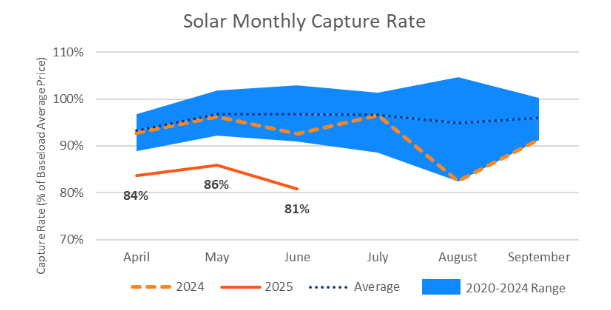
We're now halfway through Summer 2025 and it’s looking like a record-breaking season for solar cannibalisation! So far, solar generation has only captured about 83% of baseload Day Ahead prices, which means solar is getting paid a lot less than the market average.
What is solar cannibalisation?
Solar cannibalisation happens when a lot of solar power floods the grid at the same time, pushing electricity prices down during sunny periods.
We measure it by comparing:
- The average Day Ahead power price (a simple average),
- With the solar-weighted average price, which is based on how much solar is being generated each hour.
This summer, the solar-weighted price is just 83% of the average price, which shows that more solar power means lower prices.
This means solar generation won't be worth as much as you might expect when you look at baseload forward power prices - and it has been a lot less valuable, so far this Summer.
What causes this effect?
Power prices are set by supply and demand. Consumers are only willing to pay so much for electricity, which creates a demand curve. On the other side, generators offer electricity based on how much it costs them to produce it - this is called their Short Run Marginal Cost (SRMC) - which forms the supply curve.
The market price at any moment is where those two curves meet. It’s usually set by the most expensive generator still needed to meet demand. When demand goes up, prices rise. When more cheap electricity (like solar) is available, prices fall.
Solar power usually has a very low SRMC, sometimes even negative if it’s subsidised. Since the weather is typically similar across the UK at any given time, many solar farms produce power at the same time when it’s sunny. This floods the market with cheap electricity, meaning fewer expensive generators are needed - so the overall market price drops.
Why has it grown so much, so quickly?
There are a number of recent developments that have meant this summer is seeing a much stronger cannibalisation effect:
- More solar capacity: There is now over 17GW of solar in GB, from new farms and rooftop panels – and it’s still growing.
- More solar from Europe: Solar capacity has increased significantly, in countries like Germany and the Netherlands, which can export power to GB via the BritNed interconnector, further depressing GB power prices.
- Sunny, mild weather: This summer we have seen lots of warm, sunny weather so far, which boosts solar output and reduces electricity demand, both of which push prices down further.
What does this mean for developers, generators and PPA offtakers?
This is an emerging trend in the markets, and given the exceptional weather we've had in GB it is difficult to know what the long-run trend will be. Higher solar cannibalisation translates to higher shaping costs for offtakers, because they will be selling excess generation in periods of lower prices and buying back forward hedges in periods of low generation and higher prices. This increase is something we were expecting to see and has mostly been factored into our offtake cost forecasts, so it shouldn't mean a change to the PPA prices that EDF offers.
This high cannibalisation is a timely reminder to PPA offtakers to make sure they are adequately forecasting this effect and managing their risks and so can continue to offer developers and generators competitive PPAs going forwards. It's also good to remember that earnings for an offtaker from renewable contracts can be very volatile, so periods of higher shaping costs and potential short-term losses are expected - this is the value we can offer to generators and developers in managing this volatility as an offtaker.
Related articles

What next for the Corporate PPA market in Great Britain?
