
Exploring behind the meter flexibility
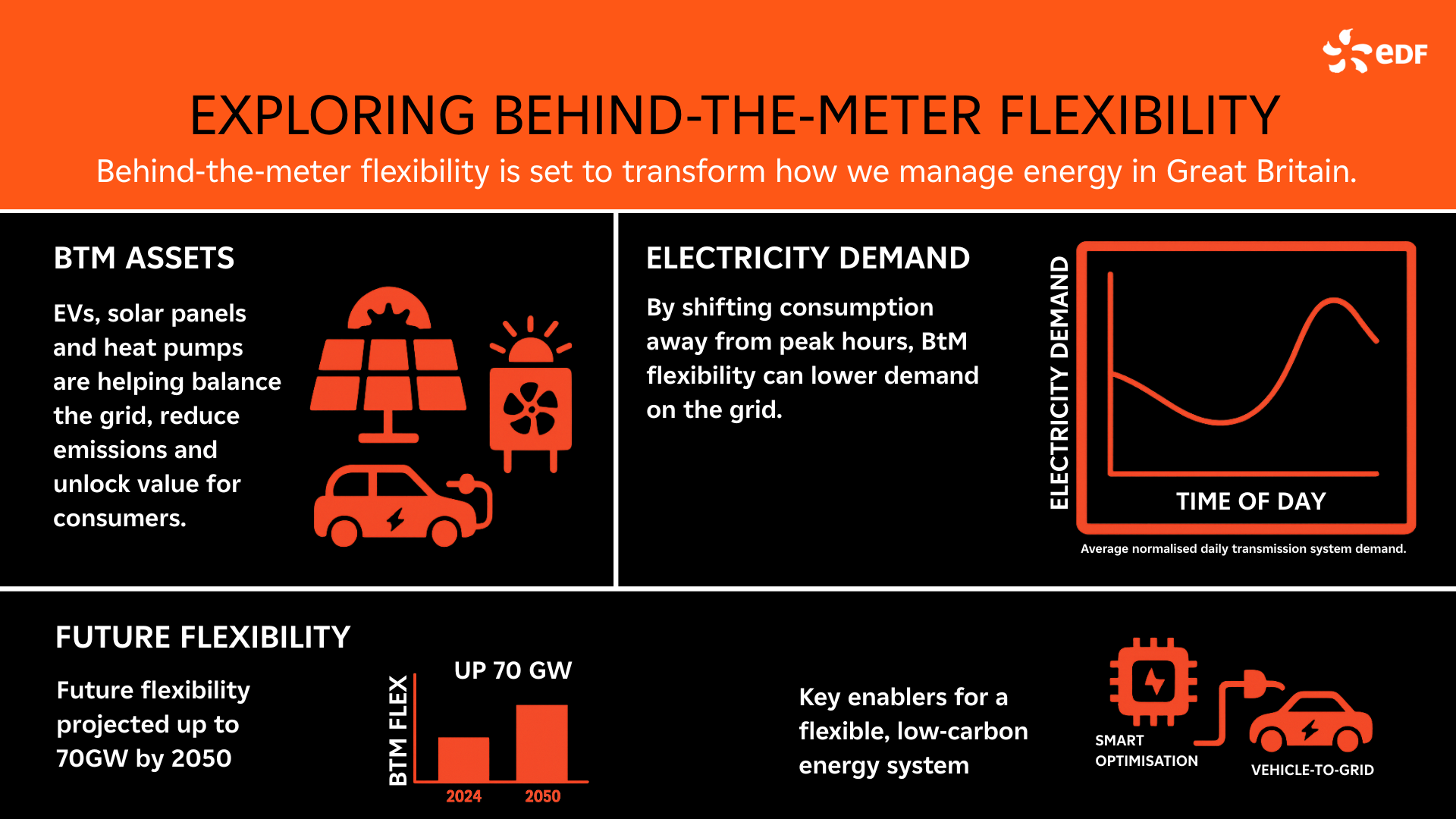
Behind-the-meter (BtM) flexibility is set to transform how we manage energy in Great Britain. Our latest blog explores the growing role of BtM assets—such as electric vehicles (EVs), solar panels and heat pumps—in helping balance the grid, reduce emissions, and unlock value for consumers.
With up to 70GW of BtM flexibility projected by 2050, smart optimisation, aggregation and vehicle-to-grid (V2G) technology will be crucial in enabling a more flexible, low-carbon energy system.
What Is Behind-the-Meter Flexibility?
In our recent blog, we outlined the key differences between front-of-meter and behind-the-meter flexibility and how both are crucial for the management of the power system in GB as we transition towards a low carbon grid. In this post, we will further explore the potential of behind the meter flexibility, and how consumers will contribute to the efficient functioning of our future energy system.
To recap, behind the meter assets refer to assets that are located on the consumer side of the meter. Examples of BtM assets include rooftop solar panels, residential battery storage systems or electric vehicles.
In this post, we take a closer look at the growing potential of BtM flexibility, and how consumers will play a key role in ensuring the efficient operation of our future energy system.
Why Now?
During the 2010s, BtM assets gained popularity thanks to government schemes such as Feed-in Tariffs (FiTs), which incentivised the deployment of small-scale renewables. Between 2010 and 2019, residential solar installations surged. Although the FiT scheme has since ended, it was replaced by the Smart Export Guarantee (SEG), which requires larger suppliers to pay households for electricity they export to the grid.
Residential solar and battery storage installations continue to rise, driven by falling upfront costs and supportive policies. Notable targets include:
- 600,000 heat pump installations per year by 2028, scaling to 1.6 million per year by 2035. [1]
- A ban on new petrol and diesel car sales by 2030, accelerating the shift to EVs.
As more ‘smart’ BtM assets come online, they create significant opportunities to flex demand in response to price signals—benefiting asset owners, grid operators, and the planet.
[1] This policy target was introduced by the previous government.
Rising Demand for Electricity
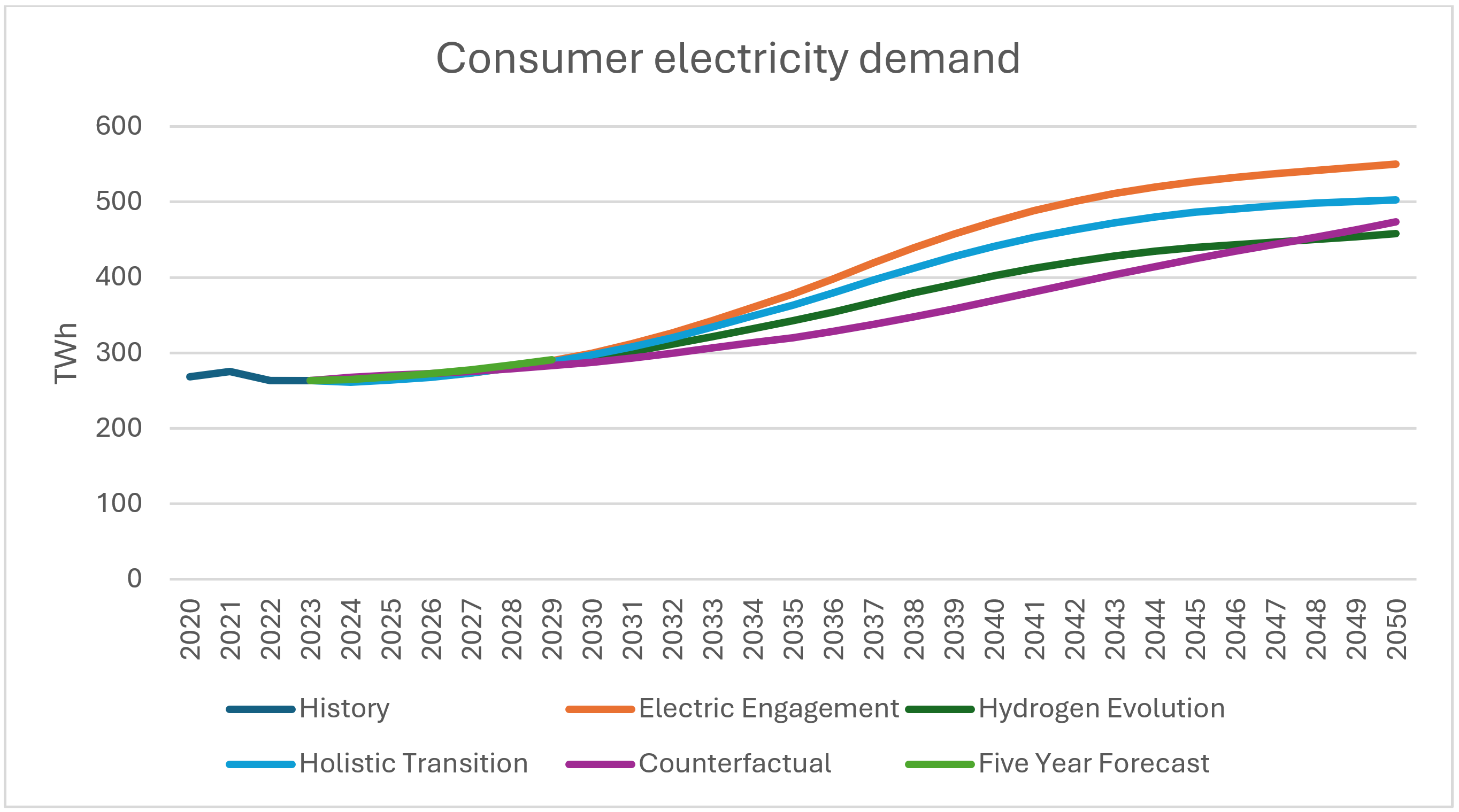
Demand growth has stalled in recent years as energy efficiency measures have decoupled economic growth from electricity demand. However, total annual consumer demand is expected to pick up once again as the policies outlined above increase electrification in the heating and transport sectors, as per the chart above.
This chart shows the NESO Future Energy Scenarios total annual electricity demand (https://www.neso.energy/publications/future-energy-scenarios-fes).
Electricity demand on the GB transmission system has a well-defined shape – there is a morning pick up as consumers wake up, fire up their lights, kettles and coffee machines and begin the day. Demand tends to fall throughout the middle of the day, particularly in the summer as distribution connected (including behind the meter) solar assets begin to generate, soaking up some of the consumer demand. As people return home after work, put the oven on and settle in for the evening, we see electricity demand peak. This evening peak is the part of the day where we typically see gas-fired assets turn on to meet the highest demand part of the day. Figure 2 shows the average normalised daily transmission system demand across 2024.
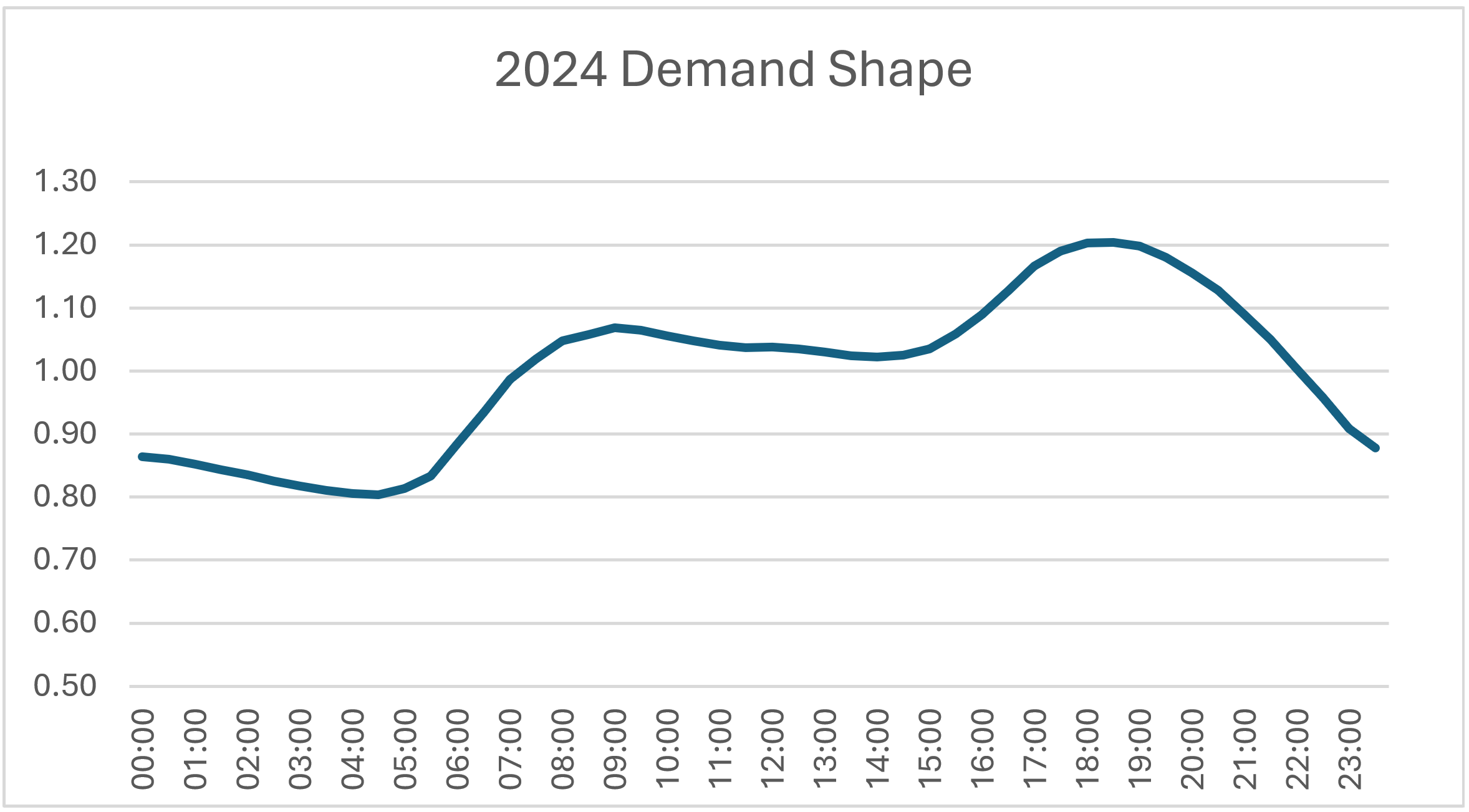
As the average demand increases in line with Fig 1, there is the potential for the peak demand to also increase, meaning we will need significant MWs of back up (likely gas fired) capacity to sit spare until it is called upon for a few hours a day. This would likely require significant capacity payments or other support to ensure this capacity is available to run at very low load factors.
Instead, if BtM flexibility is exploited to move some of that evening peak demand to other parts of the day where the power prices are lower, we can reduce peak demand relative to total demand, and the system will require fewer fossil powered assets to meet those tight periods. Consumers can also benefit from using power when it is abundant, and therefore cheaper, like during periods of high renewable output.
How much flexibility is there?
The challenge with BtM flexibility is that it can only practically be utilised around typical consumer behaviours – for example, while it may be cheapest to charge your electric car during the middle of the day where solar generation is weighing on power prices, you are likely to be at work during those times, and possibly not have access to a charger.
In the Future Energy Scenarios, NESO estimates that there could be up to 70GW of flexibility from BtM assets by 2050, as shown in Figure 3. To put this in perspective, 2024 saw a peak transmission demand of 47.5GW.
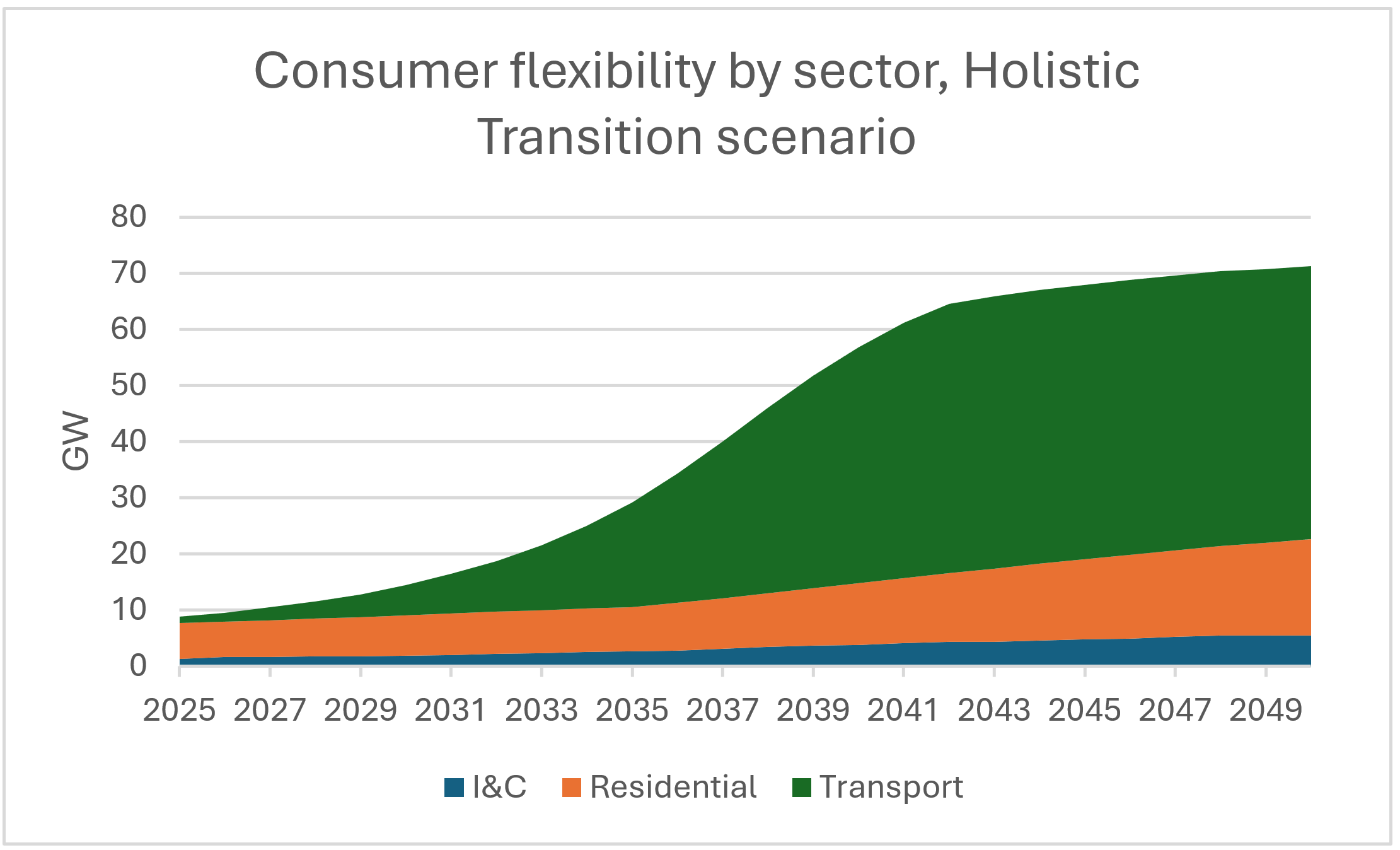
Residential flexibility provides a portion of this flexibility, with smart devices such as thermostats, heat pumps and other household appliances able to shift their demand profile so they can operate during periods of lower power prices, reducing peak load.
The majority of this flexibility is projected to come from the transport sector; via the smart charging and vehicle-to-grid capabilities of electric vehicles. Smart charging refers to electric vehicles being optimised to charge when prices are low and delaying or slowing down charging rates when prices are high. This has the benefit of increasing demand during periods of high generation and reducing demand when there is scarcity of supply, helping to maintain grid frequency, avoid renewable curtailment and reduce peak power prices. It also has the added benefit of reducing the cost to the consumer of charging the car.
Vehicle-to-grid (V2G) technology takes this concept one step further, allowing for bi-directional flows into and out of the vehicle’s battery: V2G technology has the potential to transform electric vehicles into mobile energy storage systems. While also being able to load shift and benefit from cheaper periods to charge, V2G technology also allows the EV batteries to sell power back to the grid during peak demand periods. This again has the double benefit of assisting the function of the grid and allowing consumers to monetise their BtM assets.
The Role of Aggregators
To access the full value of BtM flexibility, individual assets can be grouped together by aggregators and traded as a collective.
This opens access to:
- Wholesale markets (Day Ahead and Intraday)
- The Balancing Mechanism
- Frequency response services
- Local Distribution Network Operator (DNO) services
- Demand Side Response schemes
Optimising this flexibility will require sophisticated algorithms and experienced operators.
Conclusion
We’re transforming everyday homes into smart energy hubs—supporting the grid and saving homeowners money. Behind-the-meter flexibility represents a transformative approach to energy management, empowering consumers to optimise their energy usage and contribute to a more resilient and sustainable grid.
Through smart technologies and aggregation, consumers can take an active role in the UK’s energy transition—balancing supply and demand while reducing costs and emissions.
Related articles


