What are Time of Use tariffs and could they help your small business save money?
With energy costs continuing to be a major expense for many small businesses, finding ways to reduce your electricity bills has never been more important. One option that is becoming increasingly popular is a Time of Use (ToU) tariff.
If you've never heard of a Time of Use tariff before, don't worry. The concept is actually very simple. Instead of paying the same rate for electricity all day, the price changes depending on when you use it. By using more electricity during cheaper periods, some businesses can make noticeable savings on their energy bills.
Understanding the Time of Use traffic light system
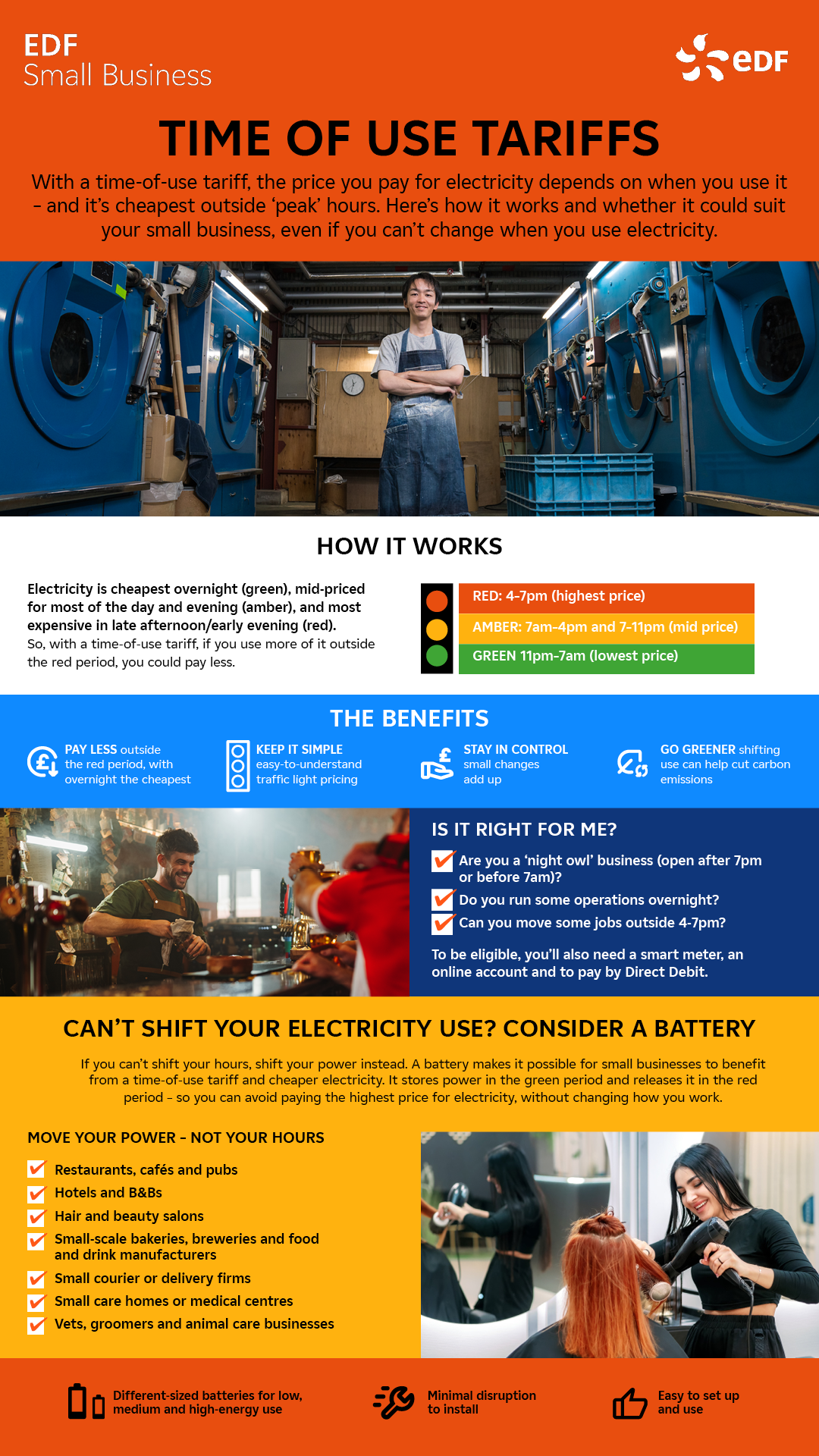
A simple way to think about a Time of Use tariff is like a traffic light:
🟢 Green (11pm-7am)
This is when electricity is at its cheapest.
🟠 Amber (7am-4pm and 7pm-11pm)
Electricity costs a mid-range price.
🔴 Red (4pm-7pm)
This is typically the most expensive period, when demand on the electricity network is at its highest.
The aim is straightforward: use more of your electricity during green or amber periods and less during the red period wherever possible.
Is Time of Use always set times?
There are two types of Time of Use tariffs.
Fixed Time of Use tariffs have set time periods, with electricity prices changing at the same times every day. This is where the traffic light timings come in.
Dynamic Time of Use tariffs work differently. The price of electricity changes more frequently based on wholesale energy market conditions and demand on the grid. Prices can vary from day to day or even hour to hour, meaning businesses need to monitor pricing or use smart technology to take full advantage of cheaper periods.
For many small businesses, fixed Time of Use tariffs are easier to understand and manage because the cheaper and more expensive periods are predictable. However, dynamic tariffs may offer greater savings for businesses that have very flexible energy use, but needs business owners who have time to monitor this.
Why is electricity more expensive between 4pm and 7pm?
During the late afternoon and early evening, homes and businesses across the UK are all using electricity at the same time. People are arriving home, switching on appliances, cooking dinner and charging devices.
Because demand is higher, electricity costs more. Time of Use tariffs reflect this by charging a higher rate during these peak hours and a lower rate when electricity demand is lower.
Small changes can lead to big savings
Many small businesses already have flexibility in when certain tasks are carried out.
A great example is a bed and breakfast.
A B&B may use significant amounts of electricity for laundry and dishwashing. Instead of running washing machines and dishwashers during the day or early evening, these jobs could be scheduled overnight or early in the morning when electricity is cheaper.
By making simple operational changes like these, businesses can potentially reduce the amount of electricity they use during peak-price periods and lower their overall energy costs.
Time of Use tariffs work naturally for some businesses
For some businesses, a Time of Use tariff fits naturally with how they already operate.
Take bakeries, for example. Many start production in the early hours of the morning, often before 7am. Since this falls within the cheaper overnight period, much of their electricity use is already happening when prices are lower.
Similarly, some takeaway businesses and kebab shops may operate late into the evening, while certain manufacturing or food preparation businesses run overnight processes.
In these cases, businesses may not need to change anything at all to benefit from cheaper electricity prices. Their existing operating hours already align with the lower-cost periods.
What if your business operates during peak hours?
Of course, not every business can simply move its energy use.
Hair salons, beauty salons, restaurants, cafés and many retail businesses are often busiest during the day and early evening. In fact, some of their highest energy use may occur during the most expensive 4pm-7pm window.
If this sounds like your business, you might assume a Time of Use tariff isn't for you.
But that's not necessarily the case.
How a battery could help
This is where battery storage can make a real difference.
Think of a battery as a way of storing cheaper electricity for later.
The battery charges overnight during the green period, when electricity prices are at their lowest. Then, during the expensive red period between 4pm and 7pm, your business can use the energy stored in the battery instead of buying electricity at the highest rates.
In effect, you're shifting your power rather than shifting your working hours.
This approach can be particularly useful for businesses such as:
- Barbers, hair and beauty salons
- Restaurants, cafés and pubs
- Small food and drink manufacturers
- Veterinary practices and grooming businesses
- Care homes and medical centres
While battery storage does require an upfront investment, the savings it can generate may help offset the cost over time. The payback period will depend on factors such as your energy consumption, the size of the battery and how much electricity can be shifted away from peak periods.
Is a Time of Use tariff right for every business?
Not necessarily.
Time of Use tariffs tend to work best for businesses that:
- Operate overnight or early in the morning.
- Can move some energy-intensive tasks outside the 4pm-7pm peak period.
- Are considering battery storage to help manage peak-time electricity use.
If most of your electricity use happens between 4pm and 7pm and you aren't able to shift usage or invest in battery storage, the savings may be more limited, or not at all.
That's why it's important to understand your current energy usage before making the switch.
Time of Use is changing the way we look at energy consumption in businesses
Time of Use tariffs offer businesses a different way to manage energy costs. Rather than simply focusing on how much electricity you use, they encourage you to think about when you use it.
For some businesses, simple operational changes such as running laundry overnight can unlock savings. For others, particularly those operating during peak hours, battery storage could provide a way to access cheaper electricity without changing how the business operates.
Every business is different, so before making a decision, it's worth speaking to your energy supplier. They can help you understand your usage patterns, assess whether a Time of Use tariff is suitable and identify the potential savings available to your business.
We’re soon launching our EDF Small Business Time of Use Tariff. Give us a call if you want to get involved in a trial 0333 188 6725.
Related articles


Energy observer November 2026
