
Do you believe in life after ROCs?

Contents
What is the Renewables Obligation (RO) Scheme?
When are assets expected to roll off their RO support?
Preparing for life after the RO
Why early engagement matters
How EDF can support you
FAQs
The GB renewables market is entering a new phase. While much of the current focus is on the next wave of CFD-backed renewable projects entering the market, a growing number of existing assets are approaching the end of their Renewables Obligation support and will enter a fully merchant part of their life cycle.
For those generators, the central question is no longer how to benefit from subsidy-backed revenue, but how to manage merchant exposure, protect value and secure the right route to market for the next stage of the asset’s life.
The Renewables Obligation, or RO scheme, came into effect in Great Britain in 2002 and was introduced by the government to encourage generation from renewable sources. Under the scheme, electricity suppliers have an obligation to provide Ofgem with a set number of Renewable Obligation Certificates, or ROCs, based on the amount of electricity they supply their customers during the annual obligation period from 1st April to 31st of March. At the same time, Ofgem awards ROCs to eligible renewable generators based on their metered output.
Suppliers can buy ROCs from renewable generators to meet their obligations to Ofgem, or if they fall short, they must pay the Buy-Out Price to Ofgem instead. This Buy-Out Price acts as a benchmark price and incentive for suppliers to purchase ROCs from the renewable generators.
Sites accredited before the 25th of June 2008 were awarded support until the 31st of March 2027, with assets accredited after the 25th of June 2028 given support until the earlier of a 20-year tenor or the 31st of March 2037.
While generators on the scheme have still been able to sell their power for additional revenue, at a Buy-Out Price of £69.34 per ROC (the current Buy-Out Price) and assets generally getting between 1 and 2 ROCs per MWh (and potentially up to 4 ROCs per MWh), the expiry of the support is a significant milestone for all impacted projects.
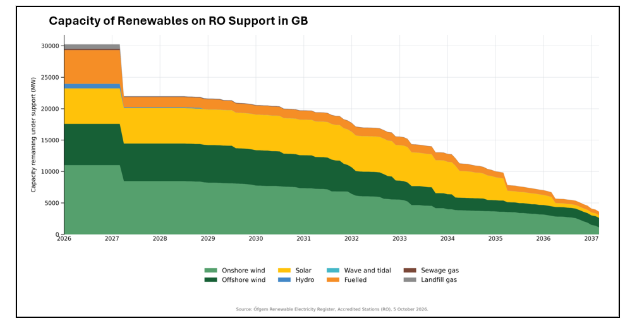
At the moment, outside of some projects which have been decommissioned, there will be a large 8.2 GW wave of projects rolling off the support scheme in March 2027. This includes a mixture of onshore wind, offshore wind, fuelled and hydro sites come out of the RO support scheme. That trend will continue and accelerate as more assets reach the end of their support periods, with the scheme fully winding down by 2037.
Looking at Ofgem’s data, which we have used to create the graph below, after the initial 31st of March 2027 drop, we see the volume of GB capacity leaving the support scheme really ramping up from 2029 onwards with about 1 GW leaving the support scheme in 2029 and 2030, roughly 2 GW leaving in 2031 and 2032, roughly 2.8 GW leaving each year from 2033 to 2035, 3 GW leaving in 2036 and nearly 4.1 GW leaving in 2037.
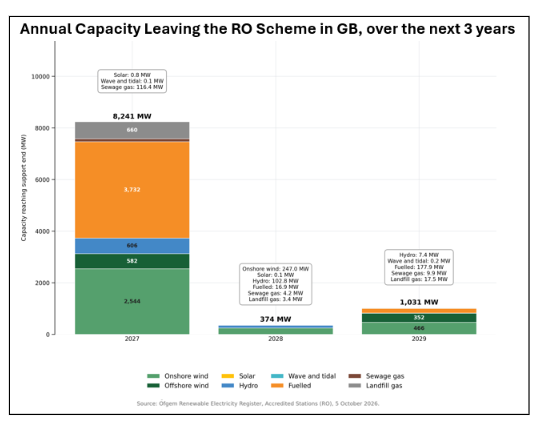
Focusing in on the the near-term outlook in the graph below, as mentioned above, 2027 will be the single largest year for assets coming off support, amounting to 8.2 GW of capacity ending its support, driven largely by fuelled technology and both onshore and offshore wind.
While 2028 is a modest year for sites leaving the support scheme in 2029 we expect to see just over 1 GW of assets leaving the support scheme, driven mainly by onshore wind, offshore wind and fuelled technologies.
The key question for renewable asset owners and generators is “what should projects do when they come off the RO scheme?” Like all big questions, there is no single answer. Each project and owner will have different commercial priorities, and what works for one asset may not work for another.
Key questions to consider:
- Has the asset paid off all debt?
- Is re-financing being considered?
- Are major investments needed to keep the asset operational?
- How do forecasted revenues across markets compare to your operating costs?
- Is the asset part of a wider portfolio? If so, how is that portfolio hedged and what is collective risk mandate?
For generators, the timing matters because route-to-market decisions often need to be made well before support ends. The earlier asset owners understand their future exposure, the more room they have to assess refinancing, reinvestment, hedging and offtake options.
Generators should engage early with an experienced offtaker with wide ranging and dynamic products that can help balance risk management, revenue certainty and value creation, to meet the individual needs of the asset.
EDF offers a range of PPA products to suit different asset strategies– including our Day-Ahead Linked, Fixed Price, and Choice PPAs that give generators options over when and how they hedge. For projects seeking greater market exposure, we also offer Flex PPAs that provide access to deeper trading opportunities through the trading of baseload blocks.
For projects seeking longer-term certainty, one of the more interesting developments in the market at the moment is the growing demand for operational assets in corporate PPAs (CPPAs). CPPAs were historically associated with additional or new build assets, but concerns around project delays, long duration contract commitments, and competition from the CfD are changing buyer preferences. Many large businesses are now actively seeking fixed-price CPPAs with operational assets on a 5 to 10 year basis.
As GB’s largest supplier to business customers, EDF is well positioned to help unlock that opportunity and connect suitable sites against corporate demand, creating value to both our generators and business customers, while simplifying the contracting process. Furthermore, our position as the largest supplier to business customers puts EDF in a strong position to add value to our generators through our Licence Exempt Supply propositions.
Whether you are considering a traditional PPA or a more bespoke route-to-market solution, speak to your EDF account manager or contact us at export@edfenergy.com to discuss your options.
When does RO support end?
RO support ends at different times depending on when an asset was accredited. Assets accredited before 25th June 2008 generally receive support until 31st March 2027, while later projects typically receive support for up to 20 years, subject to an overall scheme end date of 31st March 2037.
What happens when a renewable asset comes off the RO scheme?
Once RO support ends, generators no longer receive Renewable Obligation Certificates (ROCs) and must rely solely on market revenues and route-to-market arrangements. This makes power marketing, hedging and revenue optimisation increasingly important.
Can I still have a Power Purchase Agreement (PPA) after RO support ends?
Yes. A PPA remains one of the primary routes to market for operational renewable assets after RO support ends. Depending on your objectives, options may include fixed-price, market-linked, flexible or corporate PPAs.
Should I secure a new route-to-market agreement before RO support expires?
In many cases, yes. Route-to-market decisions often need to be made well ahead of support ending to allow time to assess market conditions, refinancing requirements, hedging strategies and commercial objectives.
Are corporate PPAs an option for operational assets?
Increasingly, yes. Many businesses are looking for long-term renewable power contracts from operational projects, creating new opportunities for existing renewable assets that are coming off subsidy support.
How far in advance should I start planning for life after RO?
There is no universal timeline, but asset owners should begin assessing their options well before support ends. Early planning gives more flexibility to evaluate PPAs, CPPAs, refinancing opportunities and risk-management strategies.
Will all technologies be affected by RO expiry?
Yes. Assets across multiple technologies, including onshore wind, offshore wind, solar, hydro, fuelled technologies and others, will progressively exit the scheme as support periods end.
What factors should asset owners consider when evaluating post-RO options?
Key considerations include outstanding debt obligations, refinancing plans, operational investment requirements, expected merchant revenues, operating costs, portfolio strategy and risk appetite.
Related articles

AR8: What Should Developers, Investors and Energy Buyers Expect from the UK's Next CfD Auction?

UK electricity demand: why it matters for business competitiveness and what must change
