
Powering the UK's digital future: getting data centre connections reform right
Contents
A strategic opportunity for the UK
What needs to change on connections?
Data centres can support a smarter energy system
Why this matters beyond data centres
How EDF can support data centre operators
Frequently asked questions
Artificial intelligence is accelerating demand for digital infrastructure. Governments, technology companies and investors are all competing to host and develop the data centres that will power AI services, cloud computing and an increasingly digital economy.
For the UK, this is a significant opportunity. Data centres can support economic growth and job creation, strengthen data security and sovereignty, and help support investment in new low-carbon energy infrastructure. The UK also has important strengths to build on, from strong international data connectivity (see table [1]) to a skilled workforce and established energy expertise.
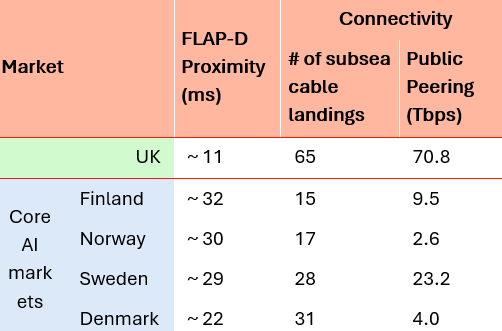
Table [1]: UK data connectivity in comparison to selected other markets. FLAP-D are Europe's five primary core data centre markets: Frankfurt, London, Amsterdam, Paris, and Dublin.
But there is a growing challenge at the heart of this opportunity: access to electricity. Power is no longer a supporting consideration for data centre development. It is becoming a strategic factor that can influence where projects are built, how quickly investment decisions are made, and whether developments progress at all.
As AI adoption grows and organisations process larger volumes of data, demand for computing power is rising quickly. That, in turn, is increasing demand for electricity and putting more pressure on an already constrained grid connection process and our evolving energy system.
Demand connection applications have increased from 41GW to 125GW in less than a year, largely driven by data centre developments (see chart [1]). Ofgem's Curate proposals are designed to address that rapid growth and ensure projects seeking grid access demonstrate a genuine commitment to delivery.
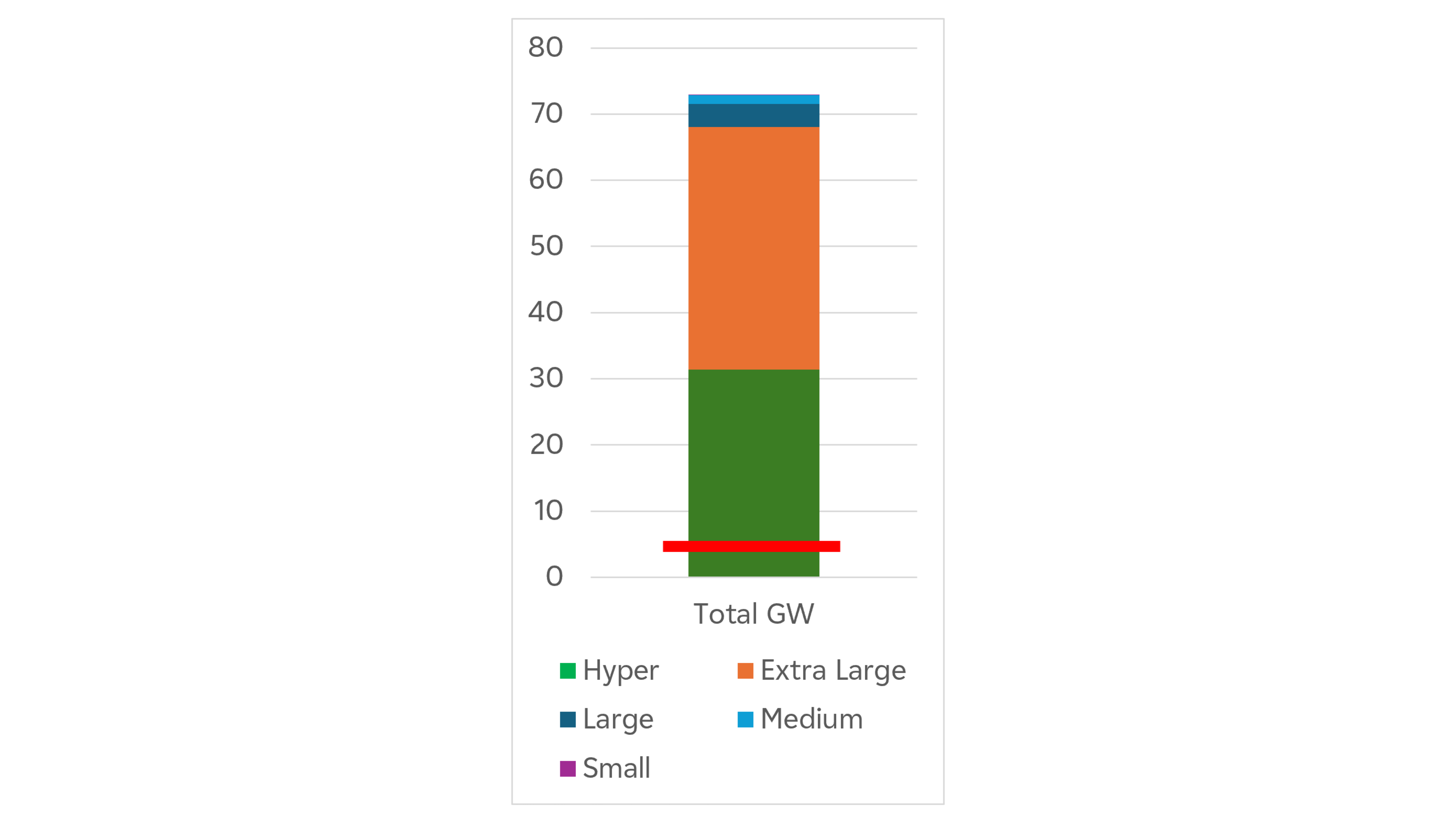
Chart [1]: Data Centre demand figures (GW) from Ofgem’s Curate consultation, ordered by size banding of Data Centre. Overlaid in Red is the 6GW minimum requirement by 2030 according to Government’s Compute Roadmap (July 2025).
We support the principle of Ofgem’s reforms. Projects that are unlikely to proceed should not occupy connection queue space alongside developments that are funded, credible and ready to move forward. A commitment fee could help reduce speculative applications and create a stronger signal of intent.
But the success of reform should not be judged only by how many projects leave the queue. The more important question is whether credible projects can progress on the timetable they need, with secure and deliverable connection dates and a wider energy system that can support them.
Make the commitment fee proportionate
There is a clear case for asking projects in the queue to show they are serious. A commitment fee could help reduce speculative applications and free up capacity for developments that are funded, credible and ready to progress.
But the level matters. If the fee is set too high, it risks becoming a barrier to genuine investment, especially where developers are already facing uncertainty over connection dates, network requirements and future costs. The aim should be to filter out projects that are unlikely to proceed, not make viable ones harder to deliver.
We believe the upper end of Ofgem’s proposed fee range (£240-710k per MW) is at high risk of producing an over-correction. A lower fee would be sufficient to incentivise project exits at this stage, and avoids adding unnecessary extra costs to development.
Do not penalise developers for delays outside their control
Any reform also needs to reflect what happens after a developer joins the queue. We know that under the current frameworks connection dates move, costs rise, and projects can become harder to deliver for reasons beyond the developer’s control.
Ultimately, what developers need are connection dates and costs that are committed and binding to send the right signals to investors. However, connections performance remains poor and unlikely to resolve in time to meet developer needs. Therefore, where delays or cost increases are driven by electricity network factors developers should have a fair route to exit without facing a termination fee. That would help make the process more balanced and give investors greater confidence.
There also needs to be stronger accountability for timely network delivery. If developers are being asked to provide substantial financial commitment, they also need confidence that connections are deliverable.
Shift the focus from managing the queue and back to delivering infrastructure
Connection reform should create greater clarity, not more uncertainty. The sector has already been through significant change, and investors need confidence that policy is moving in a stable direction.
Once the queue has been rationalised, the priority should be delivery: clear connection dates that are met, better coordination of network investment, more transparent information on infrastructure requirements, and faster resolution of barriers affecting credible projects.
Ofgem and Government need to ensure that any further interventions are only in support of project development.
The relationship between data centres and the energy system is also evolving. Data centres are large consumers of electricity, but they can also be part of a smarter, more flexible system if energy is considered earlier and more strategically.
- Long-term power purchase agreements can support investment in low-carbon generation and provide greater price certainty.
- Co-location with generation or storage can help optimise infrastructure and reduce pressure on parts of the network.
- On-site low-carbon energy assets, such as Battery Energy Storage Systems (BESS) can improve resilience and create additional flexibility.
- Demand flexibility can help align computing loads more closely with the availability of power, where operational requirements allow.
None of these options solves the connections challenge on its own. But they show why the debate should not only be about providing more power. It should also be about using energy more intelligently.
Ofgem's proposal is about more than connection queues. It reflects a broader shift taking place across the economy, as digitalisation, electrification and AI all increase demand for electricity.
Both the energy system and AI are becoming a more important enablers of growth and align with Government’s Modern Industrial Strategy. The ability to deliver power where and when it is needed will increasingly influence where investment is made.
The UK's challenge is not simply to manage rising demand. It is to make sure the right projects can move forward with greater speed and confidence. As the race to develop AI gathers pace, access to power will become one of the most important factors shaping where the next wave of digital investment goes. That makes the future of data centres a much bigger conversation about the future of the UK's energy system alongside other important topics such as energy prices.
If you are a data centre operator looking for support with a new connection or metering, energy supply, flexibility and optimisation, and if you are considering battery storage or generation associated with your data centre, get in touch to explore how EDF can help: letstalkpower@edfenergy.com
Frequently asked questions
What is Ofgem proposing for data centre grid connections?
Ofgem is considering reforms intended to ensure that projects seeking grid access demonstrate a genuine commitment to delivery. This includes a potential commitment fee designed to discourage speculative applications and help prioritise credible, deliverable projects.
Why is a commitment fee being considered?
Demand connection applications have risen from 41GW to 125GW in less than a year, largely driven by proposed data centre developments. A commitment fee could encourage projects that are unlikely to proceed to leave the queue, freeing capacity for funded, credible projects.
Does EDF support the proposed commitment fee?
EDF supports the principle of a commitment fee, but believes it must be proportionate and should accelerate viable projects rather than create another barrier to investment. The upper end of the proposed fee range, £240,000 to £710,000 per MW, risks producing an over-correction.
How can data centres support a smarter energy system?
Data centres can consider long-term power purchase agreements, co-location with generation or storage, on-site battery energy storage and demand flexibility. These approaches can support low-carbon generation, improve resilience and help make better use of available energy infrastructure.
How can EDF support data centre operators?
EDF can support data centre operators across new connections and metering, energy supply, flexibility and optimisation, as well as battery storage or generation associated with a development.
Related articles

Energy Roundup: October 2026

Why electricity prices spiked during the 2026 summer heatwaves
