
The Warm Homes Plan: why faster delivery is critical for consumer bills and the country’s energy security
The Warm Homes Plan is a £15 billion commitment to upgrade and electrify UK homes, cut energy bills and lift one million households out of fuel poverty. Without urgent action to accelerate delivery, the Plan risks stalling just as renewed instability in the Middle East and wider global uncertainty threaten household energy costs.
EDF’s Strategy and Policy team set out why faster delivery of the Warm Homes Plan is essential to cutting energy bills and strengthening UK energy security.


In this article:
- The Warm Homes Plan risks a delivery hiatus as supplier obligations end before new schemes are live
- Local authority delivery alone won’t scale fast enough without supplier support
- Energy suppliers are essential to joining up the full electrification journey, not just installation
- Future schemes must learn from what worked and what didn’t under the ECO scheme
From policy announcement to delivery challenge
Earlier this year the Government published its long-awaited Warm Homes Plan, a £15 billion programme to upgrade and electrify UK homes and lift one million households out of fuel poverty. The plan represents a significant shift in policy approach at a time where the importance of reducing energy bills and boosting energy security has never been so important for consumers given the potential implications for energy prices arising from the recent events in the Middle East.
Though a combination of grants, low or zero interest loans and regulation the Plan aims to make home energy improvements like solar PV, batteries and heat pumps widely accessible for all.
As a generator of zero carbon electricity and a supplier to five million customers, EDF is committed to delivering an electric Britain. Our mission is to help our customers save cash and carbon. Given the Plan’s similar commitment, there’s a lot for us to be supportive of.
We must act now and we must all work together to move the Plan off the page and start delivering real change for households through lower bills and reduced carbon. With this in mind we have set out four immediate priorities to help take the Plan forward.
Avoiding another delivery hiatus gap in the Warm Homes Plan — or everything else falls down
The Plan confirmed a major policy shift in how we support households: the end of supplier obligations as a funding and delivery method for retrofit, once the current schemes (ECO4 and GBIS) close at the end of this year. This marks a fundamental change in how we fund and deliver warmer homes.
Supplier obligations have been the pre-eminent means of funding and delivering energy efficiency and heating improvements for three decades, providing enduring bill and carbon savings for millions.
It will take time for the new programmes under the Plan to be set up, let alone be delivering at the scale envisioned. The first new low-interest consumer loans under the Plan are unlikely to be made to consumers until 2027. Decisions on the future design of capitals spending programmes are not expected until the end of 2026.
Most suppliers are, however, expected to have met their ECO/GBIS targets by the end of March 2026.
The biggest risk the Warm Homes Plan faces is, therefore, timing. The risk of a slow down or hiatus in delivery this year is very real. We are already seeing installers disappearing from the market. We can’t afford to lose more while they grapple with uncertainty. Supply chains weakened now will not be easy - or quick - to rebuild.
Given the ongoing events in the Middle East and the potential knock on impact on energy prices we cannot afford to slow down or stand still, now more than ever is the right time to build on the momentum left by the legacy of supplier obligations, delivering energy bills savings at scale and helping to shield customers from volatile international energy markets when they need it most. Customers can already save on average £530 per year from Solar PV1, this saving would only increase if energy prices were to rise. To ensure this momentum can be maintained, supply chain must be provided with the necessary certainty to continue to deliver at the scale needed.
At the same time, the Plan anticipates a major pivot toward local authority led delivery for low-income households - yet today, local authorities struggle to spend the funding already allocated to them. Around 43% of funding across current schemes goes unused and is returned to Government. Even the best-performing authorities leave around 20% unspent2.
Local authority delivery today is also regionally concentrated based on resource, expertise and political inclination, creating a postcode lottery for consumers. The regions with the highest concentration of fuel poverty have, for example, received on average half the funding of the most affluent areas under existing schemes.3
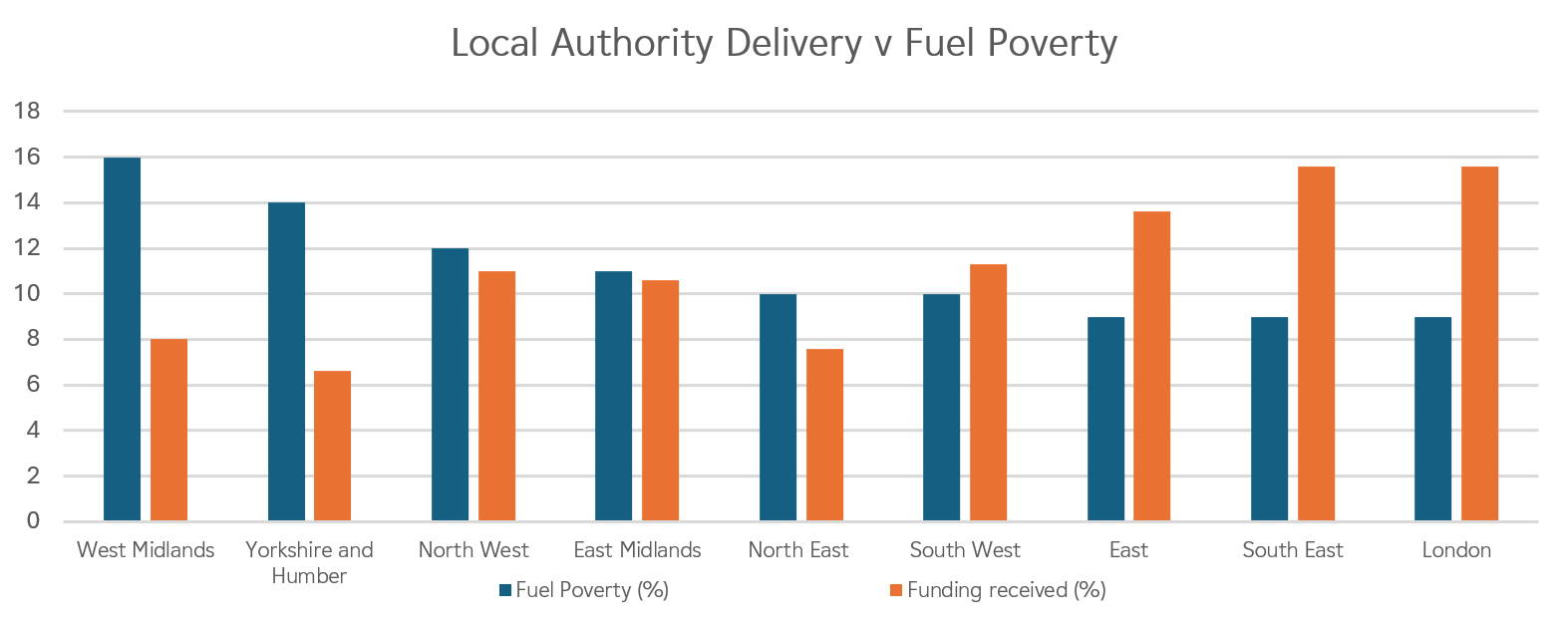
Data sourced from various reports from Department for Energy Security and Net Zero (see footer)
Scaling delivery rapidly under the new model will, therefore, require significant support to ensure local authorities can absorb increased funding, build capability and deliver consistently across the country. Energy suppliers stand ready to help. EDF already works in partnership with multiple local authorities and has end-to-end supply chains that can be deployed immediately to maintain momentum and prevent a damaging slowdown.
Working nationally is essential to deliver ‘an offer for everyone’
Recent events in the Middle East look likely to place further pressure on the cost of living for millions of British households - many of whom are still struggling with the debt legacy of Covid-19 and the last gas crisis leading to energy debt soaring north of £5.5bn4 and continuing to grow. Government also continues to have 2030 Clean Power and legally binding fuel poverty targets to meet.
The Plan commits to an ‘offer for everyone’ meaning every household regardless of income, tenure of property type, can access some form of support to upgrade their home’s energy efficiency. Given the scale of the challenge facing us, this offer is vital and urgent.
Local authorities will have excellent data on their own housing stock and residents in the social housing sector to help target funding on a street-by-street or local basis. But what about the Private Rented Sector (PRS) and Owner-Occupiers? It is worth remembering that only 155% of fuel poor homes in England are in the social housing sector.
For many better-off Owner-Occupiers, low-interest loans will be an attractive option - especially for interventions with good pay back periods like Solar PV and batteries. Yet loans are unlikely to be a suitable or attractive option for many low- and medium income homeowners, especially those already in energy debt.
Tighter Minimum Energy Efficiency Standards (MEES) will help improve the very worst privately rented homes but will by nature incentivise only the cheapest and easiest routes to compliance - which is unlikely to be heat pumps, for example.
To truly ensure the plan has an offer for all, Government should also commit to ensuring a national application route for accessing some of the £3bn of remaining capital support reserved for supporting low-income households by the Plan. Suppliers and other national organisations could then work with their customers, using their own unique data and insights, to help target support and reach those most in need. The Government already has an existing, highly successful operating model for such a scheme - the Boiler Upgrade Scheme (BUS) - that it could look to replicate and stand up quickly to support delivery ahead of winter.
Broadening delivery routes for fully funded measures, alongside an area/based approach, will better help to guarantee there are not gaps in support for households in or at risk of fuel poverty, on lower incomes, or those in debt and struggling to afford their energy bills.
Joining up the GB home electrification journey
The Plan is rightly focused on helping customers improve their homes and invest in measures to decarbonise and electrify their homes. Yet this is only part of a household’s electrification journey.
The Plan is light on how it will help ensure customers also have the smart meters, Time of Use tariffs and gas disconnections needed to maximise the impact and possible bill savings of any technologies installed. All jobs for energy suppliers. Yet, suppliers are mentioned just 5 times in the 100+ pages of the Plan.
Only energy suppliers can integrate the end-to-end electrification journey and deliver the ancillary changes that are needed if households are to maximise bill savings from new low carbon tech.
Further thought is needed as to how these parts of the customer journey will join up. Government and industry must work together to ensure electrification is coordinated from installation to end use.
What the Warm Homes Plan must learn from ECO
We are proud of the impact that supplier obligations have had, and the millions of homes they have helped to improve and lift out of fuel poverty.
Looking forward they also offer the Plan a number of important lessons for future scheme design, that must not be forgotten.
Key to the success of supplier obligations was the fact they guaranteed delivery. If suppliers did not meet their targets, they risked getting fined. The design of both local authority delivery and minimum energy efficiency standards must learn from this and address how you guarantee and enforce delivery.
Conversely, over time supplier obligations became increasingly complex – often for very well-meaning reasons. However, this complexity came at a cost. Complex eligibility criteria for measures and consumers resulted in more and more of the schemes budget being spent on overheads and administration, rather than installing measures. The BUS again offers an alternative, simpler model schemes can learn from.
We must also urgently follow through on the Plan’s commitment to improving the quality and assurance landscape. One of the big mistakes with the design of the current supplier obligations was the over reliance placed on an untested and immature framework to deliver quality. The north star must be a single quality accreditation and independent redress scheme which is assured and legally enforceable and that applies regardless of how a measure is financed.
The Warm Home Agency has a massive task on its hands getting this house in order. Improvements will not happen by themselves, it will require significant political will, commitment and likely legislative time and resources to drive meaningful change.#
Conclusion: move the Warm Homes Plan from policy to delivery
The Warm Homes Plan is an exciting opportunity to do something different and better at a time when tackling rising energy bills is once again front and centre.
We must remember that the Plan itself was never the end goal. Rather, it’s a launch pad to help millions of struggling households reduce their bills and their carbon emissions — through warmth and electrification.
The hard work begins now.
FAQS
What is the Warm Homes Plan?
The Warm Homes Plan is a £15 billion government programme designed to improve energy efficiency, accelerate home electrification, cut bills and reduce fuel poverty across the UK housing stock.
Why does delivery speed matter?
Delays risk higher energy bills for households, the loss of installer capacity, and missed clean power and fuel poverty targets. A slowdown would also weaken supply chains just as global energy price volatility increases the need to protect consumers.
How does the Warm Homes Plan help cut energy bills?
By improving insulation, electrifying heating, and enabling smarter energy use and improving insulation , the Plan can deliver lasting bill savings while reducing exposure to volatile wholesale energy prices.
What is the ECO scheme?
The Energy Company Obligation (ECO) was a government scheme that required energy suppliers to fund energy efficiency improvements, such as insulation and heating upgrades, for households on lower incomes or in fuel poverty and due to end this year.
What is the GBIS scheme?
The Great British Insulation Scheme (GBIS) was a UK government programme that offered free or subsidised insulation measures to eligible households, helping to reduce energy waste and lower bills. Like ECO, the scheme is scheduled to close this year.
1 Energy Saving Trust and Government announcement roof-top solar
2 Green Homes Grant Local Authority Delivery (LAD) and Home Upgrade Grant (HUG) release, November 2025 and Social Housing Decarbonisation Fund statistics: January 2026
3 Social Housing Decarbonisation Fund statistics: August 2025 and Sub-regional fuel poverty in England, 2025 report (2023 data) - GOV.UK
4 Energy UK raises alarm over £5.5 billion energy debt crisis
5 Improving the energy efficiency of socially rented homes in England - GOV.UK
Related articles

Why distribution network investment matters for affordability and energy security

What more needs to be done to tackle persistently high energy bills?
