Your business, powered differently: A simple guide to battery storage
Why small businesses are exploring battery storage
Earlier this year, we carried out a detailed survey of 300 small businesses across the UK to understand their priorities, challenges and interest in low carbon technologies. The results show that battery storage is becoming an area of growing curiosity, even though many businesses are still at the early stages of understanding how it works.
Here is what the survey revealed:
• 50.7% of small businesses have already considered pairing a battery with solar
• 66% say they have space for an on-site battery
• Only 10.7% have installed one so far, but 23.3% plan to do so in the next six months
• Awareness of grants and schemes that support battery adoption remains low
Explore sustainability grants here.
These insights show small businesses see the potential in battery storage, with many preparing to take their first steps. This guide is designed to give you a simple and practical introduction.
What is battery storage?
Battery storage is a system that lets your business store electricity and use it later. It can work with or without solar panels by storing energy when it is cheaper or when your panels generate more than you need. You can then use that stored energy when your business needs it most. Battery storage can be especially effective for a small business on a time of use tariff which we’ll explore later in this blog.
How battery storage can help your business
Battery storage gives your business more control over when and how you use electricity. Space is often the first question for many small businesses, but our survey shows that most sites can comfortably accommodate a battery. In fact, 66% of businesses said they have room for one, but battery sizes can vary significantly based on their capacity. Generally, a 10 kWh battery (suitable for a small shop or office) is comparable to a small suitcase or wall-mounted cabinet, while a 50 kWh battery system (suitable for a large hotel or warehouse) usually consists of multiple stacked modules or a large, floor-standing cabinet. A 50 kWh system can measure around 1500–2000 mm high and weigh over 500 kg. Battery storage offers several practical benefits, especially for small businesses managing rising energy costs and sustainability goals.
- Reduce energy costs: stored electricity can help you lower the amount you buy during higher cost periods. If you fill your battery storage with cheap off-peak electricity and use it when energy prices are higher this can give your business a competitive advantage. This is one of the reasons many small businesses are exploring battery storage. In the survey, 23.3% of businesses said they plan to install a battery within the next 6 months, which shows how important cost confidence has become.
- Improve energy resilience: a battery can support the equipment your business depends on. It helps keep essential systems running during short interruptions and adds an extra layer of protection. Only 10.7% of businesses have installed a battery, but the growing interest shown in the survey shows that energy resilience is becoming a rising priority.
- Boost sustainability: battery storage helps your business use more clean electricity on site. This is especially valuable when combined with solar. The survey highlighted a strong interest in this pairing, with 50.7% of businesses already considering adding a battery when looking at solar.
- Gain more control over energy use: the survey shows that businesses want to manage their energy more confidently and reduce exposure to higher cost periods. Motivations such as long-term cost savings after breakeven were rated very strong or strong by 80.3% of respondents, which reflects a clear desire for more control over when and how electricity is used. Battery storage helps meet this need by making stored energy available when it benefits the business most.
- Support long term cost stability: many businesses are motivated by the opportunity to optimise spending. In the survey, 24.3% rated reinvesting profit to optimise costs as a very strong motivator and 51.3% rated it strong. Battery storage supports these aims by allowing businesses to shift more of their usage to lower cost or self‑generated electricity, helping create steadier long term energy costs.
Battery options available to small businesses
Small businesses have access to several practical battery and inverter combinations that can support different levels of storage, flexibility and scalability.
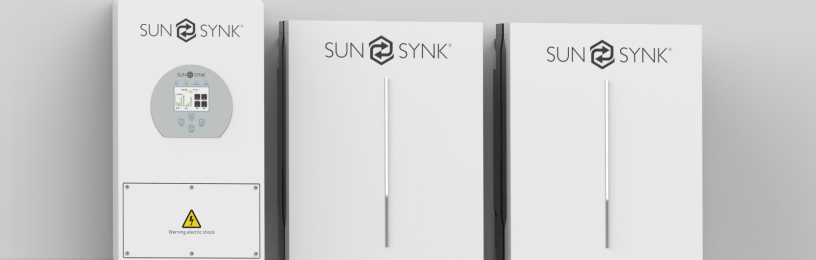
Sunsynk hybrid inverter and battery systems
Hybrid systems combine an inverter and battery to help manage both solar generation and stored energy. Options include 3.6 kW, 5 kW, and 7 kW hybrid inverters alongside 5.32 kWh and 10.64 kWh battery units. They offer a practical, good‑value solution for sites looking for a flexible setup that supports both solar generation and stored energy. These systems are modular, meaning you can increase storage capacity as your energy needs grow.
Tesla Powerwall 3 integrated system
For businesses wanting a streamlined, all‑in‑one unit, the Tesla Powerwall 3 integrates the inverter and battery into a single product. It offers up to 13.5 kWh of storage, off‑grid capability and can be installed indoors or outdoors. With a ten‑year manufacturer warranty, it offers a robust and well‑recognised option for businesses looking for long‑term reliability.
How battery storage works alongside solar
Solar panels often generate more electricity than a business needs at any given moment. Instead of sending that unused energy back to the grid, a battery can store it so it’s available later in the day when demand increases. This helps businesses make better use of the clean electricity they generate on site and improves overall energy efficiency.
A battery storage system can also be added to an existing solar setup at any stage, giving businesses the flexibility to adapt their energy systems over time. Whether installed alongside new solar panels or integrated into an established system, battery storage allows more of the energy generated onsite to be used when it’s needed most.
How battery storage works with time of use tariffs
Some electricity tariffs offer lower prices at certain times of day. A battery can help your business store electricity during these lower priced periods and use it later when costs rise. This gives you more control without changing how your business operates.
The survey shows that many businesses place strong importance on long term cost reduction and better energy management, which aligns closely with how battery systems can support smart tariff use.
Is battery storage right for your business?
Battery storage is flexible and can support many types of organisations. It suits business types that use energy outside daylight hours, rely on equipment that needs steady power or want to make better use of a solar installation.
Space is rarely a barrier as shown in the survey. If you want to stabilise your energy costs, modernise your setup or make progress toward your sustainability goals, battery storage can be a strong and practical next step.
Battery storage is becoming a valuable tool for small businesses looking to save money, improve resilience and increase sustainability. With growing interest and more options than ever before, storage can help businesses manage energy more confidently and prepare for the future.
Ready to explore how battery storage could work for your business? Find out more here.
Related articles


