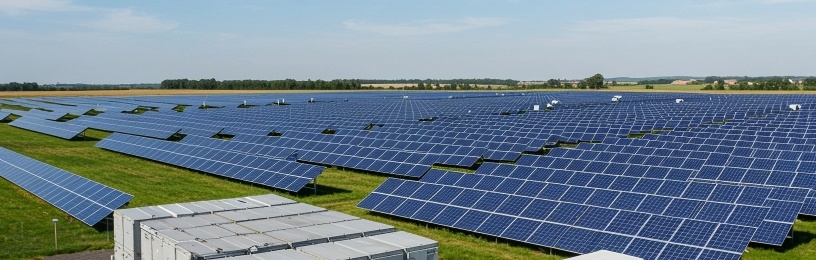
The power of co-location: Accelerating an integrated energy system
As the UK energy system evolves to meet ambitious decarbonisation targets, the need for smarter integration of renewable energy and flexible assets is more urgent than ever.
One strategy is quietly gaining momentum: co-location. By pairing renewable generation, like wind and solar, with battery storage and other flexible technologies on the same site, co-location offers a smarter, faster route to a resilient, low-carbon energy future.
What is co-location?
Co-location refers to the development of multiple energy technologies - typically renewables and storage - behind a shared grid connection point. Most commonly, solar PV is co-located with a Battery Energy Storage System (BESS) as they have complementary generation profiles - solar exporting during the middle of the day, whilst a BESS imports earlier in the day and exports later in the day.
Co-location of other technologies is possible; wind farms and BESS have been co-located in the UK, and in the future, we can expect technologies such as wind farms, solar PV, hydrogen electrolysers, data centres and BESS all to be co-located in different configurations.
In the UK, only around 12% of onshore renewables are currently co-located - a figure that must rise if we’re to meet our clean power ambitions.
Why co-location matters
Co-located projects are particularly important because both new renewable generation and new BESS capacity are essential to support the UK’s energy transition and clean power targets.
To meet the UK’s net zero targets, renewable capacity needs to triple by 2050, and every new megawatt must be generated from clean sources by 2035. This is linked to the need for low-carbon generation and the expected increase in electricity demand from the transport and heating sectors.
Battery energy storage must scale as fast as - if not faster than - renewable generation to unlock the full value of clean power. Without sufficient storage, surplus solar and wind output during peak periods risks being curtailed, forcing the grid to rely on more carbon-intensive sources such as a gas power station. By capturing and shifting renewable energy to when it’s needed most, BESS plays an essential role in balancing supply and demand.
National Grid has signalled the need for 23-27GW of battery storage by 2030 to support net zero - this is around four times today’s installed capacity. BESS can absorb surplus generation and release it when prices spike, helping stabilise the market while unlocking new revenue streams.
The benefits of co-location
Let’s take a look at some of the key benefits of co-location, both environmental and economic.
- Boosts system flexibility: Combining generation with storage helps balance supply and demand locally, reducing curtailment and enhancing system stability and resilience.
- Cuts costs: Shared land, infrastructure and operations lower capital and operational expenses.
- Speeds up grid access: Co-located projects facilitate faster connections, mitigating long connection queues faced by standalone assets. Co-location requires only a single connection for multiple assets, meaning several assets can be developed together without having to wait for a second connection - some storage and renewables assets are facing a wait for a grid connection beyond 2030. Co-location reduces time to connection whilst alleviating pressure on the National Grid.
- Supports merchant resilience: Hybridisation helps mitigate price cannibalisation and negative pricing risks, especially for older RO and CfD sites.
A co-location success story: Bramley
The Bramley project, located in Tadley, Hampshire, is a flagship example of this principle in action. This co-located project, developed by Enso Energy, sponsored by Cero Generation and optimised by EDF, brings together a 57MW, 2-hour duration battery energy storage system (BESS) with 114MWh capacity and a 49.9MW solar PV array in an AC-coupled, co-located configuration, directly connected to the Transmission network through a 57MW connection.
The solar PV was awarded a Contract for Difference (CfD) in the recent AR6 auction. The PV will have export priority, requiring the BESS to dynamically adapt around the solar generation profile, given the oversizing of the assets versus the export connection capacity.
With an annual expected generation of 60,000MWh, the site will power over 22,000 households, demonstrating what can be achieved when generation and storage are co-optimised, not just co-located.
What are the challenges with co-location?
Despite its potential, only ~12% of UK onshore renewables are co-located. Key barriers include:
- Optimisation of Revenues: Oversizing of assets, as is common in co-location, requires complex and bespoke optimisation rules to be built. Asset owners must ensure they partner with an optimiser who is able to successfully monetise this complex asset class.
- Delays: Developing a site with two technologies being built in parallel can cause delays to commissioning dates due to more complex construction, testing and energisation requirements.
- Market misalignment: CfD and RO schemes lack incentives and clear design pathways for hybrid assets.
- Planning/regulatory hurdles: Onshore wind faces stricter planning regimes than solar
- Technical complexity: DC-coupled sites face metering and compliance issues, limiting REGOs and standardisation.
The future of co-location
The future of co-location lies in diversification and scale. Today, solar and battery dominate because of their natural pairing, but developers are beginning to explore wind-battery projects and even wind-hydrogen integration.
As metering reforms enable DC coupling of assets and infrastructure for hydrogen maturity, co-location will expand across technologies. At the same time, the rise of gigawatt-scale battery parks and debt financing will increase the need for contracted revenues, driving further innovations in commercial structures from optimisers and offtakers.
Co-location is evolving from a cost-saving measure into a cornerstone of integrated, flexible energy systems.
Related articles


Utilita and EDF expand partnership to deliver battery management services for business customers
