Clean Flexibility Roadmap
From vision to action
On 23 July 2025, the UK government, Ofgem and the National Energy System Operator (NESO) published the Clean Flexibility Roadmap – the first jointly developed strategy to unlock flexibility across Britain’s electricity system.
The roadmap matters because it doesn’t just set targets, it provides a coordinated plan to deliver them. It gives the whole sector a clearer view of where we’re going, what needs to happen, and who is responsible for making it real.
We’re supportive of this direction. The roadmap closely aligns with our priorities – not just around technology and innovation, but in how we support customers to generate, use and manage energy more intelligently. In our latest PowerCast episode, we unpacked what the roadmap means for households, businesses and the wider system.
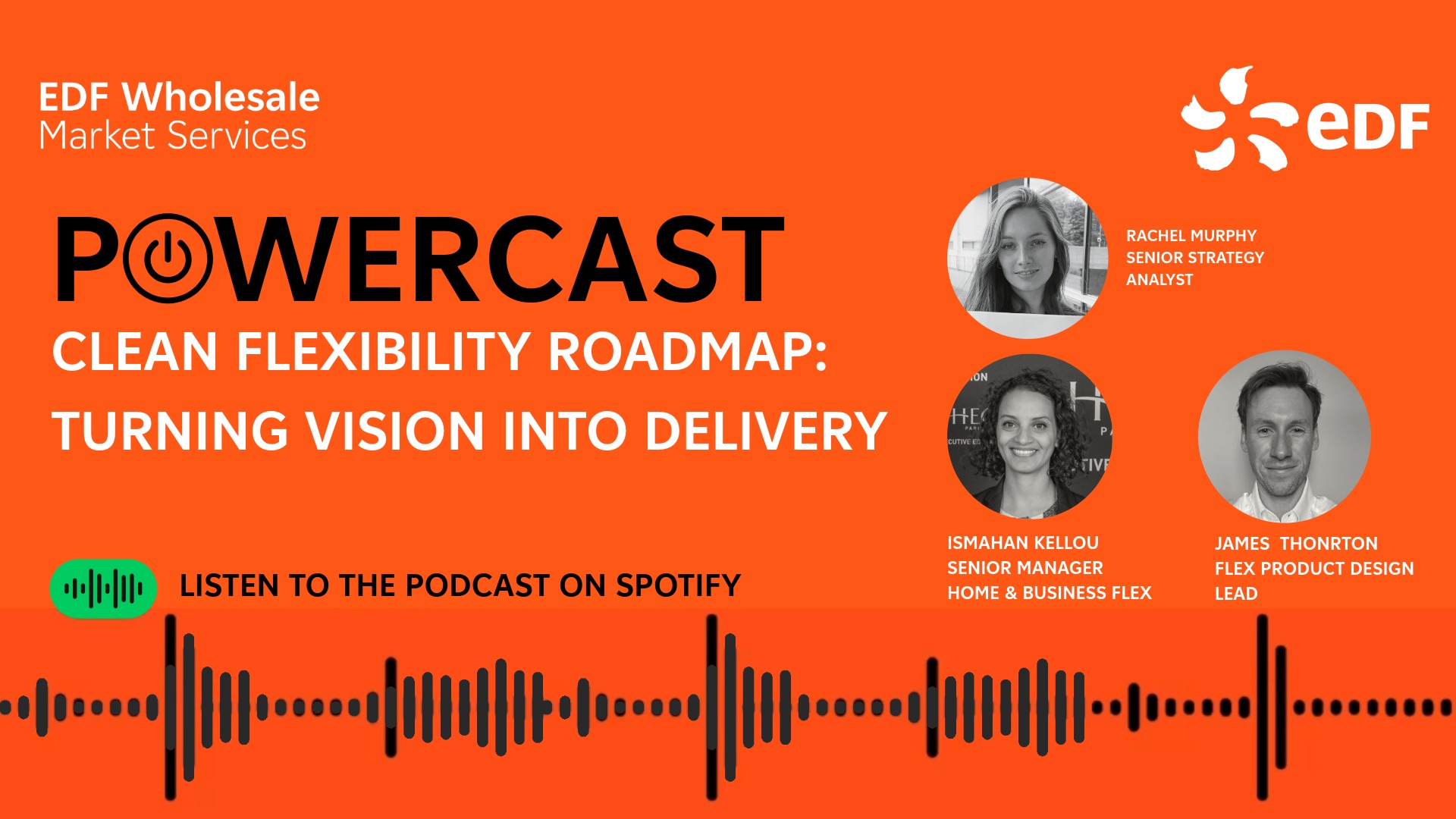
🎧 Listen to the full PowerCast discussion here
What is the Clean Flexibility Roadmap?
The roadmap sets out a shared vision for a clean, flexible and consumer-focused electricity system. Put simply, clean flexibility means shifting when or where electricity is produced or used to reduce costs and carbon emissions.
It focuses on four key areas:
- Short-duration flexibility – from seconds to hours: consumer-led flexibility, grid-scale batteries, interconnectors
- Long-duration flexibility – from multi-hour to seasonal: large-scale storage, dispatchable low-carbon generation
- Cross-cutting enablers – markets, networks, digitalisation, planning, supply chains
- Governance and delivery – clear responsibilities, milestone tracking, accountability
Why it matters: scale, impact and delivery
The scale of ambition is significant – and backed by delivery plans.
- Clean flexibility capacity is expected to grow eightfold between 2024 and 2050
- Grid-scale batteries are projected to rise from around 7 GW today to 40 GW
- Consumer-led flexibility could reach 75 GW, including 40 GW from technologies like vehicle-to-grid
This level of flexibility offers big benefits:
- For households – savings of over £200 a year by shifting usage and using smart tariffs
- For businesses – lower energy costs through load shifting, on-site optimisation and trading flexibility back to the grid
- For the system – reduced need to overbuild infrastructure, with an estimated £70 billion in system savings by 2050
To achieve this, the roadmap goes beyond vision. It sets out ownership, deadlines and delivery actions – a critical step in building investor confidence and unlocking private sector momentum.
Challenges to overcome
The roadmap also tackles the practical blockers to large-scale deployment – many of which we see every day in our work with customers.
- Grid connections and planning – Delays in securing grid access or planning approval remain a major challenge. The roadmap calls for reforms to metering, connection and registration to make it faster and clearer for projects to proceed.
- Market access and revenue stacking – Many flexible assets struggle to access consistent, transparent value streams across wholesale, balancing and local markets. The roadmap aims to address this with clearer market design and support for revenue stacking.
- Digital infrastructure and consumer engagement – To unlock mass flexibility, the system needs interoperable platforms, reliable data sharing and simple, user-friendly ways for customers to participate. Building trust and engagement at scale will be essential.
- Finance and supply chains – Long-duration technologies like hydrogen and thermal storage are still emerging, and carry risk. The roadmap suggests blended finance models and coordinated supply chain support to accelerate development.
How EDF WMS supports the roadmap
Our mission in Wholesale Market Services (WMS) is to lead the transition to net zero by delivering unmatched Route-to-Market services, market-leading trading and forecasting solutions, and empowering our customers to create transformative energy propositions.
In our PowerCast discussion, EDF experts explored how we’re already helping to deliver against the roadmap’s goals:
- Opening access to flexibility markets – As Britain’s largest Route-to-Market provider, and one of the first Virtual Trading Parties and Virtual Power Plant operators, we enable customers previously excluded from participating.
- Supporting revenue stacking – Our market-leading trading and forecasting expertise helps businesses capture value across wholesale, balancing and ancillary markets.
- Scaling clean flexibility – As the UK’s largest optimiser of grid-scale batteries, and a leader in the co-location market, we’re actively growing system flexibility and safeguarding asset longevity.
- Optimising behind-the-meter flexibility – Through our Powershift platform, we connect EV chargers, heat pumps and residential batteries to electricity markets. This reduces costs, lowers carbon emissions, and rewards customers for flexible energy usage.
- Powering renewables investment – As Britain’s largest buyer of renewable energy through PPAs, we provide revenue certainty that supports new renewable capacity and underpins the flexibility the roadmap depends on.
- Influencing policy and regulation – We engage in roadmap implementation planning to ensure infrastructure, protocols and rules enable long-term success.
What comes next
This roadmap is not a one-off publication. It’s a live programme of work. A governance framework has been created to track progress, adapt actions, and raise ambition where needed.
In the months and years ahead, we expect:
- Regular roadmap forums and industry feedback loops
- Updates to reflect new technologies and consumer behaviours
- Ongoing collaboration between government, regulators and industry
Flexibility is no longer a niche – it’s central to reaching net zero.
We’re entering a new era of opportunity, and EDF is committed to being a trusted delivery partner. With our scale, capability and unmatched market access, we will continue to deliver meaningful value for customers, businesses and the electricity system.
🎧 Listen to the full PowerCast discussion here
📄 For those wanting to read the full Clean Flexibility Roadmap, it is available on the UK Government website.
Related articles

Unlocking Domestic Flexibility at Scale

