Nuclear Enabled Hydrogen Handbook
A guide for operators and developers

The Nuclear Enabled Hydrogen Handbook was written by EDF in collaboration with United Kingdom National Nuclear Laboratory as part of the Bay Hydrogen Hub project.

This project has received funding from the government’s £1 billion Net Zero Innovation Portfolio, which provides funding for low-carbon technologies and systems. Decreasing the costs of decarbonisation, the Portfolio will help enable the UK to end its contribution to climate change.
Nuclear Enabled Hydrogen Handbook
A guide for operators and developers
The Nuclear Enabled Hydrogen Handbook was written by EDF in collaboration with United Kingdom National Nuclear Laboratory as part of the Bay Hydrogen Hub project.
This project has received funding from the government’s £1 billion Net Zero Innovation Portfolio, which provides funding for low-carbon technologies and systems. Decreasing the costs of decarbonisation, the Portfolio will help enable the UK to end its contribution to climate change.
Nuclear Enabled Hydrogen can deliver a 20-30% improvement in the efficiency of hydrogen production*
Cost to modify a nuclear power station to enable hydrogen production is estimated at 7% of the total H2 project
Utilising nuclear energy for hydrogen production could play a key role in driving down the cost of clean hydrogen for UK industry.

Innovative: Low-carbon hydrogen production through electrolysis is a key clean energy transition technology.

Enabling: Heavy industries and hard to abate transport sectors can shift energy use from fossil fuel sources.

Cost effective: The combination of nuclear energy with a solid oxide electrolyser cell can produce hydrogen at a lower cost than other technologies.
Bringing Nuclear Enabled Hydrogen to life
As part of the Bay Hydrogen Hub project, EDF and its partners have developed an operators and developers guide guide to integrate a nuclear power station with a solid oxide electrolyser fuel cell. A practical guide that will give developers a head start.
This handbook covers: proposed site design, safety, regulatory engagement, business case, economics and case studies.


"Nuclear Enabled Hydrogen could significantly reduce the cost of clean hydrogen for UK businesses. With the release of our handbook, we demonstrate how it can be delivered safely, efficiently, and at scale. We welcome discussions with developers interested in the potential of this technology."
Rachael Glaving (UK Business Development Director)
Why Hydrogen?
Hydrogen is seen as one of the key decarbonisation solutions, especially in hard-to-electrify sectors - heavy industry, long-haul transport and high temperature processes.
Hydrogen can enhance resilience and flexibility of the future energy system.
Why SOEC?
Solid Oxide Electrolyser Cell (SOEC) is a high temperature technology that reduces the amount of electricity required to produce a unit volume of hydrogen by 20-30% compared with low temperature electrolyser technologies.
Why Nuclear?
A nuclear station can offer stable and consistent low carbon electricity and heat. Heat integration enhances SOEC efficiency by reducing electricity demand. Nuclear energy enables the production of low carbon hydrogen (20gCO2/MJ HHV).
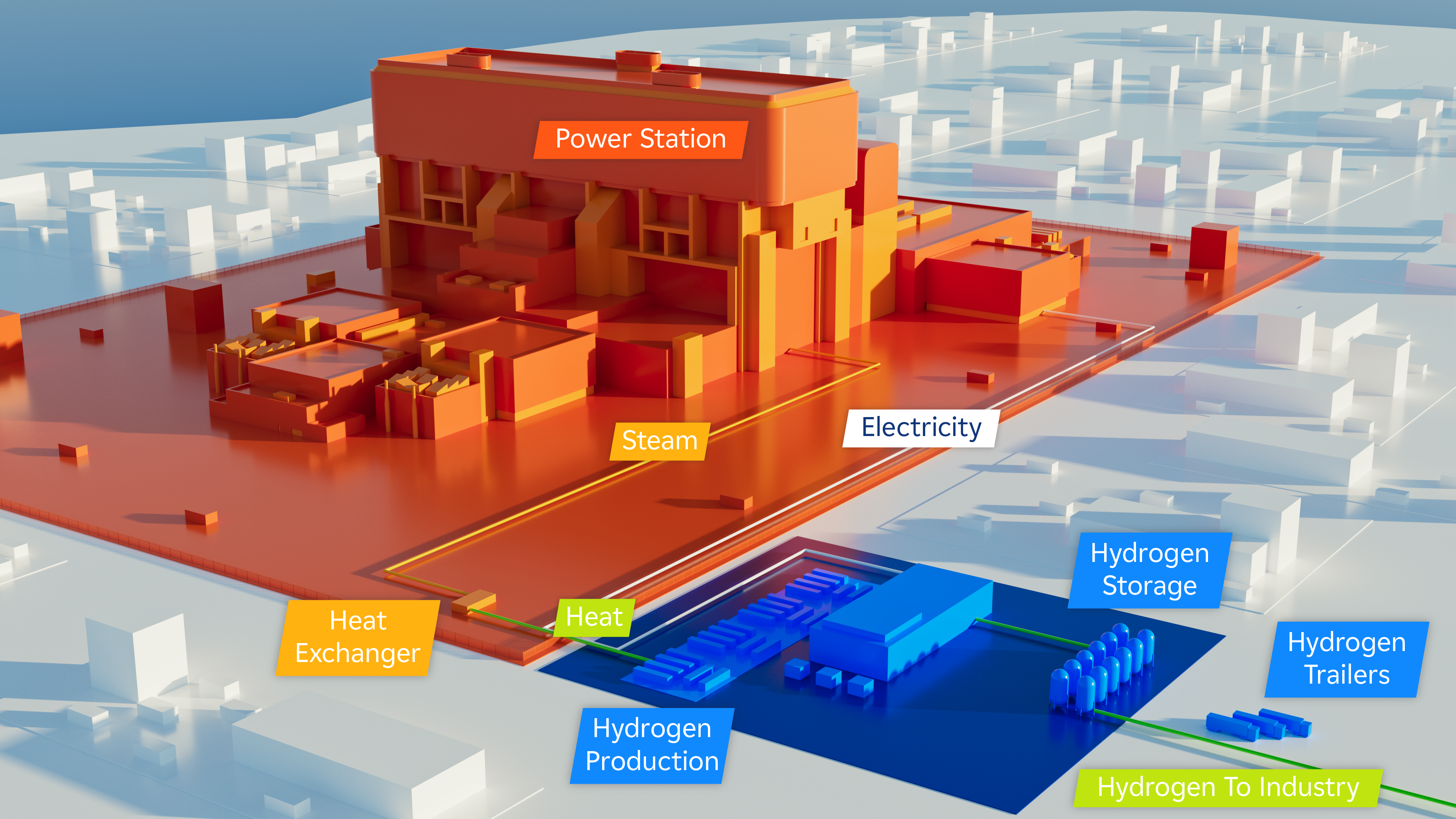
Integration of nuclear, hydrogen production, storage, transport and end use
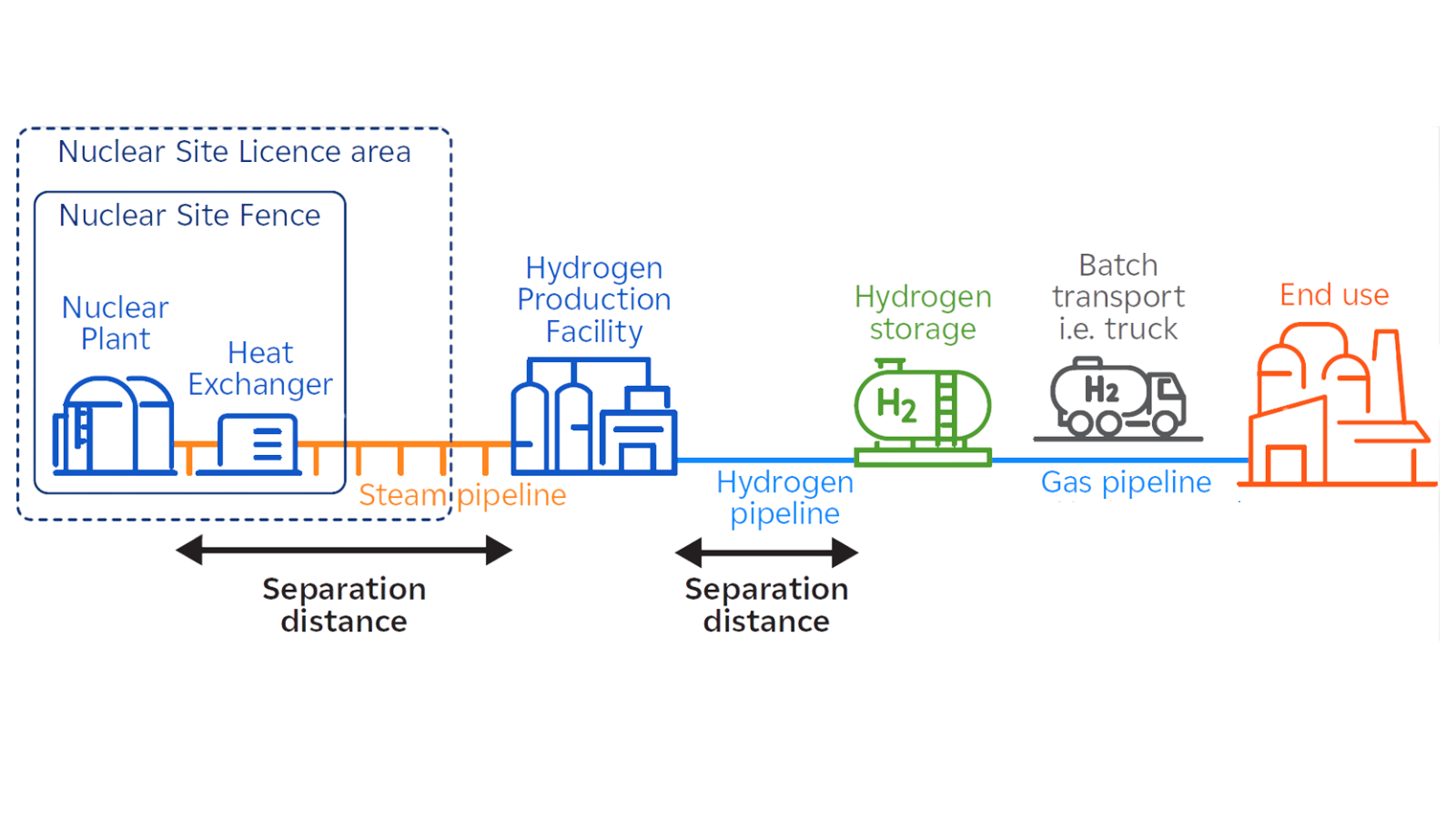
Separation distance
A small separation between the nuclear power station and hydrogen production and storage can significantly reduce the complexity of the safety case.
For a 24MW plant, the electrolysers could be sited 15-20m away from the nuclear site fence. Storage may require 50-150m distance, depending on the storage pressure.
Levelised cost of hydrogen (LCOH)
Off-takers’ hydrogen requirements significantly influence the total Levelised Cost of Hydrogen (LCOH). Waterfall chart illustrates step by step how the additional equipment increases LCOH due to capital expenditure, electricity consumption and fixed operating expenditure. Compressors have the highest impact on LCOH. These costs have been calculated based on a first-of-a-kind plant scenario.
This analysis uses actual power prices from 2023/24 where applicable, and demonstrates a 25–35% reduction in the LCOH compared to prices from the first round of the Hydrogen Business Model.
Key messages
The handbook offers comprehensive guidance on integrating nuclear and solid oxide electrolyser technologies, covering everything from proposed site design and safety considerations to regulatory engagement, business models, economic analysis, and real-world case studies.
Overview of a plant design concept:
- Nuclear enabled hydrogen can deliver a 20-30% improvement in the efficiency of hydrogen production. The 30% efficiency gain is achieved when heat in the form of steam is extracted from the power plant’s steam cycle and supplied via a heat exchanger to the electrolyser.
- Nuclear plants provide reliable clean electricity, enabling hot standby for the solid oxide electrolyser cell to support flexible operation.
- Heat is conveyed via a heat exchanger within the power station’s site boundary, with steam kept within the nuclear licensed site and heat transferred using an intermediate heating loop.
Front-end design information:
- Solid oxide electrolyser cells and supporting systems can be integrated with heat and power supplies from the power station.
- Information such as block diagrams, plant layouts, and other technical information has been included within the handbook.
Supporting safety and security assessments:
- For a 24MW plant, solid oxide electrolyser cells could be sited 15-20m from the nuclear site fence, with storage slightly further away (50-150m) depending on storage pressure.
Nuclear safety strategy case strategy:
- A relatively small distance between the nuclear power station and hydrogen storage reduces safety case complexity.
- Existing nuclear power station practices are suitable for the nuclear enabled hydrogen facility.
- Off-site hazards from nuclear enabled hydrogen facility should be treated as industrial hazards in the reactor safety case.
Nuclear site license impact:
- Hydrogen production and storage sited outside the nuclear site license area enables much of the project to treated like any other hydrogen project, minimising additional nuclear requirements. This minimises the impact on the nuclear power station’s site licence condition compliance arrangements.
- As the nuclear enabled hydrogen facility is outside the fence, it would be regulated by the Health & Safety Executive. The Office for Nuclear Regulation would regulate activities within the nuclear site.
Regulatory engagement:
- The nuclear enabled hydrogen facility should engage with Health and Safety Executive and the appropriate environment agency; the nuclear power station should engage with Office of Nuclear Regulation.
- Early engagements are recommended.
Obtaining planning permissions:
- Projects must demonstrate positive contribution to national policy objectives in planning applications.
- There is hydrogen technology-specific national policy statement; under EN-6, developers must be aware of licensed reactor designs deployable to market and permissible geographical locations for nuclear enabled hydrogen.
How a project could be delivered:
- It is recommended to establish a dedicated entity to deliver a nuclear enabled hydrogen facility, involving coordination among the nuclear power station, off-takers, distributors, landowners, funders and developers.
- Indicative cost for 24MW concept: £88 million** (£82m the facility, £6m power station modifications), with potential cost reductions based on off-takers' requirements.
- Indicative timeline for the project: 36 months**.
Commercial analysis:
- Nuclear enabled hydrogen can provide reliable, low-cost and low-carbon hydrogen (LCOH: £6-7/kg H2) by using high-temperature electrolysers instead of low-temperature ones with potential cost reductions through economies of scale, supply chain improvements, and production optimisation.
- The costs for the nuclear plant modifications is estimated to be a small proportion (less than 7%) of total costs**.
Impact of scaling up by four times to a 96 MW electrolyser:
- Consider pre-installing additional penetrations or larger pipe tunnel for easier scale-up.
- Multiple smaller heat exchangers or single large exchanger are viable options based on land availability and power station layout.
- Multiple smaller compressors could reduce upfront capital expenditure and operating temperatures, providing safety benefits.
- Location of hydrogen storage within nuclear enabled hydrogen facility should consider future scale-up impact on separation distances to the nuclear power station and other equipment.
- Scaling up nuclear enabled hydrogen facility may require additional assessment of impact on the nuclear power station due to higher electrical and heat load.
Future opportunities for NEH:
- Nuclear enabled hydrogen has global potential to help decarbonise industry, with UK applications detailed in the handbook.
- Advanced modular reactors with higher temperature outputs offer potential for efficiency gains.
Hydrogen Handbook download
Contact us
Please get in touch if you would like to know more.
*Based on existing technologies and costs in December 2024
**Based on calculations estimated in December 2024
The successful delivery of this Nuclear Enabled Hydrogen Handbook was made possible with funding from the Department for Energy Security and Net Zero through its Industrial Hydrogen Accelerator Programme, part of the Net Zero Innovation Portfolio.