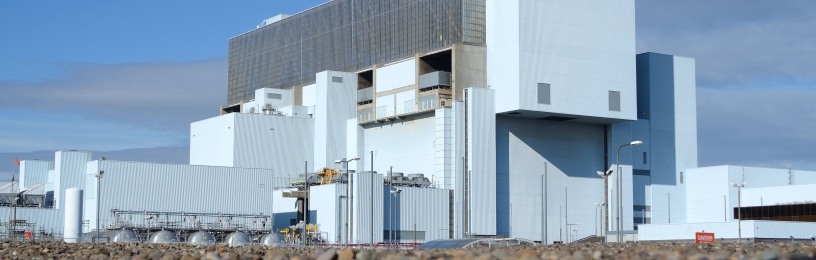
Torness achieves significant generation milestone
Torness power station has consolidated its place as Scotland’s most productive low carbon asset by reaching the milestone of 300TWh (Terawatt hours) of electricity generation.
That is enough to power every home in Scotland for 36 years, almost the same number of years the station has been generating for.
The station, which is Scotland’s last operating nuclear power station, clocked up the achievement last week. It is one of seven Advanced Gas-cooled Reactor (AGR) stations which have been providing reliable baseload electricity for nearly 50 years, as well as grid stability, which is increasingly important as the power system decarbonises and conventional thermal plants, like coal and gas, are replaced by renewable generation. Three of these stations are now defueling and the four that are generating, including Torness, are currently due to stop generating by March 2030.
Station Director, Paul Forrest, said: “This is a huge milestone for the station. Torness has produced enough electricity to power every home in Scotland for 36 years and has played a significant role in decarbonising the grid.
“More than that, it has been of huge benefit to East Lothian with around seven hundred people working at the site and nearly two thousand further jobs supported through our supply chain and the local businesses staff support with their spending.
“I am proud of the contribution Torness has made, and I am committed to ensuring it continues to quietly support the UK’s transition to a cleaner, zero carbon electric future.”
A recent report on the economic value of the UK’s current nuclear fleet found that, over its generating lifetime, Torness has already contributed more than £16 billion of economic value to the UK, many times its initial construction cost. This number excludes vital but hard to measure benefits like the contribution to security of electricity supply, system stability provided to the Grid and what value you ascribe to the fact that zero carbon dioxide (CO2) enters the atmosphere from the process. Over its lifetime the station has prevented more than 146 million tonnes of CO2 from entering the atmosphere. That is equivalent to taking every car in Scotland off the roads for more than 20 years.
Since acquisition 16 years ago EDF has invested around £8 billion in the fleet and is investing a further £1.3 billion over the next three years (2025-27) to help sustain current levels of generation boost energy security and cut carbon.
When EDF took over the nuclear fleet in 2009, Torness was due to stop generating in March 2023. Following a decision to extend the station’s generating life in December 2024, its current end of generation date is March 2030.
Notes to editors:
Construction of Torness power station started in 1980 and generation started on 25 May 1988.
The current UK nuclear fleet consists of: Defueling stations: Hunterston B – North Ayrshire (1976), Hinkley Point B – Somerset (1976), Dungeness B - Kent (1983). Generating stations: Heysham 1 – Lancashire (1983), Hartlepool – Teesside (1983), Heysham 2 – Lancashire (1988), Torness – East Lothian (1988), Sizewell B – Suffolk (1995).
EDF’s UK Nuclear Fleet Stakeholder Update 2025 gives a summary of fleet performance and a forward look at priorities.
The homes powered value is calculated using UK Government figures on domestic energy usage and Scottish Government figures on the number of Scottish households.
Related articles

Torness runners power on for charity

Torness pulls annual “Christmas Cracker”
