Managing constraints for Clean Power: short-term fixes that could lower bills
Constraint costs are a growing issue for consumers. Increases to balancing costs – driven by the cost of constraints – will add £1.23 to the typical household monthly bill under the October 2025 price cap.[1] This figure is set to grow in the years ahead. As an energy sector, we have a duty to consider swift and impactful interventions that can bring down constraint costs fast and save consumers money as we transition to clean power.
This is not a new issue. The Government’s Review of Electricity Market Arrangements (REMA) focused heavily on reducing constraint costs. It will take years to upgrade the grid and some time to fully implement a Reformed National Market. In the meantime, we should explore how to save consumers money sooner. Given the need for urgency, this blog suggests three avenues we think should be examined further.
The challenge
Constraints arise when more electricity is scheduled to be generated in a part of the country than can either be used locally or carried elsewhere. This has a cost, because NESO must simultaneously pay power stations in areas with excess supply to turn off whilst buying replacement power from stations in unconstrained areas. The most prominent constraints are between Scotland and England and are mainly managed by turning off wind farms in Scotland and turning on gas power stations in England and Wales.
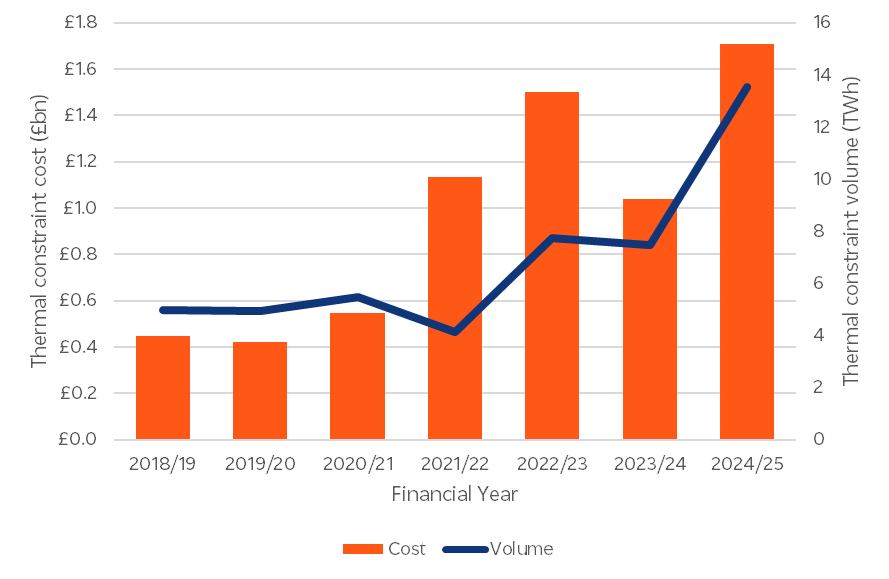
Figure 1: Constraint costs and volumes are increasing
Source: 2025 Annual Balancing Costs Report (NESO)
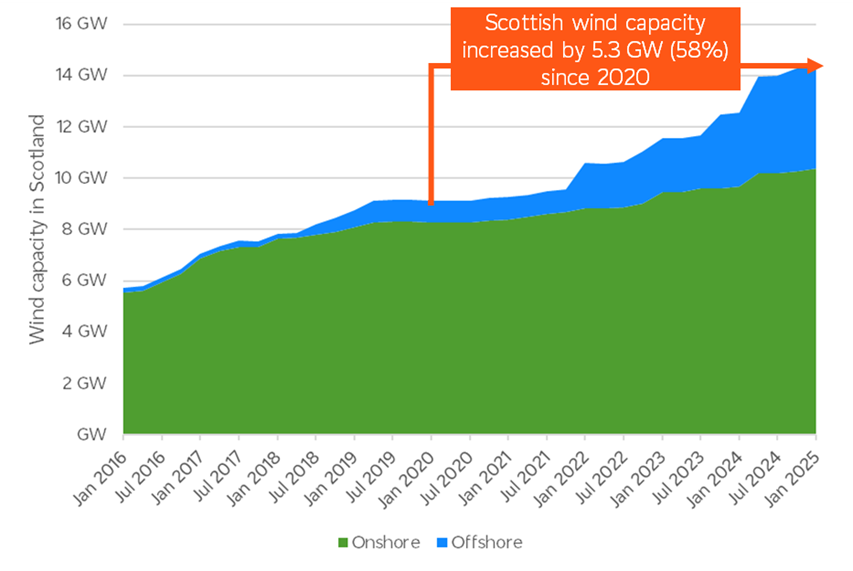
Constraints are not inherently bad: matching renewable generation with demand 100% of the time would require an impossibly large and expensive network. A system led by intermittent, dispersed renewables with low marginal costs (supported by firm generation like nuclear) is likely to see a higher economic level of constraints, even if it is cheaper overall. The problem is that costs are rising quickly, nearly trebling between 2020 and 2024/25 to £1.7bn,[2] and forecast to peak between £4-£8bn in 2030[3]. One of the key drivers is that wind farms in Scotland are growing faster than transmission capacity – expanding 50% since 2020. This challenge is spreading to other regions with large renewable developments too.
Figure 2: Wind capacity in Scotland is growing quickly
Source: Energy Trends (DESNZ)
What can we do in the short term?
Building the right grid infrastructure will make a big difference to constraints, but grid enhancements are major projects that take a long time to deliver. The first two Eastern Green Link undersea cables from Scotland to England are not due to be operational until 2029,[4] with many other projects not expected until well into the 2030s. While grid upgrades are being delivered, we need more immediate changes to the current design of the energy system that protect consumers, reassure the public and maintain investor confidence in the face of complex, technical interventions elsewhere.
Much of that work is already underway, with NESO considering new markets that will pay generators, battery operators and consumers to help avoid constraints. Given the potential for significant consumer savings,[5] this work should be prioritised and accelerated.
Simultaneously, upgrading NESO IT systems will allow the Control Room to make full use of batteries and consumer-led flexibility to minimise costs. Ofgem must also keep enforcing market competition rules like the Transmission Constraint Licence Condition (TCLC) to ensure wind farms are paid fairly to turn down.
This, however, is unlikely to meaningfully address the direction of travel on constraints and in turn, the costs consumers will pay. We have, therefore, identified three solutions that suggest how we might go further.
EDF Solution 1: Provide more detailed forecasts
The problem
It is hard to understand how constraint costs will develop and what the sector can do to mitigate them – such as through targeted investment in generation or storage – because we only have access to high-level forecasts, not the more granular data about the deployment of generation and grid enhancements that inform them.
The solution
NESO and Mission Control know when different renewables projects and network upgrades are due and can therefore estimate the impact they will have on the system. Plans for Clean Power 2030 are based on that information. The Government should formally request NESO to publish forecasts of constraints (broken down by regions, key boundaries and the impact of individual projects) at least annually. This could be done as a core part of NESO’s regular industry publications and help inform significant frameworks, such as the Strategic Spatial Energy Plan. This could make a difference by:
- Optimising investment: The transmission upgrades that deliver the most value should be actively identified and prioritised. Some projects have an outsized impact: there are three projects that could together save consumers £4bn in 2030 alone if they are accelerated.[6]
- Enabling interventions: The further ahead of time pinch points are identified, the easier it is to address them, including by better planning outages and buying gas generation ahead of time, as suggested below.
- Explaining the challenge: Better information can help politicians and voters properly balance the savings of grid upgrades against local impacts.
In addition, to ensure a balanced and evidence-based argument on the constraints issue, NESO should also publish their view of how the optimum level of constraints may change in a renewables-led system. For instance, NESO’s Clean Power 2030 advice identified that the necessary grid investment to meet clean power in an efficient way led to £2.8-3.5bn of constraint costs in 2030, demonstrating that we may need to adjust the baseline used to assess constraints.
EDF Solution 2: Reduce transmission outages
The problem
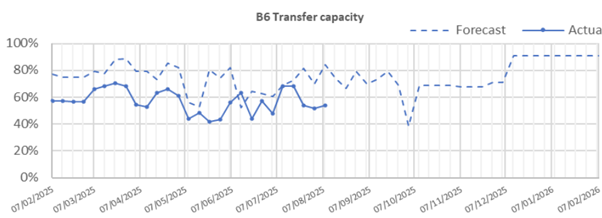
Outages on the transmission network reduce capacity which can lead to higher constraint costs. Sometimes, these outages are to allow for planned maintenance or because of unplanned interruptions like bad weather. Additionally, like roadworks on a motorway that close a lane, upgrades on the grid temporarily reduce capacity. There are so many enhancement projects currently in progress that some of the lines south from Scotland are frequently at only half their total capacity, increasing costs.
Figure 3: Network outages between Scotland and England are large and persistent
Source: NESO Operational Transparency Forum
The solution
NESO and the networks work closely together to lessen the impact of outages. However, with a national “sprint” underway to achieve Clean Power 2030, we should consider what more can be done to reduce constraints caused by outages, including:
- Planning ahead: Better planning and avoiding overlapping outages could help minimise the time transmission lines are unavailable.
- Aligning incentives: Mimicking constraint costs in the price control incentives set by Ofgem could encourage network companies to better balance the costs of outages and grid improvements. This might save customers money if, for example, spending extra on working faster or outside normal working hours reduces outage lengths and, therefore, constraint costs.
- Spreading the cost: Paying for the cost of network outages caused by transmission works over a longer period (as happens with costs like labour and equipment) would save today’s consumers money and smooth the temporary spike in constraints costs expected in coming years.
UKERC estimate that increasing usable capacity by just 500MW would have cut constraint costs by 25% in 2024.[7] With more upgrades coming, these savings could be even higher in future.
EDF Solution 3: Buy gas generation better
The problem
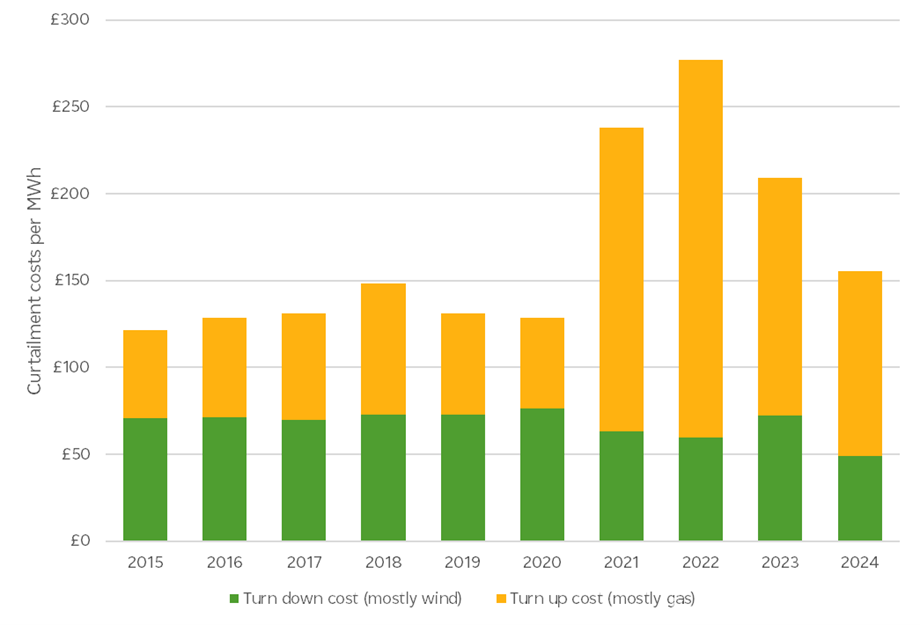
Two thirds of the cost of curtailment last year went to turning up generation,[8] mostly gas. Most of that expense is unavoidable (covering generators’ fuel and running costs), but gas generation used to replace curtailed wind has historically received a premium of around 30% above wholesale rates.[9] Buying gas generation last minute in the Balancing Mechanism increases costs for generators (e.g. start costs) and reduces market competitiveness.
Figure 4: The bulk of constraint costs are for gas generation
Source: analysis of GB Renewables Map | Curtailment, after UKERC
The solution
We should consider what more can be done to minimise the premium paid to gas generation, including looking at:
- Buying gas ahead of time: Rather than buying replacement power only a few hours before it is needed, NESO could acquire gas generation further in advance based on forecasts of network outages and weather. This could be achieved by using more “Schedule 7a” transactions, where NESO trades with power stations in advance. There is also scope to explore adapting new types of service like Balancing Reserve to place more power stations on standby to manage constraints.
- Expanding monitoring and enforcement: Ofgem enforces rules to ensure market participants act fairly and do not benefit from manipulating the market. The licence conditions that explicitly govern how generators act in relation to constraints (TCLC) currently only cover turning power stations off (called “bids”, which are often wind). Expanding them to include power stations turning on (called “offers” which are often gas) would help guard against unfair behaviour from gas generators, saving consumers money.
Removing the premium paid to gas could lead to annual savings in the hundreds of millions.
Further improvements in the way the system is operated could also help reduce the cost of gas – particularly continuing work that is already happening to update IT systems and streamline markets so that batteries and other forms of low-carbon flexibility can play more of a role in managing constraints.
The long-term fix
The changes above could help us make the most of the system we have today, and it is vital the Government, NESO and Ofgem rigorously pursue them. Rising costs over the past few years have shown that because constraint costs will always feature in the electricity system, we need a long-term strategic approach to provide the best value for consumers.
The £60bn being invested in 5,550km of new network[10] as part of Clean Power 2030 will help correct the historic underspend in the grid. But that investment in a bigger network must be paid for, with the transmission costs (TNUoS) paid by consumers now forecast to treble to £11.75bn by 2030/31.[11] This means we cannot just keep building our way out of the problem.
Instead, to deliver the least cost low-carbon system for customers we need to agree on how to strike the right balance between investment in the network and where and how much generation is built. NESO are doing this to some extent by preparing strategic plans to guide where future generation, demand and network infrastructure should be located, starting with the Strategic Spatial Energy Plan (SSEP). Constraint costs arising from all sources, including outages, must be comprehensively considered as part of this work and any proposed network expansion must be realistically deliverable and properly costed. Likewise, ongoing reforms to the grid connection queue process will prioritise new connections that provide the most value.
But for 2030 and beyond, there needs to be a bigger focus on whole system costs to keep consumer bills down. This should include a harder look at providing stronger and more predictable locational signals, such as the Reformed National Market changes to the grid charges (TNUoS) paid by generators. Likewise, today’s model of gas power stations participating in wholesale and balancing markets will become less workable as they run for fewer hours each year. Before it becomes too late, we need to start considering more radical options such as taking some gas assets out of the wholesale market, in addition to ramping up investment in low-carbon flexibility like batteries, hydrogen, long-duration storage and consumer-led flexibility to displace gas.
Without action on constraints, we risk undermining the case for clean power as consumers question the efficacy of paying wind farms to turn off and gas power stations over the odds. Now is the time to act, while we also look at a set of longer-term actions that could make a more lasting impact.
Acknowledgements
We would like to thank Keith Bell and Callum MacIver at UKERC for their valuable work and engagement on this topic (especially their blog from June).
[5] Initial analysis of Constraints Collaboration Project impact, Constraints management options: Net Consumer Benefit (Baringa)
[7] Transmission Network Unavailability – the Quiet Driving Force Behind Rising Curtailment Costs in Great Britain (UKERC)
[8] Analysis of GB Renewables Map | Curtailment
[9] Based on estimates from assessments of market data including historical factors such as gas start-up costs, pay-as-bid incentives and market power: Transmission Network Unavailability – the Quiet Driving Force Behind Rising Curtailment Costs in Great Britain (UKERC), Assessment of locational wholesale electricity market design options in GB (FTI) and Hydrogen Production from Thermal Electricity Constraint Management (Arup).


Related articles

Why distribution network investment matters for affordability and energy security

What more needs to be done to tackle persistently high energy bills?
