
Understanding ROCs and REGOs: the past, present, and future
What are ROCs and REGOs?
Renewable Obligation Certificates (ROCs) and Renewable Energy Guarantees of Origin (REGOs) are two types of renewable energy certificates, which help support the growth of sustainable energy in the UK.
ROCs are certificates that are issued as accreditations to renewable energy generators for the energy they produce. For each megawatt-hour (MWh) produced, generators receive either a ROC or multiple ROCs as there are different levels of support for different types of assets.
These certificates can be traded or sold to energy suppliers, who are required to submit them to Ofgem (the UK’s energy regulator) as proof of compliance with their renewable energy obligations. Energy suppliers have the option to either submit the required number of ROCs or pay a ‘buy-out’* fee set by Ofgem.
REGOs act as evidence to certify the exact amount of electricity that has been generated from renewable sources. For each MWh of renewable energy a generator produces, one REGO certificate is issued. REGOs can be sold or bundled with energy sales, allowing suppliers to allocate renewable certificates to their electricity mix, which consumers can use to demonstrate renewable energy usage.
Historical background
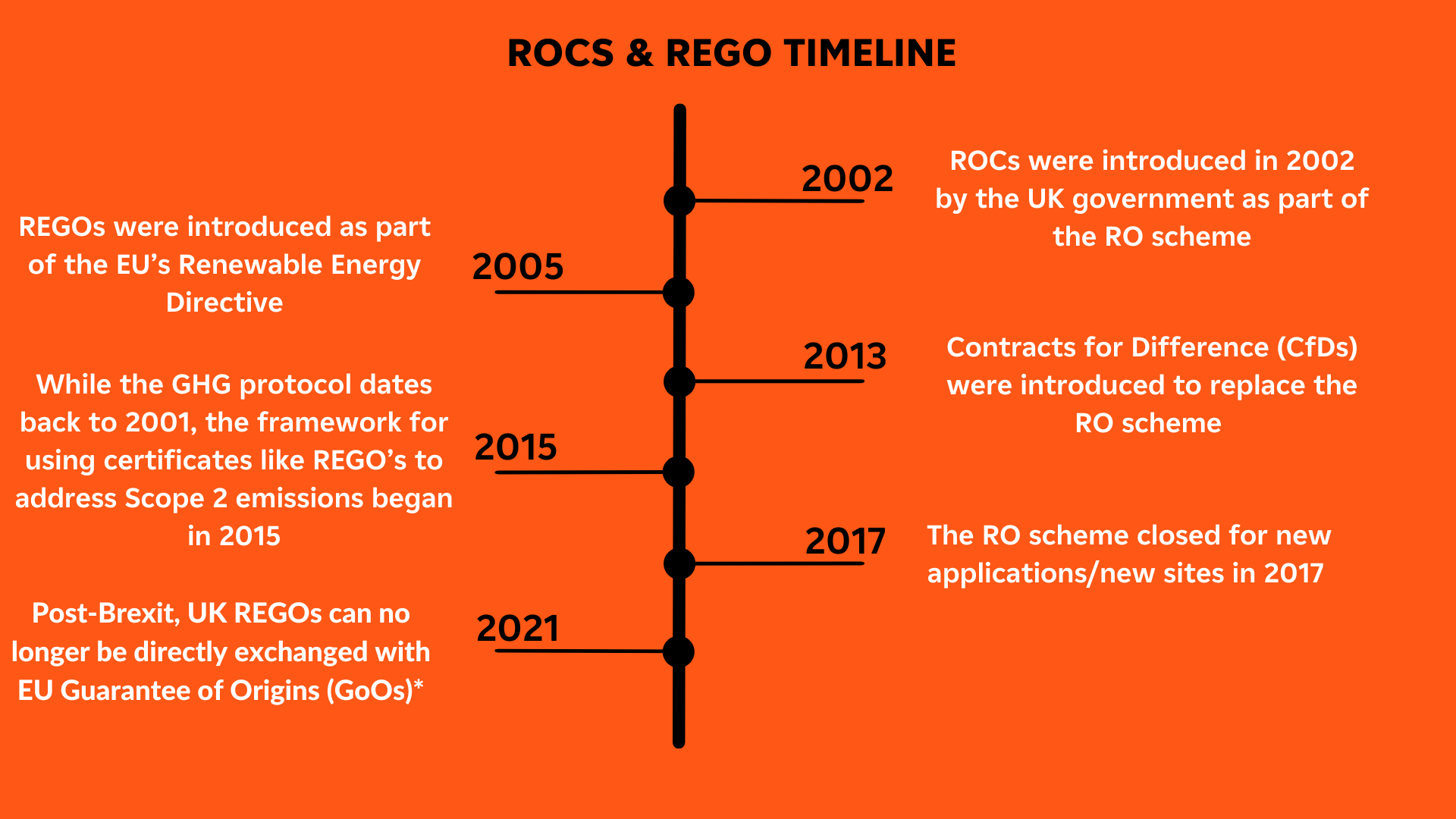
ROCs and REGOs have been around for a long time, take a look at the timeline below to see how they’ve evolved.
Understanding ROCs and REGOs, and their role in today’s market
ROCs
ROCs continue to serve generators who have registered before 2017, and these certificates will be honoured until 2037. Their value is shaped by supply and demand as well as interest rates, reflecting current market dynamics.
The Contract for Difference (CfD) scheme has now become the primary support for new renewable installations. CfDs provide a more stable fixed price model by issuing a fixed “strike price” for electricity, to reduce uncertainty about volatile wholesale prices and encourage long-term investment. Read more about the latest CfD auction results and what this means for renewable developers, here.
The issuance of ROCs is based on the amount of renewable electricity generated by accredited projects under the RO scheme. While the insurance is determined by generation levels, the market value of ROCs is influenced by supply and demand dynamics. Energy suppliers’ obligations and the availability of ROCs in the market play a significant role in shaping their trading prices.
For generators, ROCs continue to serve as a key revenue stream, with their value influenced by supply and demand dynamics. At EDF, we support both generators and suppliers by facilitating ROC trading, and offering Power Purchase Agreements (PPAs) that include ROC buyback options. We also help provide strategic market insights to optimise returns.
REGOs
REGOs remain in high demand, as reaching net zero represents a key priority for businesses and consumers. This is because they allow suppliers to verify renewable sources and consumers to align their energy usage with sustainability goals.
However, following April 2023, UK REGOs are no longer interchangeable with the EU’s Guarantees of Origin certificates (GoOs), which has resulted in reduced supply and consequent increased prices and volatility throughout the year. Whilst no longer recognised in Europe; Great Britain and Northern Ireland continue to issue REGOs, allowing electricity suppliers to comply with their Fuel Mix Disclosure (FMD) obligations.
REGOs are issued by Ofgem to certify the renewable origin of electricity that has been generated from renewable sources by accredited generators. They help support transparency in reporting while promoting renewable energy generation. The compliance period, running from April to March, applies to suppliers, who use REGOs to meet their Fuel Mix Disclosure (FMD). This allows suppliers to demonstrate the proportion of renewable electricity provided to consumers.
Prices can be volatile, as demonstrated in recent years, particularly during the recent Compliance Periods (CPs). While CP23 has seen trading levels lower than the highs observed in CP22, price fluctuations continue due to factors such as market demand, regulatory changes, and the effects of the UK’s exit from the EU.
So, what does the future look like?
ROCs future outlook
After the Renewable Obligation (RO) scheme's final expiration date in 2037, the government will fully transition to the CfD scheme. Meanwhile, the Department for Energy Security and Net Zero (DESNZ) is currently reviewing the ROC scheme and exploring a potential transition to Fixed Price Certificates (FPC). This was launched with a view to help stabilise the volatile ROC market, by reducing price fluctuations and addressing supplier payment defaults. If adopted, FPCs would result in generators being offered a set ROC price, in turn reducing market-driven price variability.
The decision surrounding FPCs will shape the future of the ROC market and have an impact on both suppliers and renewable projects remaining under the RO scheme. At EDF, we don't at this time believe that the uncertain benefits of moving to a fixed price scheme outweigh the certain costs and impacts for generators, which will ultimately be passed on to consumers.
Should the FPC model succeed, it aims to serve as a bridge for the remaining RO-registered projects, ensuring a smooth transition as the CfD scheme becomes the primary mechanism support for renewable energy generation. While ROCs are no longer issued to new projects, they continue to play a significant role in the UK’s renewable energy landscape. Some of the earliest ROC-accredited assets will begin to see their accreditation expire in 2027, but many will remain active until the scheme’s closure in 2037.
REGO’s future outlook
The future of REGOs is set to develop with ongoing reviews and initiatives.
The 2021 Call for Evidence on transparency of carbon content in energy products highlighted concerns for many respondents about REGOs being an ineffective tool for achieving this. As a result, the Department for Energy Security and Net Zero (DESNZ) is now conducting a broader review of the scheme, including the potential for more granular matching of REGOs to the electricity they represent.
There are expected changes in the landscape with the upcoming Greenhouse Gas (GHG) Protocol review expected for 2026. This review is expected to have far-reaching implications on carbon accounting practices. In particular, it may further integrate renewable certificates, such as REGOs, into emissions reporting frameworks, especially for Scope 2 emissions.
Alongside the GHG Protocol review, initiatives like the RE100, a commitment from businesses to 100% renewable electricity, are driving increased demand for renewable energy. As businesses from all over the world commit to RE100, the pressure to secure renewable energy continues to grow. Contributing to the continued demand for REGOs and the need for long-term reforms to meet these growing goals.
As the landscape continues to evolve, we’ll keep you informed and up to date on any changes, so be sure to keep an eye out for our quarterly newsletter.
To discuss anything specific please reach out to us by contacting ppa@edfenergy.com.
Keep up to date with the latest GHG Protocol Standards & Guidance here: https://ghgprotocol.org/standards-guidance. Any decisions you make when entering into an energy contract are the responsibility of you and your business.
Buy-out* This system helps to balance the market, ensuring that suppliers contribute to renewable energy growth in the UK. Certificate prices reflect market conditions and supply dynamics, and the amount can vary based on technology and the commissioning date of the generation asset.
GoOs* GoOs are certificates issued in the EU to verify that a specific amount of electricity has been produced from renewable energy sources. Since Brexit, UK REGOs are no longer interchangeable with the EU’s GoOs, reducing supply and driving up REGO prices due to increased demand.
Related articles

Do you believe in life after ROCs?

AR8: What Should Developers, Investors and Energy Buyers Expect from the UK's Next CfD Auction?
