The Power of Flexibility: Why batteries are central to a smarter energy future
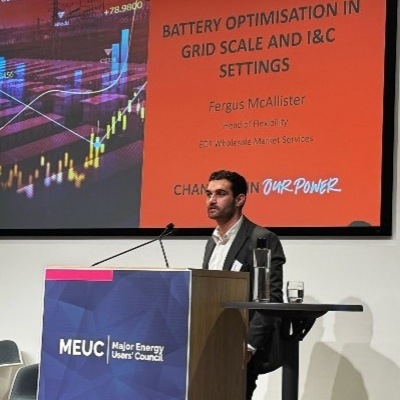
At the MEUC Spring Conference, Fergus McAllister, Head of Flexibility, EDF Wholesale Market Services, shared his knowledge and passion for the future of batteries, with a clear message: ‘‘I love batteries and the market does too.’’ This article captures and expands on the key insights from his presentation.
As the drive for decarbonisation intensifies, energy flexibility has become an essential service, and battery optimisation is at the very centre of this shift. Once considered niche, batteries are now central to the UK’s net zero ambitions.
The energy market is undergoing a fundamental shift
The Clean Power 2030 (CP30) vision calls for more than 25GW of battery storage in the UK within the next five years. Today, only around 5GW has been deployed. This shortfall represents a major opportunity for businesses and investors.
Batteries are the perfect partner to renewable energy, charging during periods of surplus and discharging when demand peaks. Whether it’s grid-scale infrastructure or behind-the-meter (BTM) applications, their ability to store and dispatch electricity quickly and reliably is key to unlocking more wind and solar across the system.
EDF: A market leader in flexibility
EDF Wholesale Market Services is helping lead the charge. With over 2GW of contracted battery capacity (1 GW of which is live), EDF is the UK’s largest battery optimiser - managing around 20% of the UK battery market through its 24/7 shift trading desk and PowerShift platform.
PowerShift integrates AI, automation, and advanced forecasting to optimise value across all battery types - standalone, co-located, or BTM. From short-term frequency response to wholesale energy arbitrage, EDF’s strategies are tailored for each asset’s technical and commercial profile.
No two batteries are the same, and optimisation is done dynamically based on factors such as duration, warranties, constraints, and market conditions.
Batteries generate value through a stacked revenue model
Battery profitability now depends on tapping into several revenue streams simultaneously. Rather than choosing a single route, EDF blends opportunities based on each asset’s capabilities, market conditions, and the customer’s commercial priorities. The value stack typically includes:
- Ancillary services - National Grid ESO contracts services like Dynamic Containment, Regulation, and Moderation to maintain system frequency near 50Hz. Batteries that respond within a second are ideal, and while prices have dropped due to increased competition, fast-acting assets still perform well in this space.
- Wholesale market trading - Batteries can charge when electricity is cheap and discharge during price peaks, especially across day-ahead and intra-day markets. With rising volatility from renewables, this trading window offers strong arbitrage opportunities. EDF’s algorithms constantly reforecast to optimise returns, in real time.
- Balancing mechanism and reserves - EDF positions batteries in the real-time balancing mechanism, where the system operator calls on assets to flex up or down. Emerging products like Balancing Reserve and Quick Reserve reward availability, even without dispatch.
- Non-energy costs (NEC) avoidance - Behind-the-meter batteries and distribution connected batteries reduce exposure to peak-time charges, like DUoS, by discharging during high-cost intervals. These cost savings are accessible even with fixed energy supply contracts.
- Capacity market - Though typically lower in value, this market offers dependable annual income in exchange for guaranteed availability during demand peaks.
By layering these opportunities and continuously reoptimising, EDF ensures each battery asset delivers maximum commercial performance across all timescales.
Case Study: Battery economics for I&C users
To illustrate how real-world economics are shifting, Fergus shared a detailed I&C case study with a large UK retail chain. The site in question runs a 2.5 MW baseload operation, consuming around 23 GWh annually, and recently installed a 3 MW, 2-hour battery system alongside 12 MW of rooftop solar PV.
The solar installation frequently generates surplus midday energy, particularly in summer months. Without storage, much of this would be exported at low rates or even curtailed. The battery enables the site to store and shift excess energy to later periods, especially the evening peak when DUoS charges and wholesale prices both tend to spike.
EDF’s PowerShift platform orchestrates this strategy: charging from solar, discharging to reduce site demand at costly times, and opportunistically bidding into ancillary and reserve markets where beneficial. It also ensures the asset’s cycling remains within warranty limits to protect long-term value.
This comprehensive optimisation strategy yields around £200,000 per year in revenue and savings, against an upfront CAPEX of £1.2 million - resulting in a projected 7-8 year payback. While every site differs, this example underscores how a well configured BESS can unlock multiple value streams from existing infrastructure.
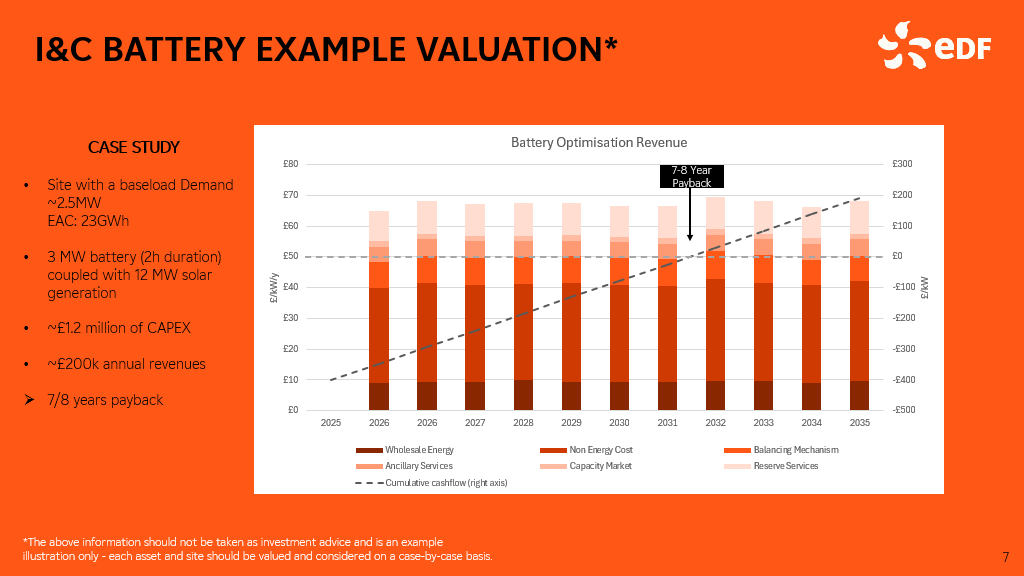
The chart above summarises the revenue stack from an actual I&C battery installation optimised by EDF, showing how different revenue streams including wholesale trading, NEC savings, and ancillary services contribute to a 7–8 year payback profile.
The human side of innovation
While AI and automation are powerful, Fergus emphasised the human skills needed to make battery optimisation successful. EDF’s flexibility team - traders, developers, engineers, and more, help customers manage risk, policy, and market shifts.
Innovation is about people, and we build trust through partnerships by developing new products like revenue guarantees or lobbying to unlock new flexibility markets.
What next?
With battery prices falling, energy volatility rising, and markets diversifying, now is the moment to act. Whether your site is already generating solar or simply consuming large volumes of power, EDF can help evaluate if a battery investment makes sense for you.
Get in touch with the team at Letstalkpower@edfenergy.com
Watch the full presentation with Fergus McAllister at the MEUC Spring Conference 2025
Related articles

Unlocking Domestic Flexibility at Scale

