Five facts about the Reactor Pressure Vessel installation
All you need to know about the ‘heart’ of Hinkley Point C.
The installation of the Reactor Pressure Vessel (RPV) into the first reactor building is this year’s big construction milestone for Hinkley Point C. Rob Jordan, Project Construction Director, has described it as ‘this year’s dome lift’.
So, what is the RPV and what does installation involve?
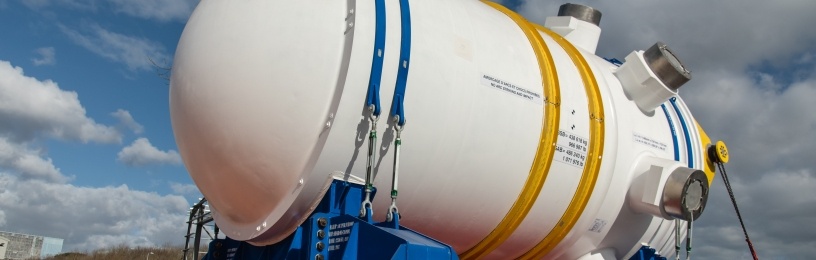
The RPV is a stainless-steel chamber that weighs 500 tonnes. Immense heat will be generated in its core and exchanged in the steam generators, which are large pieces of equipment linked to the RPV via pipework. The steam produced drives the turbines and creates zero-carbon energy.
The 13-metre-tall metal structure, which took seven years to build, will be lifted up the side of the fuel building and pass through an equipment hatch on rails into the reactor building. It will then be rotated and lowered by the polar crane to its base, with just 40mm clearance on each side.
Here are five key facts about the RPV…
- It’s already on site
The RPV arrived at Hinkley Point C last February, travelling by barge from France, where it was manufactured. It was brought onto site from Combwich Wharf and stored in an environmentally-controlled building for safekeeping. - The installation is the next major milestone
The dome lift was the last major milestone in the reactor building. Since then, preparations have been ongoing inside the building to create the landing area, known as the reactor pit, for the RPV. - It moves on a special rail track
To ensure this vital piece of equipment is moved safely, it will be moved on rails and lifted by a specialised lifting and handling system. The lifting system will lift the RPV up to the height of the equipment hatch, 19.5 metres above the ground. The RPV will then pass safely through the equipment hatch in an operation spanning two to three days. - It needs to be rotated inside the reactor building
The RPV will enter the reactor building through the equipment hatch and then be rotated 90 degrees to be lowered vertically into the reactor pit. This rotation will be completed by the polar crane, which operates on circular rails inside the top of the reactor building. - Attention will then turn to pipework
Once the RPV has been installed, work will begin on connecting vital pipework to complete the primary circuit. This circuit is essential for forming the steam that finally drives the turbine, and it also helps to keep the reactor cool during operation.
Related articles


Keeping local roads moving
